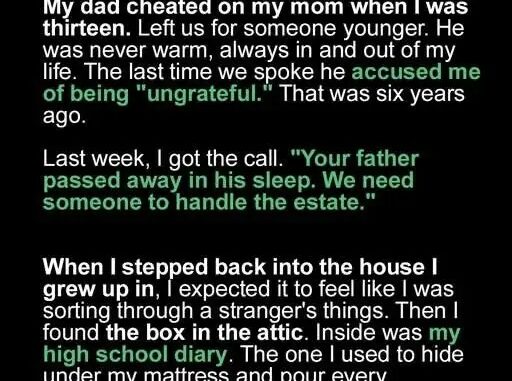
When Cara returned to her late father Philip’s house, she expected dust and distance—not closure. He had left when she was 13, never cruel but never warm. Their last conversation ended in anger six years before his death.
The house felt frozen in time. While sorting through his things, she found her old teenage diary in the attic. Embarrassed, she flipped through it—then froze.
In the margins were notes in his handwriting.
Gentle. Loving. The father she’d always needed.
“You are not unlovable.”
“I’m proud of you.”
“One test doesn’t define you.”
Further in, she found a confession:
“I was a bad father. You didn’t deserve the silence. This was the only way I knew how to talk to you. I hope someday you’ll forgive me.”
Cara broke down. He had been speaking to her all along—just not out loud.
Before leaving, she placed a sticky note on his desk: “I read every word. I heard you.”
Weeks later, she stood at his grave with wildflowers and whispered goodbye.
This time, it wasn’t anger she felt.
It was release.