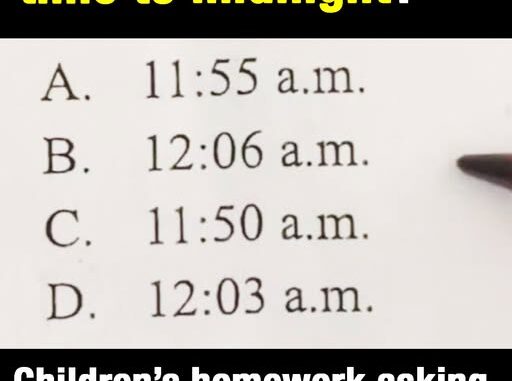
This viral homework question is a classic case of how small details—and our assumptions about them—can trick the brain. Let’s break it down clearly:
The Question: “What is the closest time to midnight?”
Options:
- A. 11:55 a.m.
- B. 12:06 a.m.
- C. 11:50 a.m.
- D. 12:03 a.m.
Step 1: Understand “midnight.”
- 12:00 a.m. = midnight
- 12:00 p.m. = noon
Step 2: Measure distance from midnight
- 11:55 a.m. → 12 hours 5 minutes away
- 11:50 a.m. → 12 hours 10 minutes away
- 12:06 a.m. → 6 minutes after midnight
- 12:03 a.m. → 3 minutes after midnight
Step 3: Pick the shortest distance
- Clearly, 12:03 a.m. is only 3 minutes past midnight, making it the closest. ✅
Why people get confused:
- A.M./P.M. mix-up – Many see 11:55 and assume it’s p.m. (near midnight), but it’s actually a.m. (near noon).
- Directional bias – People expect “closest” to mean “approaching midnight” rather than just minimal difference in minutes.
Key Tip: Always double-check if it’s a.m. or p.m. when working with 12-hour clocks. It makes all the difference!
The answer: D. 12:03 a.m.
If you want, I can make a simple visual trick chart to show why 12:03 a.m. beats 11:55 a.m., which makes this question instantly clear. Do you want me to do that?