Your husband’s actions were extreme and unacceptable. Moving your daughter out in the middle of the night, without your consent, crosses a serious line. That’s not problem-solving—that’s control. It broke trust, destabilized your child, and avoided any real conversation.
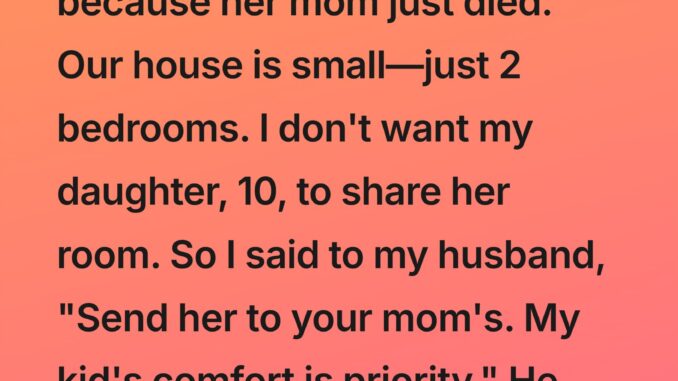
But your original stance also needs scrutiny. Asking a grieving 12-year-old—who just lost her mother—to live somewhere else so your daughter can keep her own room isn’t a neutral decision. It sends a clear message about who belongs and who doesn’t. In a blended family, that kind of hierarchy can do lasting damage.
So what’s really happening here? Two parents are prioritizing their own child, but neither is protecting the family as a whole.
The reality is: this was always going to require sacrifice. A two-bedroom home with three children means someone’s comfort changes. There’s no version where everything stays the same. The question isn’t “who keeps their room?”—it’s “how do we handle this transition in the least harmful way for both kids?”
Right now, the most urgent issue is your daughter. Being removed overnight likely felt like rejection or punishment. She needs immediate reassurance and stability—bring her home, reestablish her space, and explain clearly that she wasn’t replaced.
Then comes the harder part: rebuilding a plan that includes both children fairly.
That likely means:
- The girls sharing a room, at least temporarily, with thoughtful adjustments (privacy dividers, agreed rules, personal zones).
- Open conversations acknowledging both girls’ feelings—one lost her mother, the other lost her sense of security.
- Clear boundaries between you and your husband: no unilateral decisions, especially involving the kids.
Your husband also needs to face what he did. Supporting his grieving daughter is right—but doing it by displacing another child isn’t. If he can’t engage in a real conversation about that, the issue goes beyond housing—it’s about whether you can co-parent safely together.
One more hard truth: this isn’t just about space. It’s about belonging. Both girls need to feel like this is their home—not that one is being “fit in” while the other is “protected.”
If you move forward, it has to be with that principle at the center. Otherwise, this situation will keep resurfacing in different, more painful ways.