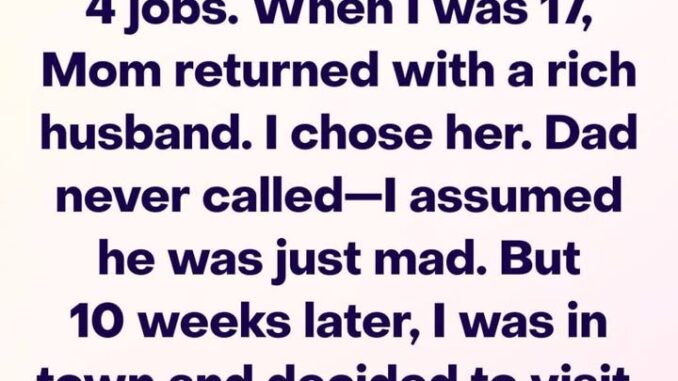
This hits hard because the conflict isn’t really about money—it’s about how we understand love when we’re young versus when we finally see clearly.
As a child, you measured life in visible things: food in the fridge, clothes, what other kids had. That’s normal. When those things were missing, your mind tried to explain why, and the easiest answer was to blame the person closest to you—your father.
But your father was living a different reality. His version of love wasn’t loud or impressive—it was quiet, exhausting, and constant. Working multiple jobs, coming home broken, still making sure you were okay first. That kind of love is easy to miss when you’re young because it doesn’t look like “success.”
Your mother, on the other hand, represented everything that looked like success. Stability, comfort, ease. It makes sense that you were drawn to that—it felt like the life you had been denied.
The turning point isn’t just the hospital scene. It’s the realization that:
- One parent offered comfort when it was convenient
- The other gave everything when it was hardest
That’s a brutal but important distinction.
Also, your father’s reaction matters more than anything:
He didn’t punish you. He didn’t guilt you. He didn’t say “I told you so.”
He simply said, “I knew you’d come back.”
That’s not weakness—that’s a level of emotional strength most people never reach.
And your mother’s response—drawing a line and making love conditional—clarified everything in a single moment.
If there’s one truth underneath all of this, it’s this:
You didn’t fail as a child—you just didn’t have the perspective yet.
You have it now.
And the fact that you came back, stayed, and took responsibility—that’s the part that actually defines you going forward, not the moment you left.