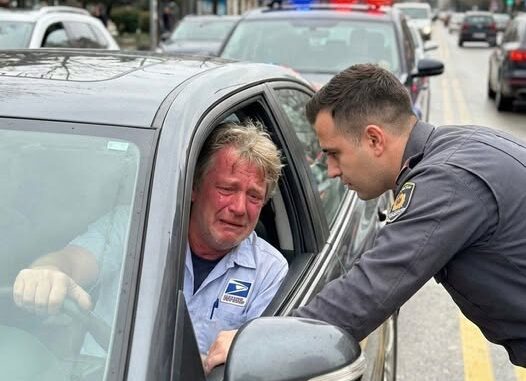
I stood there for a second longer than I should have, listening to him try to steady his breathing.
This wasn’t the usual stop. No attitude. No excuses. No story that kept shifting.
Just panic that felt real.
Behind me, cars kept moving. Horns. Engines. Normal life continuing like nothing was happening at the shoulder of the road.
I glanced back at his vehicle. Work badge on the seat. Delivery route still open on the dashboard screen. Phone lighting up again.
“Sir,” I said, softer now, “I need you to understand—88 in a 55 is serious.”
“I know,” he said quickly. “I know, I just… I didn’t think. I just—”
He stopped, jaw tight.
“I need to get there,” he finished.
I looked at him properly then. Not as a driver. As a man watching something important slip further away with every second we stood there.
I could’ve written the citation. That was the job. That was clean. Simple. Controlled.
Instead, I made a decision I wouldn’t later find in any manual.
“Put it in park,” I said.
He did.
I stepped back toward my cruiser, keys already in hand. He followed, confused now.
“Sir?”
I opened the passenger door of my unit and pointed.
“Get in.”
He froze. “What?”
“Get in the car,” I repeated. “You’re not driving like this. Not today.”
He hesitated—just long enough for me to see the conflict in him between rules and everything else.
Then he got in.
I flipped on the lights.
No siren yet.
Just clearance.
And I drove.
At first, he didn’t speak at all. Just stared forward, hands still shaking in his lap. Then, quietly:
“Thank you.”
I didn’t respond right away. I was focused on the road, on cutting through traffic safely, on doing this without turning it into something worse.
But somewhere between intersections, I realized something simple.
This wasn’t about speeding.
It was about fear driving faster than the car ever could.
When we reached the hospital, I pulled into the emergency lane and stopped.
He was out before I fully parked.
“Go,” I said.
And he did.
I stayed in the cruiser.
Minutes passed.
Long enough for doubt to creep in. Long enough for the job part of my brain to remind me what I had just done.
Then the doors opened.
A nurse stepped out, scanning the lot.
She saw me.
“You brought him?” she asked.
I nodded.
She exhaled like she’d been holding her breath all day.
“You got him here just in time,” she said.
And then, quieter:
“She and the baby are both okay.”
I didn’t move for a moment.
Just sat there, engine still running, lights still flashing against the hospital walls.
Because in that moment, I understood something every officer eventually learns in a different way:
Not every stop ends with a ticket.
Some end with a beginning.