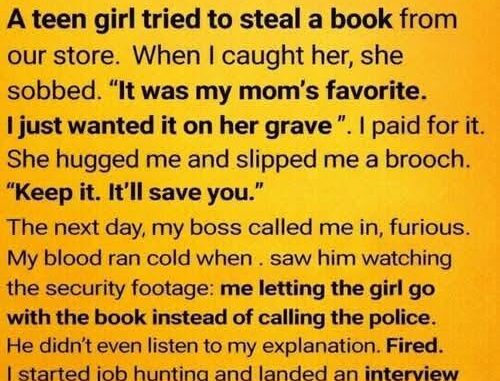
The bookstore felt ordinary to most people, but to me it was an escape — old, dusty, quiet, and comforting in its predictability. Most days were routine until one Tuesday, when a teenage girl walked in acting strangely. I noticed her secretly put a book into her backpack, but instead of running when I approached her, she froze and started crying.
She explained that her mother had died a year earlier, and the book was the exact copy they had read together. She wanted to leave it on her mother’s grave but couldn’t afford it. Feeling sorry for her, I paid for the book myself despite knowing it could cost me my job.
Before leaving, she hugged me and gave me a silver flower brooch, calling it her mother’s “lucky one.” The next day, my manager fired me after seeing the security footage.
A week later, while interviewing at a design firm, I wore the brooch for luck. During the interview, the executives recognized it and introduced me to the company owner, Arthur. The brooch had belonged to his late wife, and his daughter Elena — the girl from the bookstore — had disappeared after her mother’s death.
When I told Arthur about meeting her at the cemetery, he realized she was still alive and finally found her again. Arthur later hired me, saying he valued kindness more than perfect qualifications. Elena returned home too, though she was still recovering.
Arthur insisted I keep the brooch, believing it had somehow chosen me. Looking back, the money I spent on that book was the best investment I ever made, because one act of compassion completely changed my life.