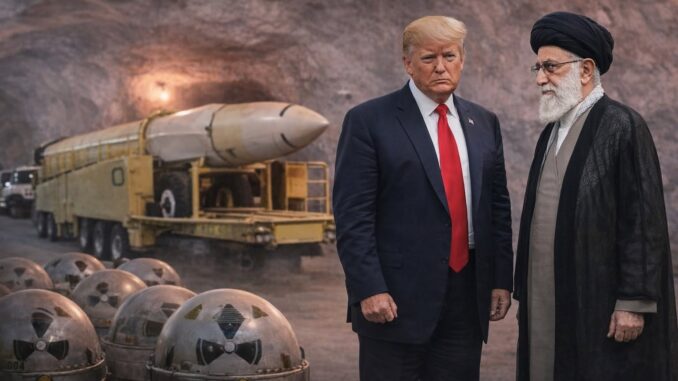
More than 500 meters beneath the earth lies a vast network of underground “missile cities” that form the core of Iran’s military strategy. These fortified bunkers contain missiles, launch facilities, and personnel, designed to survive heavy air attacks and continue operating even during war.
Iran is widely regarded as the Middle East’s leading missile power, with an arsenal estimated at over 3,000 ballistic missiles. Hidden within these underground complexes are short-range systems such as the Fateh and Zolfaghar, as well as longer-range missiles capable of bypassing advanced air defenses.
Particular concern centers on medium-range missiles like the Shahab-3, Khorramshahr, and Sejjil, which can strike targets up to 2,000 km away. Analysts believe the technology behind these systems could support even greater ranges in the future. Their growing accuracy has already been demonstrated in regional military operations.
Iran has also invested heavily in advanced missile technologies, including hypersonic and cruise missiles. Projects such as the Fattah-2 aim to improve speed and maneuverability, while cruise missiles like the Soumar can fly at low altitude to reduce radar detection.
Supporting this missile force is a large drone program. Systems such as the Shahed-136 are inexpensive, can be launched in large numbers, and are intended to overwhelm enemy defenses, making it easier for ballistic missiles to penetrate.
Experts believe much of Iran’s missile infrastructure remains protected because it is deeply buried underground. Although intercontinental missile capability is generally considered years away, the country’s current missile and drone arsenal already has major implications for regional security.
The existence of these deeply buried missile cities means that any future conflict could face a resilient and coordinated response, highlighting the growing role of underground military infrastructure in modern warfare.