My Mother Wouldn’t Remove Her Coat
The first instance I reached for the buttons on my mother’s coat, she let out a scream.
Not a loud one. It was a brief, startled sound, as if she had caught herself before anyone downstairs could hear.
Then she grasped my wrist.
“Please don’t.”
I stood frozen beside her bed.
Mom was seventy-eight years old and weighed perhaps a hundred pounds at that time. She had been wearing the same thick gray wool coat since I arrived at her home that afternoon, despite the thermostat in the hallway indicating seventy-four degrees.
“Mom, you’re sweating.”
She shook her head.
“I’m fine.”
“You’ve had this on for six hours.”
Her fingers tightened around mine.
Then she glanced toward the bedroom door.
“Please don’t let David know you tried to take it off.”
David was my older brother.
Up until that moment, I had believed the most troubling issue in my mother’s house was that he and his wife had become a bit too controlling.
I was mistaken.
I had traveled from Columbus to western Pennsylvania that morning because Mom was turning seventy-eight. I hadn’t informed anyone of my arrival. With my job at the Ohio Attorney General’s office and Mom repeatedly assuring me she was “doing fine,” visits had become less frequent than I wished.
The house appeared different as soon as I pulled into the driveway.
The flower boxes were empty. Mom’s little blue sedan was absent. Every curtain facing the street was drawn.
David’s new SUV was parked next to the garage.
His wife, Karen, opened the door before I knocked twice.
“Rachel?”
She glanced behind me towards the driveway.
“What are you doing here?”
“Visiting my mother for her birthday.”
Karen quickly regained her composure and smiled.
“Of course. I just wish you had called. She gets confused when her routine changes.”
That was the first time she used that term.
Confused.
She used it four more times before dinner.
Mom forgot things.
Mom misplaced items.
Mom repeated the same questions.
Mom no longer comprehended money.
Mom required David to manage everything.
David joined us in the kitchen and retrieved a folded document from a drawer next to the refrigerator.
“Mom signed a power of attorney.”
I looked at him.
“When?”
“A few months back.”
“Why didn’t you inform me?”
He shrugged.
“Because I’m the one living twenty minutes away. You’re six hours away.”
That part was accurate.
What troubled me was Mom’s expression.
She sat at the kitchen table with both hands clasped around a mug she wasn’t drinking from. Her gray coat remained buttoned up to her throat.
I turned toward her.
“Mom, did you want David managing your accounts?”
Before she could respond, Karen opened the refrigerator.
“Rachel, don’t start questioning her. She becomes agitated.”
Mom averted her gaze.
That was when I ceased asking questions.
I had spent enough years interviewing frightened witnesses to know that sometimes the quickest way to lose the truth was to demand it in front of the person they feared.
So I smiled.
I had dinner.
And I observed.
The Items That Were Missing
Mom had always been particular about small details.
Her pills were organized in a plastic container by the kitchen window. Her checkbook resided in the second drawer of her desk. Dad’s photograph was positioned on the mantel next to a small brass clock.
That evening, the pill organizer was absent.
So was the checkbook.
When I inquired about Mom’s car, David replied that they had sold it.
“She shouldn’t be driving.”
“Did she agree to sell it?”
He sighed.
“Rachel, this is exactly why I didn’t call you. You show up twice a year and suddenly you’re auditing everyone.”
I let that go.
After dinner, Karen brought Mom a small plastic cup containing two pills.
Mom gazed at them.
“Where’s the blue one?”
Karen’s expression shifted for half a second.
“You don’t take that anymore.”
“Dr. Harris said—”
“Your prescription changed.”
Mom looked at David.
He continued eating.
I pulled out my phone as if checking an email and made a note.
At nine, David and Karen went downstairs to watch television. Mom said she was tired, so I followed her upstairs.
She walked slowly.
Halfway down the hallway, she paused and placed one hand against the wall.
“You okay?”
“Just tired.”
I offered my arm.
She hesitated before accepting it.
That bothered me too.
My mother had never hesitated to touch me.
In her bedroom, I noticed an overnight bag pushed behind a chair. It was empty except for an old paperback and a pair of socks.
“Were you planning to go somewhere?”
Mom looked at it.
Then at the door.
“Karen packed that.”
“Why?”
She didn’t respond.
I sat beside her.
“Mom, look at me.”
She did.
“Do you want me here?”
Her mouth began to tremble.
“Yes.”
That was sufficient.
I told her I would assist her with a shower before bed, something I had done after her hip surgery two years ago. I walked her into the bathroom, turned on the light, and reached for her coat.
That was when she screamed.
Now we stood facing each other in the brightly lit bathroom while water ran uselessly behind the shower curtain.
“Mom, what happened?”
“Nothing.”
“Then let me see.”
“Rachel—”
“I’m locking the door.”
I did.
The sound of that lock altered her expression.
She began to cry silently.
I helped her unbutton the coat.
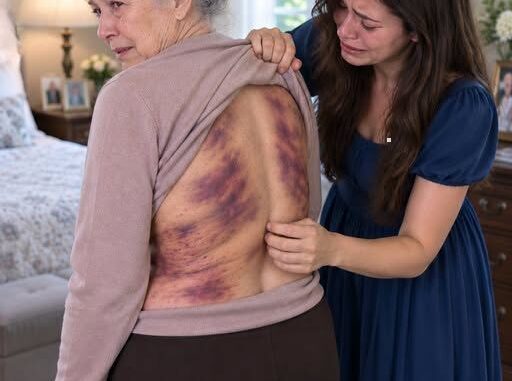
Underneath, she wore a long-sleeved cotton shirt.
When she slowly pulled up one sleeve, I noticed dark marks along her forearm and several narrow bands around her wrist.
I didn’t ask ten questions.
I asked one.
“Who did this?”
Mom sat on the closed toilet lid.
For several moments, she stared at the bathmat.
Then she murmured:
“David gets angry when I ask about my money.”
I crouched in front of her.
“What money?”
She swallowed.
“The cabin.”
My father had purchased a small cabin near Lake Erie thirty-three years ago. After he passed away, Mom rejected every offer to sell it.
I had spent my childhood summers there.
“What about the cabin?”
Mom looked at me.
“They sold it.”
I thought I must have misunderstood.
“Who sold it?”
“David.”
“Mom, the cabin was in your name.”
“He brought papers.”
She began rubbing her wrist.
“He said I had to sign because taxes were getting too high. I told him I wanted to talk to you first.”
“And?”
Her eyes darted to the locked door again.
“He got angry.”
The television downstairs was loud enough that I could hear canned laughter through the floor.
I retrieved my phone.
“Mom, I need to take pictures of your arms.”
She nodded.
I captured only what was necessary.
Then I turned on the voice recorder.
“I want you to tell me what occurred in your own words. Only if you want to.”
She stared at the phone for a long time.
Then she began speaking.
The Cabin Was Just the Start
The cabin had sold four months earlier.
David informed Mom that the money was being placed into a safer account.
She never received a statement.
Then two investment accounts began sending correspondence to David’s address instead of hers.
When Mom inquired why, Karen told her she was forgetting conversations they had already had.
“They keep saying there’s something wrong with my memory,” Mom said. “Maybe there is sometimes. I forget names. I forget where I put things.”
“Forgetting names doesn’t mean someone gets to take your money.”
She nodded.
Then she recounted the will.
Three weeks earlier, David had brought a man to the house with papers. Mom was told the new will would “simplify things.”
“What did it state?”
“Everything goes to David.”
I stared at her.
“Did you sign it?”
She nodded.
“Why didn’t you call me?”
The moment the question left my lips, I regretted it.
Mom looked down at her wrists.
That was my answer.
I reached across the sink and turned off the shower.
“Where are your medications?”
“Karen keeps them.”
“Your bank statements?”
“David.”
“Your phone?”
She pointed toward the bedroom.
I checked it.
My number was still saved, but several of my recent calls were missing from the history.
Mom observed me.
“He said you were busy.”
I slipped the phone into my pocket.
“I’m not too busy.”
Then someone knocked.
Mom jumped so violently that her shoulder hit the wall.
“Mom?” David called. “Everything okay?”
I glanced at her.
She was frightened.
I opened the door just enough for him to see my face.
“She’s fine. I’m helping her get ready for bed.”
David looked past me.
“Why is the door locked?”
“Because she’s getting undressed.”
He scrutinized me for a moment.
Then he smiled.
“Okay. Don’t keep her up too late.”
I closed the door.
Mom whispered:
“Does he know?”
“No.”
For the next fifteen minutes, I acted like the daughter who had simply come home for a birthday.
Then I became a lawyer.
Not because my title could magically resolve anything, and not because I could personally arrest my brother.
But I knew enough to understand what needed to be done first.
I called a county judge I had worked with years earlier, explained that I was reporting suspected abuse of a vulnerable adult, and inquired who I needed to contact for emergency protection.
He provided me with two numbers.
I called both.
Then I contacted the county sheriff’s office.
I provided my name, my mother’s name, her age, the address, and exactly what I had documented.
No speeches.
No threats.
No warning to David.
The dispatcher asked whether my mother was in immediate danger.
I looked at the gray coat lying on the bathroom floor.
“Yes.”
The Doorbell Rang at 11:47
Forty minutes later, David knocked again.
“Rachel, you coming down?”
“In a minute.”
Mom sat on the edge of the bed wearing clean pajamas and a cardigan. Her gray coat was folded beside her.
I had packed her identification, medications I could find, phone, charger, and two changes of clothes into my suitcase.
“Where are we going?” she asked.
“Somewhere you can sleep.”
“David will be angry.”
I zipped the suitcase.
“He can be angry.”
At 11:47, the doorbell chimed.
David called from downstairs.
Then I heard a second voice.
A man.
Karen said something I couldn’t decipher.
Mom grasped my hand.
“Rachel?”
“Stay here.”
I walked downstairs.
Two sheriff’s deputies stood inside the entryway. Behind them was a woman from Adult Protective Services.
David turned toward me.
His expression shifted.
“What did you do?”
“I made a report.”
Karen emerged from the kitchen.
“A report about what?”
I didn’t respond.
The APS worker introduced herself and requested to speak privately with Mom.
David moved towards the stairs.
“Absolutely not. My mother is confused.”
One deputy positioned himself between him and the staircase.
“Sir, remain down here.”
David pointed at me.
“She hasn’t been here in months. She doesn’t know what’s happening.”
I looked at him.
“Then let Mom explain it.”
He had no reply to that.
For the first time since I arrived, my brother wasn’t speaking for her.
And upstairs, my mother was ready to speak for herself.
My Brother Had an Explanation for Everything
The following morning, Mom woke up in my hotel room and asked where her coat was.
I pointed toward the chair.
She stared at it for a few seconds.
Then she said:
“I don’t want to wear it.”
It was the smallest statement she had made since I arrived.
It was also the first choice I had heard her make without glancing toward a door.
The night before, the APS worker had interviewed her privately. The deputies had documented what they could and assisted us in leaving without further confrontation.
David called me seventeen times before breakfast.
I answered the eighteenth.
“Where is she?”
“Safe.”
“Bring her home.”
“No.”
There was a pause.
Then his tone softened.
“Rachel, you’re making a serious mistake. Mom falls. She bruises easily. She gets confused. Karen and I have spent almost a year caring for her while you were in Ohio living your life.”
That was the justification he would repeat for weeks.
Mom fell.
Mom forgot.
Mom agreed.
Mom misunderstood.
Every transaction had a reason.
Every missing document had an explanation.
Every question became proof that she was confused.
But one fact was hard to explain.
The cabin.
I obtained a copy of the sale record through the county.
Mom had supposedly consented to sell the property for $310,000.
The signature appeared to be hers.
The money had not gone into any account she recognized.
When I showed her the record, she put on her glasses and read it twice.
“That’s not what he told me.”
“What did he say?”
“He said the papers were for taxes.”
That statement became far more significant than any dramatic allegation I could have made.
The investigation expanded from there.
The two investment accounts had also been shifted under David’s control using the power of attorney.
And the new will had been prepared after he already had control over most of Mom’s financial information.
I did not investigate my own case.
That mattered.
I was Mom’s daughter first, and I knew my professional position could complicate matters if I attempted to use it as a weapon. I assisted her in retaining an independent attorney, handed over the evidence I had gathered, and stepped back while the appropriate agencies managed the rest.
David despised that.
He wanted this to remain a family dispute.
Because a family dispute could be dismissed.
Documents were more challenging.
“Your Mother Asked Me To Manage Everything”
Three days after we exited the house, David appeared at the attorney’s office.
Karen accompanied him.
I was sitting beside Mom in a conference room when they entered.
David appeared drained. Karen looked furious but composed.
She placed a folder on the table.
“We have every right to be here.”
Mom’s attorney glanced at her.
“Mrs. Miller requested that both of you have no further access to her accounts while this matter is reviewed.”
David turned toward Mom.
“You requested that?”
Mom didn’t reply immediately.
He leaned closer.
“Mom?”
She looked at him.
“Yes.”
His face became expressionless.
Karen opened the folder.
“This is absurd. We have power of attorney.”
The attorney slid another document across the table.
“Not anymore.”
Mom had revoked it that morning.
David stared at the paper.
“Rachel put you up to this.”
Mom’s hands were folded in her lap.
“No.”
“You don’t comprehend what you’re signing.”
Mom stared at him for several seconds.
Then she inquired:
“How much did you get for my cabin?”
Nobody moved.
David finally replied:
“Mom, we’ve discussed this.”
“How much?”
“Three hundred ten thousand.”
“Where is it?”
Karen interjected.
“It was reinvested for your care.”
The attorney spoke.
“Then providing the records should be straightforward.”
Karen ceased speaking.
That silence had more impact than any accusation could have achieved.
David pushed his chair back.
“You know what? Fine. Let Rachel take care of you. Let’s see how long she lasts.”
Mom flinched.
I nearly responded.
She touched my hand under the table.
So I remained silent.
David exited first.
Karen followed him.
Mom waited until the door closed.
Then she asked her attorney:
“Can I revert my will?”
“Yes.”
“Good.”
The Woman They Claimed Couldn’t Remember
The process wasn’t swift.
That is the aspect people omit when recounting stories about justice.
Nothing transpired overnight except getting Mom out of that house.
The remainder required records, interviews, medical evaluations, bank statements, and time.
But Mom astonished everyone except me.
Her doctor discovered normal age-related memory changes, not the severe impairment David and Karen had repeatedly described.
She remembered the cabin.
She remembered refusing to sell it.
She remembered asking to call me before signing papers.
She recalled Karen taking her phone.
She remembered precisely why she had begun wearing that gray coat every day.
The woman they had depicted as too confused to manage her own affairs became the most lucid witness in the room.
Investigators also traced enough of the cabin proceeds and investment transfers to challenge David’s assertion that everything had been utilized for Mom’s benefit.
The will was contested.
The power of attorney was eliminated.
Mom’s remaining accounts were secured.
Some of the transferred funds were frozen while the case progressed.
David called me one final time.
I answered because Mom requested me to.
“You destroyed this family,” he said.
I was standing in Mom’s new apartment, holding a box of dishes while she arranged photographs on a bookshelf.
“No, David.”
I glanced at Mom.
She was trying to decide where to place Dad’s picture.
“I opened a bathroom door.”
He hung up.
I didn’t call back.
Mom Bought a Yellow Sweater
Six months after her birthday, I drove back to Pennsylvania.
This time Mom resided in a small senior apartment ten minutes from her church. It wasn’t luxurious, but it featured wide windows, a little balcony, and a kitchen she could manage independently.
Her finances were being handled according to her preferences with independent professional oversight.
David and Karen were no longer making decisions on her behalf.
The legal proceedings were still progressing through their final stages, and I had learned not to promise Mom outcomes I couldn’t control.
What I could assure her was simpler.
Her home was hers.
Her phone was hers.
Her money was safeguarded.
Her decisions were hers once more.
That afternoon, we went shopping.
Mom spent twenty minutes browsing through sweaters before selecting a soft yellow one.
At the register, she laughed because she had forgotten her reading glasses in the car.
Then she stopped laughing.
“See?” she said quietly. “I do forget things.”
I retrieved the glasses from my purse.
“You left them in my car. That’s not the same as forgetting who owns your life.”
She smiled.
When we returned to the apartment, I noticed the old gray wool coat hanging in the hall closet.
“Do you want me to dispose of that?”
Mom gazed at it.
For a moment, I thought she might say yes.
Instead, she took it off the hanger, folded it carefully, and placed it in a storage box.
“No,” she said. “Just put it somewhere I don’t have to wear it.”
So I did.