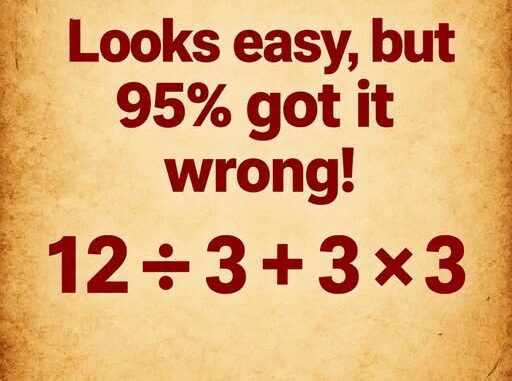
At first glance, this equation appears to be one you could resolve in just a few seconds:
12 ÷ 3 + 3 × 3 = ?
There are no fractions, no parentheses, no square roots, and no daunting numbers. It seems almost too straightforward to be labeled a “challenge.”
That is precisely what makes it effective.
When individuals see an expression that looks easy, many start calculating before fully comprehending it. Some move from left to right, others instinctively add numbers first, and a surprising amount ends up defending an answer derived from an incorrect order of operations.
So before continuing, try it yourself.
No calculator.
No peeking at anyone else’s response.
And don’t rush simply because the numbers are small.
What did you come up with?
If your initial thought was that the answer is clear, this puzzle might be more misleading than it appears.
Why Easy Math Puzzles Lead to Many Incorrect Answers
These viral equations rarely rely on complex mathematics. Instead, they take advantage of habits.
When we encounter small, familiar numbers, our brains tend to view the problem as routine. This promotes quick mental calculations rather than careful analysis.
Take another look at the expression:
12 ÷ 3 + 3 × 3
There are three distinct operations: division, addition, and multiplication.
The arithmetic itself is simple. The real question is which operation should be executed first.
That distinction is where most incorrect answers originate.
Someone who simply processes from left to right might perform the initial division correctly, then add the next number, and only afterward multiply. Another individual may prioritize the addition because it is in the middle. Both methods can yield a neat-looking result, but neat does not necessarily imply correct.
Mathematics follows established rules so that the same expression carries the same meaning for everyone.
The Rule You Must Remember
Most students learn the order of operations using acronyms like PEMDAS or BODMAS.
PEMDAS stands for Parentheses, Exponents, Multiplication, Division, Addition, and Subtraction. BODMAS uses Brackets and Orders instead of Parentheses and Exponents, but the core principle remains essentially the same.
One detail causes considerable confusion: multiplication does not automatically take precedence over division just because the letter “M” appears before “D” in PEMDAS.
Multiplication and division hold equal priority.
When both are present in the same expression, they are handled from left to right.
The same applies to addition and subtraction.
For this specific puzzle, however, we do not even need to choose between multiplication and division because they appear in different parts of the expression.
Both must be completed before the addition.
That hint is sufficient to resolve the challenge.
But don’t jump to the final answer just yet.
The First Part of the Puzzle
Begin with:
12 ÷ 3
That calculation yields:
4
So the original expression can now be simplified to:
4 + 3 × 3
This is where another common error arises.
Some people now see 4 + 3 and immediately convert it to 7.
However, multiplication still takes priority over addition.
Thus, we are not done yet.
The Second Part Is Where People Rush
The remaining multiplication is:
3 × 3
That results in:
9
Now the expression has been simplified to something much easier:
4 + 9
At this point, there is only one operation remaining.
And now we can finally add.
Why Working Straight From Left to Right Can Lead to Errors
Imagine someone calculates the original expression like this:
12 ÷ 3 = 4
Then:
4 + 3 = 7
Then:
7 × 3 = 21
That person would confidently arrive at 21.
Each individual calculation is accurate.
The issue lies in the order in which those calculations were executed.
The expression does not instruct us to perform every operation from left to right without regard for priority.
If that were the intended interpretation, parentheses would be necessary:
(12 ÷ 3 + 3) × 3
That expression indeed equals 21.
But it is not the expression presented in the puzzle.
A small set of brackets can entirely alter a mathematical outcome.
Why Parentheses Are So Important
Mathematical notation is crafted to eliminate ambiguity.
Compare these two expressions:
12 ÷ 3 + 3 × 3
and
(12 ÷ 3 + 3) × 3
They contain the same numbers and most of the same symbols, yet they convey different instructions.
In the first expression, multiplication and division are completed before addition.
In the second, the parentheses compel us to calculate everything inside them first.
This is why viral math puzzles can actually be beneficial when they are properly explained. Beyond sparking discussions in the comments, they reinforce a vital principle: mathematical symbols indicate not only what to compute but also when to compute it.
A Common Misunderstanding Regarding PEMDAS
Another reason these puzzles provoke debate is that PEMDAS is sometimes taught too simply.
People may interpret it as:
Multiplication always comes before division.
Addition always precedes subtraction.
That is not entirely accurate.
Multiplication and division belong to the same priority level, so you handle them from left to right. Addition and subtraction also share a priority level.
For instance:
24 ÷ 6 × 2
You should not automatically multiply 6 × 2 first.
Instead, proceed from left to right:
24 ÷ 6 = 4
Then:
4 × 2 = 8
Understanding that rule becomes especially crucial when viral puzzles include multiple division and multiplication signs.
Why Do These Math Challenges Go Viral?
The appeal is psychological as much as it is mathematical.
A complex equation intimidates people, so many simply scroll past it. An expression that appears easy does the opposite. It encourages participation because nearly everyone thinks, “I can solve that.”
Then someone comments one answer.
Another person responds with something entirely different.
A third insists that everyone else has overlooked PEMDAS.
Within moments, a problem that takes only a few seconds to solve can generate hundreds of comments.
The best viral puzzles strike a perfect balance: simple enough for almost anyone to try, but just tricky enough to spark disagreement.
This equation fits that pattern almost flawlessly.
The Numbers Are Simple — Attention Is the Real Challenge
What makes this challenge intriguing is that none of the individual operations is difficult.
Most people can calculate:
12 ÷ 3
3 × 3
and
4 + 9
without writing anything down.
The challenge lies in taking the time to apply those operations in the correct order.
That is why someone with strong mental math skills can still miscalculate the puzzle, while a person who computes more slowly may arrive at the right answer.
Speed is not synonymous with accuracy.
In fact, the feeling that a problem is “too simple” often leads people to overlook something significant.
Try a Similar Puzzle Before Revealing the Answer
If you believe you have mastered the pattern, consider this expression:
16 ÷ 4 + 2 × 5
Division and multiplication take precedence over addition.
So:
16 ÷ 4 = 4
and:
2 × 5 = 10
Then:
4 + 10 = 14
Now try applying the same logic to our original puzzle.
No tricks have been added.
You simply need to resist the urge to perform the addition too soon.
So, What Is 12 ÷ 3 + 3 × 3?
Now we can combine everything.
Start with the original expression:
12 ÷ 3 + 3 × 3
Complete the division:
12 ÷ 3 = 4
Complete the multiplication:
3 × 3 = 9
That leaves:
4 + 9
And finally:
4 + 9 = 13
The correct answer is 13.
If you arrived at 13 on your first try, you followed the standard order of operations correctly.
If you got 21, you likely calculated from left to right without completing the multiplication first.
And if you obtained something entirely different, revisit the original expression and check which operation you performed first.
The best part about puzzles like this is that the mathematics itself is not challenging. The real challenge is recognizing what your brain tends to do automatically.
Sometimes the simplest-looking equation is precisely the one that warrants a second glance.
What was your initial answer — 13 or something else?