There were papers.
Receipts.
A few small packages.
And something else that made me stop cold.
All the color drained from my face.
Then I looked at my son.
And suddenly, six months of strange behavior began to make sense.
The hidden money.
The muddy clothes.
The torn sleeve.
The repeated promise that he was “almost there.”
And most of all…
why there had never been enough money for that bicycle.
PART 2
Scattered across the stainless-steel prep table were official medical receipts, small pharmacy prescription bags, and a series of heavy legal documents stamped with official court seals. But it was the item lying right in the center of the table that caught my breath and held it trapped in my chest.
It was a thick, leather-bound notebook—my late husband’s medical journal.
Beside it sat a printout of an overdue mortgage notice for our home, marked with a red FINAL WARNING stamp from three months ago.
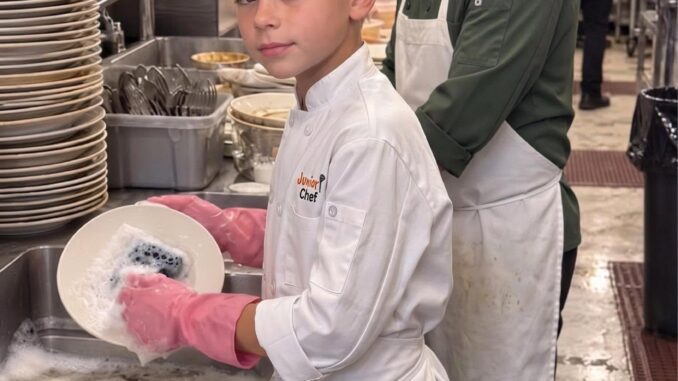
I stared at the paper, then at my son. Caleb stood near the dish pit, his eyes wide with terror, tears streaking through the gray grease smudges on his cheeks. His hands were trembling, raw and chapped from hours of scrubbing pots in scalding water.
“Caleb…” my voice cracked in the quiet kitchen. “What is all this?”
Sal walked over, wiping his hands on a white apron stained with marinara and grease. The burly diner owner looked at me, his weathered face softened by deep concern rather than anger.
“Ma’am,” Sal said gently, pointing to the scattered receipts. “Your boy wasn’t saving for a matte-black bicycle. He’s been coming in here every single Saturday, working six-hour shifts, and taking every penny in cash. And every Saturday at 5:00 PM, he walks three miles across town to the county courthouse annex and the medical billing office.”
I blinked, my brain struggling to connect the dots. “The billing office…?”
“The hospital debt from Mark’s final weeks,” Sal explained softly. “And your house’s back property taxes.”
I turned to Caleb, stunned. “Caleb, those medical bills… those were cleared by insurance years ago. I told you everything was taken care of after your father passed!”
Caleb wiped his nose with the back of his sleeve, looking down at his worn sneakers. “They weren’t cleared, Mom,” he whispered, his voice trembling violently. “I found the collection letters in the bottom of your closet four months ago. The insurance company denied the final ICU stay. They sent a collections notice threatening to put a lien on the house. You didn’t know I saw it, but I did. You were crying in the kitchen every night after I went to bed, looking at the spreadsheet.”
My knees felt weak. I reached out, gripping the edge of the prep table to steady myself.
Four months ago, I had received a terrifying notice from an aggressive collection agency demanding $8,500 for Mark’s lingering ICU charges from three years ago—a clerical error by the hospital that I had been quietly fighting through a pro bono legal clinic. I had kept the stress entirely hidden from Caleb, hiding the notices in my closet, swearing to protect him from the financial ruin his father’s sudden heart attack had left behind.
Or so I thought.
“You… you saw those letters?” I asked, a tear spilling over my cheek.
“I read them,” Caleb sobbed, wiping his face. “It said if the debt wasn’t paid or placed on a structured payment plan by the end of the year, they’d start foreclosure proceedings on the house. Dad built this house, Mom. You love this house. I couldn’t let them take it from us.”
“So you worked…”
“I made a deal with the collections clerk,” Caleb said, looking up at me with raw, desperate eyes. “I went to their office in person. I brought my first paycheck from Sal. I told them I was thirteen, and that my mom didn’t know, but I promised I’d bring them eighty dollars every single week if they held off on sending the final foreclosure notice to the court.”
Sal let out a heavy sigh, shaking his head. “He’s been paying off your family’s debt, ma’am. Eighty dollars a week. Every Saturday, rain or shine.”
I felt the ground completely drop from beneath me. The image of my son staring longingly at that black-and-orange bicycle in the store window flashed through my mind. He hadn’t just been staring at a dream—he had been looking at the sacrifice he was choosing to make every single day so his mother wouldn’t lose her home.
PART 3
“Then what happened today?” I asked, my voice shaking as I pointed to his torn sleeve and the scrape on his cheek. “Sal said you ‘tried to do it again.’ What happened at the creek?”
Sal stepped forward, placing a gentle hand on Caleb’s shoulder. “That’s why I called you, ma’am. An hour ago, one of my line cooks saw Caleb running down the alley behind the diner. Two older high school kids—local troublemakers who hang around the park—knew Caleb carried his cash in his backpack every Saturday afternoon.”
My heart seized. “They jumped you?”
Caleb squeezed his eyes shut, nodding slowly. “They cornered me near the footbridge by the creek. They wanted the backpack. They said if I gave it to them, they’d let me go. But… but that was four weeks of payments inside. If I lost that money, the clerk said the grace period would end, and the court notice would be mailed to you on Monday.”
Tears streamed down my face as I listened to my thirteen-year-old boy describe a nightmare no child should ever have to face.
“I didn’t let them take it,” Caleb whispered, his jaw setting in a rigid, fierce line that looked so much like his father’s. “I fought them off. I dropped my shoulder, shoved the bigger guy into the mud, and ran through the brush until I lost them near the diner back door. I fell down the embankment, but… but I kept the bag.”
“Caleb…” I stepped toward him, wrapping my arms around his trembling shoulders and pulling him tight against my chest. I buried my face in his dusty hair, smelling the familiar scent of dish soap, grease, and rain. “Oh, baby… why didn’t you tell me? Why did you carry this all by yourself?”
“Because you were already carrying everything else,” he sobbed into my shoulder, his small arms wrapping tightly around my waist. “Dad wasn’t here to help you anymore. I’m the man of the house now, Mom. It was my job.”
“You’re thirteen, Caleb,” I wept, kissing the top of his head. “You’re a child. It was never your job to carry the weight of this family’s survival.”
Sal cleared his throat, wiping a quiet tear from his own eye before tapping the metal table. “Ma’am, when Caleb came bursting back through my kitchen doors, bruised up and clutching that backpack like his life depended on it, he tried to hide in the pantry to clean himself up so he could walk to the collections office before it closed at six. My head cook caught him trying to stitch his own shirt with a safety pin.”
Sal looked down at the boy with profound respect.
“I’ve run this diner for thirty years,” Sal continued, his voice thick with emotion. “I’ve hired dozens of teenagers. Most of ’em complain after twenty minutes of wiping tables and quit after their first paycheck. But this boy… this boy worked until his hands bled, never missed a shift, and didn’t spend a single nickel on himself.”
Sal pulled a thick manila envelope from his back pocket and laid it beside Mark’s medical journal.
“When I realized what was going on an hour ago,” Sal said, “I called my brother-in-law, who happens to be a senior supervisor at the county billing department. I gave him the reference number on those collection notices.”
I looked at the envelope, then at Sal. “What did he say?”
“He said the hospital’s third-party billing company filed those claims fraudulently after the primary insurance audit closed two years ago,” Sal explained, a small, triumphant smile breaking across his face. “It was an illegal debt collection attempt. My brother-in-law erased the remaining balance from the county system forty-five minutes ago. Your house is completely safe, ma’am. You don’t owe them a single dime.”
FINAL PART
Silence fell over the diner kitchen.
Caleb pulled back from my hug, his eyes wide as he looked at Sal, then at the manila envelope resting on the table. “The… the debt is gone?” he stammered. “All of it?”
“Zero balance, kiddo,” Sal smiled, giving Caleb’s head a playful rustle. “And the $1,200 you’ve paid ’em over the last six months? The county auditor is issuing a full refund check to your mother by mail next week.”
Caleb stood there, paralyzed by the sudden collapse of the crushing weight he had carried on his young shoulders for half a year. The tense, guarded posture he had held for months completely melted away, leaving behind just a tired, brave little boy.
He buried his face in his hands and cried—not tears of fear or grief, but tears of pure, unadulterated relief.
I held him tight, resting my chin on his head, whispering promises that everything was going to be okay, that we were going to be alright, and that he didn’t have to be the man of the house anymore.
“Now then,” Sal said, clapping his large hands together with a loud snap, breaking the emotional spell in the room. “We have one final piece of business to take care of.”
I wiped my eyes and looked at the diner owner. “Sal, I can’t thank you enough for what you’ve done today—”
“I didn’t do it for thanks,” Sal interrupted, reaching under the prep counter and pulling out a heavy set of brass keys. “Caleb, pick up your backpack.”
Caleb sniffled, zipping his bag up and slinging it over his shoulder. “Am I fired, Sal?”
Sal laughed out loud—a big, booming belly laugh that echoed off the stainless-steel appliances. “Fired? Kid, you’re the best worker this diner has ever seen. But your Saturday shift is officially over for the day. Come on.”
Sal led us out through the kitchen doors, across the dining room where a few evening patrons were enjoying their meals, and out into the front parking lot.
Parked right beside Sal’s pickup truck was something covered by a dark blue canvas tarp.
Sal walked over, grabbed the edge of the tarp, and whipped it off with a flourish.
There, standing in the golden light of the late-afternoon sun, was the bicycle.
Matte black.
Bold orange lettering across the heavy aluminum frame.
Twenty-one speed Shimano gears, dual hydraulic disc brakes, and brand-new dirt tires resting against the asphalt. Attached to the handlebars was a bright red bow and a small, handwritten tag that read: PROPERTY OF CALEB – PAID IN FULL BY THE MANAGEMENT.
Caleb gasped, stopping dead in his tracks. His jaw dropped, his eyes going wide as saucers. “The… the Apex Trail 500…?”
“Custom ordered it from the sporting goods store three weeks ago,” Sal said proudly, crossing his arms over his chest. “I noticed you staring at it through the window every time you walked past the shop on your way to the diner. I thought you were just a kid daydreaming about a fancy toy. I had no idea what you were really doing with your money.”
Sal looked down at Caleb, his eyes shining with deep pride.
“You earned this bike ten times over, Caleb,” Sal said softly. “Consider it your six-month bonus from Sal’s Diner.”
Caleb looked at me, his eyes asking for permission, still unable to believe the magnificent machine standing in front of him was actually his.
“Go on, sweetie,” I laughed through my tears, giving him a gentle push forward. “It’s yours.”
Caleb ran to the bicycle, his fingers tracing the matte-black frame, testing the gear shifters, and gripping the rubber handles. A huge, radiant, boyish smile spread across his face—a smile I hadn’t seen since his father was still alive.
He hopped onto the seat, adjusted the helmet Sal handed him, and took off across the empty side lot, the orange lettering on the frame gleaming in the autumn sun.
I stood beside Sal on the sidewalk, watching my son ride back and forth, laughing out loud as the wind whipped through his hair.
For three years, I had worried that the trauma of losing his father had broken something inside my boy. I had worried that the poverty and stress of our lives had stripped away his childhood forever. But as I watched him race across the pavement, strong, resilient, and finally free of the invisible mountain he had been climbing alone, I realized something far greater.
Mark hadn’t just left us memories when he passed. He had passed his courage, his fierce loyalty, and his unbreakable heart straight down to his son.
Caleb pulled up beside us, skidding to a triumphant stop, his face flushed with pure happiness.
“How is it?” Sal asked, grinning.
“It’s perfect,” Caleb beamed, looking up at me with bright, hopeful eyes. “It’s the best bike in the world.”
I knelt down beside him, wiping a spot of dirt from his cheek, and held his face in my hands.
“You don’t ever have to hide things from me again, Caleb,” I whispered softly. “We’re a team. We carry things together.”
“I know, Mom,” Caleb smiled, leaning his head against my shoulder. “I know.”
That evening, as the sun dipped below the horizon, we walked home together. Caleb rode slowly beside me on his new matte-black bicycle, chatting happily about gears, trail rides, and middle-school science projects, while I walked beside him under the quiet evening sky.
The road ahead was still long, and life would undoubtedly bring more challenges. But as I looked at my son riding proudly beside me, I knew we were going to be just fine. Because my thirteen-year-old boy hadn’t just saved our home—he had shown me the true meaning of love, sacrifice, and family.