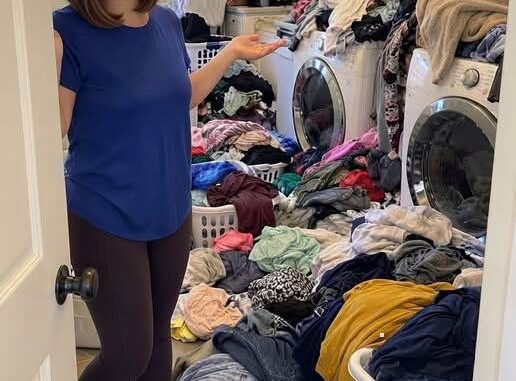
Let me begin with the washing machine.
I purchased it the year my husband, Frank, and I settled into our home on Elm Creek Road.
It was a simple white top-loader with no distinctive character.
The type of appliance you hardly think about because it just performs its function.
For thirty-one years, laundry was my responsibility.
Not because Frank and I ever formally divided the household tasks.
It simply unfolded naturally.
He managed the yard, repairs, the car, and everything outdoors.
I took care of the home.
And I did the laundry.
Every week.
For thirty-one years.
Frank’s shirts were washed, pressed, and hung up.
His socks were paired and folded.
When our son Marcus was born, I washed his clothes as well.
Grass stains.
Paint on sleeves.
Socks that mysteriously entered the machine in pairs but emerged alone.
I became quite skilled at laundry.
I still am.
However, after three decades of it, I discovered something.
Laundry is more than just laundry.
It signifies attention.
You handle the items another person wears against their skin.
You witness the traces of their day.
Where they have been.
What they spilled.
What they worked in.
What they endured.
There is something personal about caring for someone’s garments.
I had willingly done so for the people I cherished.
What I had never consented to was becoming the unpaid laundry service for anyone who showed up at my door with a bag.
My name is Dorothy Calloway.
I’m sixty-eight years old.
My husband, Frank, passed away four years ago.
My son Marcus is thirty-seven and works as a structural engineer.
He is highly competent in his profession.
On a personal level, he has always been somewhat less adept at dealing with uncomfortable circumstances.
I first noticed this when he was around fifteen.
I kept hoping he would outgrow it.
He’s still working on it.
His wife, Vanessa, is thirty-four.
She serves as a marketing director at a software firm.
Vanessa is smart, organized, driven, and very efficient.
I admired that quality in her.
The issue was that her efficiency sometimes translated into finding someone else to handle what she didn’t have the time to do.
Eventually, that someone became me.
It started with one basket.
Marcus and Vanessa had been married for six years.
They lived about twenty minutes away and visited most Sundays with their two children.
Lily was eight.
Theo was five.
Sunday dinner at Grandma’s had become a cherished family tradition.
I loved it.
I adored those kids.
Lily had Frank’s eyes and his tendency to genuinely listen when others spoke.
Theo had my laugh, which I took as a compliment for both of us.
For those children, I would have done nearly anything.
One afternoon, Vanessa brought a laundry basket into the house.
“Would you mind tossing these in with yours?”
It seemed harmless.
I was already doing laundry.
One extra basket was insignificant.
So I agreed.
The first time, it truly was nothing.
The second time, there were two baskets.
Again, I didn’t mind.
They were busy.
The kids had activities.
Life happens.
But by the sixth or seventh time, baskets had morphed into bags.
And requests had turned into expectations.
Soon, Vanessa was arriving every weekend with bags of laundry and placing them next to my washing machine.
Then she would leave with everything clean, folded, and organized.
I observed something.
She never helped with folding.
And she never expressed gratitude in a way that acknowledged the actual effort.
She would say,
“Thanks, Dorothy.”
But in the same tone one might use at a drive-through window.
Efficient.
Quick.
Barely making eye contact with me.
I also noticed that Marcus never commented.
That bothered me more.
He would sit at my kitchen table eating the lunch I had prepared while his wife brought bags of laundry into my basement.
He was fully aware of what was happening.
He simply chose to remain silent.
Silence may not signify agreement.
But when someone is being treated unfairly in your presence, silence can easily resemble permission.
One Sunday, after Vanessa delivered another large bag, I finally spoke up.
“Vanessa, I’m sixty-eight. I don’t mind helping occasionally, but I’m not your laundromat.”
I intentionally kept my tone calm.
I wasn’t looking to provoke an argument.
I was merely stating a fact.
Vanessa laughed.
Not in a cruel way.
Almost as if she found my complaint somewhat absurd.
“You’re home all day anyway.”
I glanced at Marcus.
He was staring at his plate.
That moment lingered with me.
Vanessa’s remark stung, but at least I grasped her perspective.
In her view, retirement equated to availability.
If I was home, then obviously I had time.
It was a self-centered way of thinking, but at least it was clear.
Marcus’s reaction was more perplexing.
His wife had dismissed his mother right in front of him.
And he looked at his plate.
He was thirty-seven years old.
And he looked at his plate.
I thought about Frank.
Frank would not have looked at his plate.
He would have spoken quietly and calmly.
He would have said something like,
“My mother asked you not to bring the laundry anymore. We’ll take it home.”
And that would have been the end of it.
But Frank was gone.
And Marcus had said nothing.
I spent the following week reflecting.
Not constantly.
But enough.
Two questions kept resurfacing.
What should I do about the laundry?
And what should I do about the underlying issue—the notion that because I was retired, my time belonged to anyone who wanted it?
I decided to tackle the laundry first.
One issue at a time.
The next Saturday, Vanessa arrived with four bags.
Four.
More than she had ever brought before.
Marcus carried them downstairs and arranged them next to my washing machine.
That appeared to be the extent of his involvement.
I looked at the bags.
Then smiled.
“Leave them downstairs.”
Vanessa looked taken aback.
Perhaps she had anticipated another confrontation.
“Are you sure?”
The question seemed automatic.
“Absolutely.”
She went back upstairs.
I waited until everyone had settled outside.
The afternoon was pleasant.
Marcus had brought a cooler.
The children were playing in the yard.
Vanessa was on her phone.
I went downstairs.
I had already made up my mind about what I was going to do.
I was going to sort the laundry.
Not wash it.
Sort it.
Vanessa’s clothes in one bag.
Marcus’s in another.
The children’s items separated as well.
Then I would return everything just as it had arrived.
Unwashed.
My original plan was to leave a note explaining that everyone could now manage their own items.
Simple.
Calm.
No yelling.
No drama.
Just a shift in the arrangement.
I opened the first bag.
Nothing out of the ordinary.
Then I started sorting the second.
That was when I discovered the shirts.
Men’s dress shirts.
And they were not Marcus’s.
I knew that instantly.
You might wonder how.
But when you have washed someone’s clothes for the first sixteen years of their life, you recognize their belongings.
Marcus preferred practical attire.
Good quality, but nothing flashy.
These shirts were different.
Expensive.
Tailored.
Chosen by someone who cared significantly about their appearance.
I set them aside.
Next, I found a pair of dark gray dress pants.
Too narrow for Marcus.
Too short.
There was a tailor’s label inside.
Someone else’s trousers.
I placed them next to the shirts.
Then came three white button-down shirts with dry-cleaning tags attached.
The cleaner was located across town.
Not the place Marcus and Vanessa usually utilized.
I knew because I once drove Vanessa to pick up their clothes when her car was being repaired.
I sat back on the basement floor and stared at the pile.
My initial thought was immediate.
Call Marcus.
My phone was in my pocket.
My hand actually moved toward it.
Then I hesitated.
I considered what would happen if I called him.
The children were outside playing.
Marcus was sitting in my backyard.
It was a typical Saturday afternoon.
And the only thing I truly knew was that I had found men’s clothing that did not belong to my son inside Vanessa’s laundry bags.
I had no idea why they were there.
Of course, one explanation came to mind immediately.
The obvious one.
But I did not actually know.
And once certain words are spoken, they cannot be taken back.
I thought about Frank.
Frank would not have called Marcus from the basement without knowing the whole story.
He would have asked himself what was his business and what wasn’t.
My business was the laundry.
Their marriage was theirs.
So I continued sorting.
Vanessa’s pile.
Marcus’s pile.
The children’s clothing.
And the unfamiliar men’s clothing went with Vanessa’s items since they arrived in her bag.
I put everything back into separate bags.
I chose not to leave the note.
I didn’t start the washing machine.
Then I went upstairs and prepared dinner.
Around six, I called everyone inside.
Vanessa stated she would grab the laundry first.
I heard her head down the basement stairs.
Then silence.
A few seconds later, her voice rose sharply.
“What did you do?”
Then I heard Marcus coming downstairs.
The children followed.
I remained in the kitchen.
Voices drifted up from below, but I couldn’t discern everything.
A question from Marcus.
Vanessa responding.
Marcus speaking again, much quieter.
I continued setting the table.
A few minutes later, Marcus came upstairs alone.
He stood in the kitchen doorway.
For a moment, he looked like a confused twelve-year-old.
Unsure.
Trying to comprehend something he hadn’t anticipated learning.
“Mom.”
“Dinner is almost ready.”
“What happened with the laundry?”
“I sorted it.”
He stared at me.
“I thought it would be easier if everyone’s items were separated. That way, everyone can manage their own.”
He was silent.
Then he said,
“There were clothes down there I didn’t recognize.”
“I suppose Vanessa can clarify those.”
He scrutinized me closely.
“Did you…”
“I sorted laundry, Marcus. That’s all I did.”
Another silence.
“She’s upset.”
“I imagine she is.”
“She claims the laundry isn’t finished.”
“That’s correct.”
I looked directly at him.
“I told her last week that I’m not a laundromat. You heard me.”
His eyes dropped to the floor.
There it was again.
The plate.
The floor.
Anywhere but the uncomfortable conversation.
For a moment, my heart ached for him.
He was my son.
I wanted to shield him.
But he wasn’t twelve anymore.
He was thirty-seven.
Some things he had to confront himself.
“Go talk to your wife,” I said. “Bring the children up when you’re ready. Dinner will still be warm.”
He went back downstairs.
While I waited, I thought about Frank again.
During the last year of his life, when we both understood where his illness was leading, we often discussed Marcus.
What we loved about him.
What concerned us.
One evening Frank remarked,
“He avoids conflict.”
“He has your calm demeanor,” I replied.
Frank shook his head.
“No. I’m calm because most things don’t genuinely bother me. Marcus is different. Things affect him deeply, but he says nothing.”
He paused.
“There’s a difference.”
Frank was correct.
Marcus’s silence wasn’t peace.
It was calculation.
He was always weighing the discomfort of speaking against the discomfort of remaining silent.
At work, that probably made him diplomatic.
At home, it sometimes meant small issues lingered until they became significant ones.
The week prior, he had witnessed Vanessa dismiss me.
He hadn’t agreed with her.
But speaking up felt harder than staying silent.
I had always believed that calculation was misguided.
The short-term discomfort of saying something is typically much cheaper than the long-term cost of saying nothing.
That Saturday was about to demonstrate it.
Ten minutes later, they came upstairs.
Lily and Theo arrived first.
Both appeared perplexed.
I offered them water and asked Lily about a book she had been reading.
She immediately relaxed.
Marcus was next.
His expression had shifted.
He looked like someone who had realized that a familiar place was not quite as he had always envisioned it.
Vanessa entered last.
She had her purse over one shoulder and all four laundry bags in her arms.
She had carried them herself.
“We’re going home.”
“Stay for dinner.”
“I don’t think—”
“Vanessa.”
I maintained a calm tone.
“Stay for dinner.”
Something in my voice made her pause.
She set the bags down.
Then looked at me.
“Whatever you and Marcus need to discuss, you don’t need to resolve it right now. Not in front of the kids.”
She stared at me.
“You can have dinner. Then you can go home and have whatever conversation you need to have after Lily and Theo are asleep.”
I paused.
“I noticed what I noticed. I’m not pretending I didn’t. But I also don’t want to be the person who tears apart your family on a Saturday afternoon.”
The kitchen fell silent.
Lily was observing us closely.
“I want dinner with my grandchildren,” I continued. “And my son. And his wife. That’s all I want from tonight.”
Vanessa slowly placed her purse on the chair.
Then she took a seat.
Dinner was not comfortable.
I won’t pretend otherwise.
We ate because dinner had been prepared and because the children needed a sense of normalcy.
Lily shared about a science project.
Theo spilled his water, which oddly became the most natural moment of the entire evening.
Everyone reached for paper towels.
Someone chuckled.
For a few seconds, we were simply a family again.
Marcus spoke carefully.
Vanessa barely contributed.
Around eight, they prepared to leave.
I hugged Lily and Theo.
Marcus embraced me longer than usual.
Then Vanessa paused on the porch.
“Dorothy.”
“Vanessa.”
She hesitated.
“The clothes you found. I know what you’re thinking.”
“I’m not sure what I’m thinking.”
And that was the truth.
“I sorted the laundry. That’s all I know.”
“It’s not what it seems.”
“Then explain it.”
She looked at me.
“To Marcus,” I added. “Not me.”
I paused.
“Whatever the explanation is, he needs to hear it tonight.”
Her expression shifted slightly.
Not quite gratitude.
But something akin to it.
“Okay.”
“Okay.”
They left.
Marcus called at 10:30 that night.
I was already in bed reading.
“Mom.”
“Marcus.”
“She was washing clothes for someone from work.”
I waited.
“A man in her office. His wife has been hospitalized for weeks. He’s managing the household and everything else alone. Apparently, he mentioned that he couldn’t even find time to get to the laundromat.”
I remained silent.
“She started taking his laundry with ours to assist him.”
“Why didn’t she inform you?”
Marcus sighed.
“She said she thought it would be awkward. And she didn’t believe I would understand.”
He paused.
“She does things like this, Mom. Helps people without informing anyone. Last year she helped a coworker cover rent, and I didn’t find out until much later.”
“She’s complicated.”
“Yes.”
I sat with that information.
Then Marcus asked,
“Does that change anything?”
“About what?”
“The laundry.”
I considered carefully.
“No.”
He was quiet.
“Vanessa helping someone whose wife is ill is kind. But bringing his laundry to my home without consulting me is still inappropriate. Four bags of someone else’s clothes were dropped at my house as if my time belonged to everyone.”
“I know.”
“The clothes just don’t signify what I briefly feared they might signify.”
“No.”
Then Marcus said something I had longed to hear.
“I spoke to her about the laundry. All of it.”
I closed my book.
“And?”
“I told her what I should’ve said last week.”
I smiled faintly.
“How did that go?”
“She said she genuinely didn’t realize it had become a pattern. She thought you didn’t mind.”
“That’s something she needs to work on.”
“Yes.”
“And you too.”
Silence.
“You didn’t notice either.”
Another silence.
“No. I didn’t.”
“You looked at your plate.”
“Mom…”
“I’m not trying to punish you, Marcus. I’m merely stating what happened.”
I paused.
“You heard your wife dismiss me and chose not to say anything. Those moments may seem trivial when they occur, but they accumulate.”
He said nothing.
“Your father never looked at his plate.”
The silence on the phone shifted.
“I know.”
“I don’t expect you to become your father. I expect you to evolve into the version of yourself who speaks up when something needs to be said.”
“Even when it’s uncomfortable.”
“Especially then.”
He was quiet for a long moment.
Then:
“I owe you a real apology. In person.”
“I’ll accept one.”
“And Vanessa is calling you tomorrow.”
“I’ll respond.”
“Mom?”
“Yes?”
“I love you.”
“I know. I love you too. Now go be with your wife.”
He chuckled softly.
“Goodnight.”
“Goodnight, Marcus.”
Vanessa called the following morning at nine.
“Dorothy.”
“Vanessa.”
“I wanted to clarify about the clothes.”
“Marcus already informed me.”
“Oh.”
There was a pause.
“So you know it wasn’t…”
“I know.”
Another pause.
“I also want to apologize about everything else.”
I waited.
“The laundry. The way it became something expected.”
She sounded anxious.
“I genuinely didn’t consider how much work I was imposing on you. I thought, you’re home anyway, you have the machine, you’re already doing laundry…”
She paused.
“And I realize now that it wasn’t my decision to make.”
“That’s correct.”
“That isn’t an excuse. Just an explanation.”
“I understand.”
“I should have asked every time.”
“Yes.”
“And I should have helped with folding.”
That part sounded as though Marcus had specifically mentioned it.
“Yes.”
“I’m sorry, Dorothy.”
Her apology was straightforward.
No excuses.
No theatrics.
I let it settle for a moment.
Then I said,
“Can I explain something to you?”
“Yes.”
“You mentioned I’m home all day.”
She fell silent.
“Retired doesn’t mean available.”
I continued.
“It means I completed one chapter of my working life and now I have the freedom to choose how I spend the next one.”
I read.
I garden.
I take a painting class on Tuesdays.
I have lunch with my friend Margaret on Fridays.
I visit Frank’s grave every Thursday morning.
“Being home doesn’t imply I’m waiting for someone to assign me a task. It means I’ve earned the right to determine what my time is for.”
Vanessa was quiet for several seconds.
“I never viewed it that way.”
“I know.”
Then she surprised me.
“Why didn’t you speak up sooner?”
I reflected on it.
“Because you’re my son’s wife. Because I was trying to be generous. And because I allowed something minor to escalate into something larger.”
Frank used to say resentment is like water behind a dam.
A little pressure is manageable.
But if you keep adding to it without releasing anything, eventually something breaks.
“I delayed too long. That part is mine.”
“And sorting everything instead of discussing again?”
“I aimed to change the arrangement without turning it into another argument.”
I paused.
“What I discovered during the sorting was entirely coincidental.”
“I know.”
“Marcus informed you?”
“Yes.”
Another pause.
“Why didn’t you call him right away?”
“Because it wasn’t mine to do.”
She became quiet.
“Whatever those clothes meant—and now I understand what they meant—it was your responsibility to explain them to your husband.”
“I thought you would use it against me.”
“Why?”
She didn’t respond.
“What would I gain from destroying your marriage?”
I continued.
“Your children are my grandchildren. Your unhappiness doesn’t enhance my life. I want Marcus married to someone who treats him well. I want that person to be you.”
I paused.
“But I also want respect.”
“It’s clear.”
“Good.”
Then Vanessa elaborated more about her colleague.
His name was David.
His wife had been hospitalized for eight weeks.
He was attempting to manage work, home, and everything else alone.
Vanessa had started helping because that was simply her nature when someone was in need.
“I’m going to organize something better,” she said. “Perhaps a group from work can assist with meals and other tasks.”
“That sounds much more reasonable.”
Marcus came over alone on Tuesday.
He stood in my kitchen wearing his work attire.
“I’m sorry.”
“For what?”
“For looking at my plate.”
Despite myself, I smiled.
“The plate thing.”
“Yes.”
“Sit.”
I made coffee.
Then I shared something about Frank.
“Your father never once failed to support me in public throughout thirty-one years of marriage.”
Marcus listened.
“That doesn’t mean we always agreed.”
We disagreed plenty.
Sometimes loudly.
But we did it later.
Privately.
“In front of others, Frank never allowed me to stand alone while someone dismissed me.”
Marcus gazed into his coffee.
“That’s what I need from you,” I said. “Not agreement with everything I say. Just the understanding that I deserve to be treated with respect.”
I looked at him.
“Vanessa is your wife. I’m not asking you to choose between us. I’m asking you to remember that I’m your family too.”
“You’re right.”
“I know.”
He almost laughed.
“I also realize I should have addressed the laundry sooner. I let it grow too large. That part belongs to me.”
“The sorting was quite effective.”
“It was intended to be practical.”
“It became something else.”
“That part wasn’t planned.”
He regarded me.
“I trust Vanessa about David.”
“So do I.”
“You do?”
“It aligns with who she is.”
I smiled slightly.
“She helps people. That’s a commendable quality. She just needs to stop volunteering other people’s efforts while doing it.”
Marcus chuckled.
“She mentioned you told her that retired doesn’t mean available.”
“I did.”
“She’s been contemplating that.”
“Good.”
Then Marcus said,
“Dad would have appreciated how you managed this.”
I looked down at my coffee.
“Your father would have dealt with it more swiftly.”
Marcus smiled.
“He would have spoken up immediately.”
“Yes.”
“But I think we would have ended up in the same place.”
“What place?”
“Sunday dinner.”
He looked at me.
“Family still together. Necessary things discussed. People given a chance to improve.”
“That was your intention?”
“I’m sixty-eight, Marcus.”
I had buried my husband.
I had lived long enough to realize that winning an argument about laundry was not what mattered most.
“What truly matters is Lily telling me about her science project. Theo spilling water at dinner. All of you gathered around my table on Sunday.”
I looked at him.
“That’s what I was safeguarding.”
Marcus was quiet.
Then he said,
“I love you, Mom.”
“I know.”
I smiled.
“Bring everyone on Sunday.”
And he did.
The Sunday dinners continued.
The first few were slightly awkward.
People chose their words cautiously.
Then the discomfort faded.
Vanessa began helping clear the table.
Then she started assisting with dishes.
Eventually, it stopped feeling like an apology and began to feel like participation.
One Sunday, she inquired about my painting class.
The following week, she recalled what I had told her and asked how a particular project had turned out.
She was paying attention.
I noticed.
Marcus and Vanessa eventually hired a laundry service that came every Thursday.
It was practical.
Sustainable.
And required absolutely nothing from me.
Exactly as it should be.
As for David, Vanessa organized several coworkers to help him properly.
Meals.
Errands.
Practical support.
She assisted him in a manner that didn’t rely on quietly transferring the work to someone else.
I reflected on everything that had transpired.
Especially those moments in my basement when I had been looking at unfamiliar men’s clothing and crafting a narrative in my mind.
A narrative that turned out not to be true.
It reminded me how swiftly people can build certainty from incomplete information.
And how much harm I might have caused if I had acted on that certainty immediately.
I was thankful I hadn’t called Marcus from the basement.
Frank would have approved of that.
Several months later, Lily asked why the laundry bags no longer came to Grandma’s.
“Your parents hired a service.”
“Why?”
“Because I told them I needed them to.”
She pondered that.
“Did you have to ask a lot?”
“More than once.”
“Was it awkward?”
“For a little while.”
“But now everything is okay?”
“Better than okay.”
Lily considered this thoughtfully.
“So you just had to keep saying it.”
“Yes.”
“And they had to listen.”
“Exactly.”
She seemed satisfied and returned to her book.
I sat at the table contemplating how simple the truth sounded when an eight-year-old articulated it.
You say the thing that needs to be said.
If necessary, you say it again.
You find a way that works.
You give people the chance to hear you.
And then, if everyone is willing to make a few adjustments, you sit down together on Sunday and enjoy dinner.
The washing machine on Elm Creek Road still functions.
Plain white.
Top-loading.
No character whatsoever.
It washes precisely what I choose to place inside it.
Nothing more.
Nothing less.
And that is exactly how it ought to be.