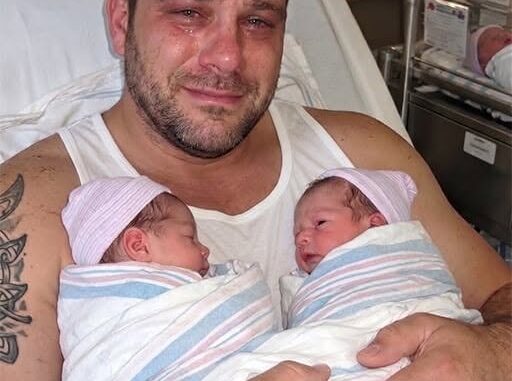
My daughter reached toward it with both hands.
And suddenly, I knew the secret I had spent almost two decades protecting was about to become the thing that hurt her most.
My name is Laurel, and when I was twenty-seven, I gave birth to twin girls.
Tessa arrived first, screaming so loudly that one of the nurses laughed and said she already had opinions about the world.
Her sister came eleven minutes later.
We named her June.
June was smaller, quieter, and had thick dark hair that never seemed to lie flat. There was a tiny crease near her left eye that became noticeable whenever she cried.
For nine days, Grant and I lived inside the exhausted happiness of new parenthood.
There were bottles on every table, blankets draped over every chair, and two bassinets beside our bed. Grant used to walk around the house with one baby tucked against each shoulder, looking both terrified and proud.
We were tired beyond anything we had imagined, but we were happy.
Then one morning, June didn’t wake up.
Everything after that became a collection of images I spent years trying not to remember.
An ambulance in front of our house.
Grant standing barefoot on the driveway.
A hospital hallway that seemed impossibly bright.
A doctor speaking gently while I stared at his mouth without really hearing him.
The official cause was SIDS.
There was no injury, no illness anyone had missed, and nothing Grant or I could have done differently.
People thought those words would comfort us.
They didn’t.
For a long time, I wanted there to be a reason. I wanted a mistake, a missed warning, or someone I could blame, because helplessness was much harder to live with than anger.
While Grant was arranging things at the funeral home, I took June’s crib apart.
I don’t remember deciding to do it.
I remember finding a screwdriver.
I remember removing the mattress.
I remember carrying the wooden pieces into the garage one by one until the place beside Tessa’s crib was empty.
When Grant came home, he stood in the doorway of the nursery and stared at the bare space.
“You took it down?”
“I couldn’t keep looking at it.”
For a moment, I thought he might argue with me.
Instead, he walked over to Tessa’s crib, placed his hand against her back to make sure she was breathing, and nodded.
That became our way of grieving.
We didn’t fight about June.
We barely talked about her at all.
Tessa was still a newborn, waking every few hours, and I became almost obsessed with checking her breathing. Sometimes I would wake in the middle of the night and stand over her crib until Grant came looking for me.
Whenever I felt grateful that Tessa was alive, guilt immediately followed.
I had gone into the hospital with two daughters.
I had come home from the funeral with one.
At first, not telling Tessa seemed reasonable.
She was a baby.
Then she was three.
At five, she started kindergarten, and I told myself there was no need to put something so painful into the mind of a child who couldn’t possibly understand it.
Grant didn’t completely agree.
One evening when Tessa was seven, we were driving home after a friend’s birthday party when he brought it up.
“Maybe we should start thinking about telling her.”
I knew immediately what he meant.
“She’s seven.”
“I know.”
“What exactly would you tell her?”
“The truth. That she had a twin sister.”
I stared through the windshield.
“And then what? She spends the rest of her childhood asking why she’s alive and June isn’t?”
“We don’t know that she would.”
“And we don’t know that she wouldn’t.”
Grant was quiet for a while.
Then he said, “She still has a right to know.”
I hated those words because part of me knew he was right.
Still, I wasn’t ready.
So he let the conversation end.
There was always another reason after that.
When Tessa was twelve, she went through a terrible year at school. Two girls she had been close to suddenly stopped speaking to her, and she came home crying so often that some evenings I sat on the edge of her bed until she fell asleep.
I told Grant, “Not now. She’s already having a hard enough time.”
At fifteen, she was anxious about her grades.
At sixteen, her first boyfriend broke her heart.
At seventeen, college applications took over her life.
Every age brought some new worry, and every worry gave me another excuse.
Our entire family helped keep the secret.
My mother had a hospital photograph of me holding both babies. Before Tessa became old enough to ask questions, I asked Mom to remove it from the hallway.
My sister stopped saying June’s name around us.
Once, my father accidentally referred to “the girls” during dinner. I looked at him so quickly that he immediately changed the subject.
Everyone knew.
And somehow, because everyone knew, I convinced myself that no one was lying.
We were protecting her.
At least, that was what I called it.
But June never completely disappeared from my life.
Every September 9, while Tessa celebrated another birthday, I woke up knowing exactly how old June would have been too.
When Tessa turned ten, June would have been ten.
When Tessa learned to drive, June should have been learning too.
Occasionally, I would set four plates on the table instead of three and only realize what I had done when Grant quietly removed the extra one.
He never mentioned it.
I never did either.
On Tessa’s birthdays, Grant had a habit of disappearing into the garage after dinner.
Sometimes he stayed there for twenty minutes. Sometimes almost an hour.
I assumed he needed privacy.
I had my own strange habits on those days. I always did laundry after everyone went to bed, even if the hamper was nearly empty. Folding towels gave my hands something to do while my mind went places I didn’t want it to go.
For nearly eighteen years, Grant and I mourned the same child in different rooms.
Then Tessa turned eighteen.
We invited about thirty people to the house. There were folding tables across the backyard, balloons tied to the fence, and a grocery-store cake with HAPPY 18TH, TESSA! written in blue icing.
My brother was at the grill, my mother was rearranging food no one had asked her to rearrange, and Tessa’s friends had taken over one corner of the yard.
She was happy.
Really happy.
That year, Grant and I had saved enough to buy her a used car.
When he handed her the keys, Tessa stared at them for several seconds before screaming.
“You didn’t!”
Grant laughed. “Then I suppose someone has left a very expensive object in our driveway.”
She threw both arms around his neck.
I was standing a few feet away, watching them, when Grant looked over Tessa’s shoulder at me.
Something in his expression made my stomach tighten.
After the gifts were opened, he stood.
“Could everyone give us a few minutes?”
Conversation around the yard faded.
My sister looked at him, then immediately looked at me.
She knew.
I shook my head slightly.
Grant saw me.
“No,” I whispered.
He came closer.
“Laurel, she’s eighteen.”
“Not today.”
“If not today, when?”
There was no anger in his voice, and somehow that frightened me more.
For years, I had been able to delay this conversation simply by becoming upset enough.
This time, he wasn’t going to let me.
My mother quickly stood and began guiding people toward the house.
“Come on. Let’s give them some privacy.”
Tessa watched everyone leave with a confused expression.
“What is going on?”
Grant didn’t answer.
Instead, he walked toward the garage.
A minute later, he returned carrying a wooden chest.
I had never seen it before.
Not once.
We had lived in that house for nearly eighteen years. I had opened every cabinet in that garage, complained about his tools, moved Christmas decorations around, and searched for missing extension cords.
Yet somehow, I had never seen that chest.
It wasn’t large. The wood was dark, and the corners were slightly uneven as if whoever had made it had done so by hand.
Grant placed it on the table.
Tessa ran her fingers over the lid.
“Dad, what is this?”
He pulled out a chair and sat across from her.
I remained standing because I wasn’t sure my legs would hold me if I moved.
“There is something your mother and I should have told you a long time ago.”
Tessa looked at me.
I couldn’t meet her eyes.
Grant continued.
“You weren’t born by yourself, Tess.”
Her forehead creased.
“What does that mean?”
“You had a twin sister.”
For a second, Tessa looked as though she thought he had made some strange joke.
Then she saw my face.
Her expression changed.
Grant swallowed.
“Her name was June.”
Tessa stared at him.
“She was born eleven minutes after you. You both came home with us.”
My chest tightened so badly that I could barely breathe.
“She di333:::d nine days later.”
Tessa didn’t cry.
She didn’t shout.
That was somehow worse.
Her hands remained on the wooden lid.
Finally, she asked, “What’s in here?”
Grant looked at the box.
“I started it the night she di333:::d.”
He opened the chest.
Inside were two hospital bracelets.
Two tiny knitted hats.
A pink blanket I hadn’t seen since the week June di333:::d.
And photographs.
Dozens of them.
I felt as though someone had opened a door into a room I had spent eighteen years trying to seal shut.
There was a photograph of Grant asleep on the couch with both girls against his chest.
Another showed me in the hospital holding Tessa in one arm and June in the other.
There were sympathy cards, June’s birth certificate, and a copy of her death certificate.
Then Tessa saw the envelopes.
They were tied together with a ribbon.
She picked up the first one.
Written on the front was:
Tessa — Age One.
Her eyes moved to the next.
Tessa — Age Two.
Then Age Three.
Four.
Five.
All the way to eighteen.
“What are these?”
Grant’s voice trembled.
“Letters.”
“From who?”
“Me.”
She stared at him.
“You wrote me letters?”
“Every birthday.”
“About her?”
He nodded.
Tessa looked at the stack again, and when she spoke, her voice was quieter.
“So every year, you wrote me a letter about the sister you weren’t telling me existed?”
Grant lowered his eyes.
“Yes.”
Tessa stood so suddenly that her chair scraped against the patio.
“Does everyone know?”
I closed my eyes.
“Tessa—”
“Grandma?”
“Yes.”
“Aunt Meredith?”
“Yes.”
“Uncle Owen?”
I nodded.
Her face crumpled, but she still didn’t cry.
“Everyone knew except me.”
“We thought we were protecting you,” I said.
Her eyes fixed on mine.
“From what?”
“From carrying something you were too young to understand.”
“I’m eighteen.”
“I know.”
“No, Mom. I’m asking what you thought you were protecting me from.”
I forced myself to answer.
“I was afraid you’d feel guilty.”
“For being alive?”
The question hit me harder than anything else she had said.
“Yes.”
Tessa stared at me in disbelief.
“So you decided how I would feel before you ever gave me the chance to feel anything?”
I had no answer.
She looked back at the chest.
“I had a sister for nine days, and every person I love knew except me.”
Grant stood.
“I should have told you sooner.”
She turned toward him.
“Then why didn’t you?”
He hesitated.
That pause told her more than any explanation could.
“Because Mom didn’t want you to?”
“I was scared too,” he said. “We both handled this badly.”
Tessa picked up her purse.
“I can’t be here right now.”
I followed her into the house.
“Please don’t leave like this.”
She turned at the front door.
“How exactly would you like me to leave after finding out I’ve been lied to for my entire life?”
Then she walked out.
She stayed with my sister for two nights.
The morning after the party, the wooden chest sat on our dining table.
I couldn’t stop looking at it.
Finally, I asked Grant, “Where did you keep that?”
“In the garage.”
“Where?”
“Behind the cabinet with my tools.”
I opened the lid and touched one of the tiny hats.
My hands began shaking.
“You kept all of this?”
“I couldn’t throw it away.”
“Why didn’t you tell me?”
He looked at me for a long moment.
“Because you would have wanted it gone.”
“I wouldn’t have.”
“Laurel, you took apart her crib while I was arranging her funeral.”
I looked down.
He wasn’t trying to hurt me.
That made it worse.
“So that’s why you went into the garage every birthday?”
He nodded.
“I wrote to Tessa.”
“What did you write?”
“Things I hoped we’d eventually tell her.”
I started crying.
“You should have made me tell her.”
Grant’s face tightened.
“I tried for years.”
“You asked. Then I said no, and you let me.”
“What was I supposed to do? Tell our daughter behind your back?”
I wiped my face.
“Maybe.”
He stared at me.
I whispered, “Maybe someone should have.”
When Tessa finally came home, she carried the chest upstairs.
For several days, she barely spoke to either of us.
She read Grant’s letters slowly.
Sometimes she came downstairs angry.
Sometimes her eyes were swollen from crying.
On the fourth evening, she brought one envelope into the kitchen.
Tessa — Age Twelve.
She sat across from us.
“Dad, you wrote that you wanted to tell me that year.”
Grant nodded.
“You wrote that Mom thought I already had enough to deal with.”
I couldn’t look at her.
Then she said something I had spent eighteen years being afraid she wouldn’t be able to say.
“I don’t feel guilty that I lived.”
I looked up.
Tears were running down her face.
“I’m sad that she di333:::d. I’m confused that I had a twin sister and never knew her. I don’t even know what I’m supposed to feel about someone who was part of my life before I can remember.”
I reached for her hand.
This time, she didn’t pull away.
“But I don’t feel guilty,” she continued. “I’m angry that you decided I would.”
“I’m sorry.”
“I should have known her name, Mom.”
Something inside me collapsed.
“Yes.”
“I should have seen pictures.”
“Yes.”
“I should have understood why Grandma sometimes cried on my birthday.”
I covered my mouth.
Tessa looked between Grant and me.
“I know you weren’t trying to hurt me.”
“We weren’t,” Grant said.
“I know. But you did.”
There was no defense left.
So I nodded.
“Yes. We did.”
A week later, Tessa asked where June was buried.
On Saturday morning, the three of us drove to the cemetery.
Grant carried flowers.
Tessa carried the letter he had written on her first birthday.
I carried nothing because I still didn’t know what I could possibly bring to a daughter whose grave I had kept hidden from her sister.
June’s headstone was small.
Tessa stood in front of it for a long time.
Then she crouched and touched the stone.
“Hi, June.”
Grant began crying beside me.
Tessa read part of the old letter quietly, then placed a copy beneath the flowers.
She had written something on the back.
I didn’t ask what it said.
After everything we had kept from her, I understood that she deserved to have something that belonged only to her and June.
Before we left, Tessa looked at me.
“I don’t want us to hide her anymore.”
“We won’t.”
“I mean it, Mom. I don’t want people changing the subject if someone says her name. I don’t want Grandma hiding pictures.”
I nodded.
“Neither do I.”
A few days later, my mother put the old hospital photograph back in her hallway.
In it, I am twenty-seven years old, exhausted and smiling, with one newborn daughter resting against each arm.
For eighteen years, I couldn’t bear to look at that picture because all I could see was the child I had lost.
Now, when Tessa visits her grandmother, she sometimes stops in front of it.
She sees both babies.
And slowly, I am learning to do the same.