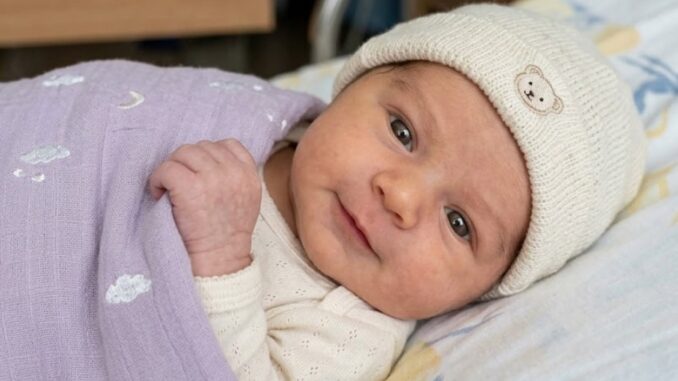
For almost ten years, my husband, Graham, and I had wanted one thing more than anything else: a child.
We tried naturally. We tried treatments, injections, procedures, and months planned around calendars and doctor appointments. Twice I became pregnant, and twice we lost the baby before we ever got far enough to feel safe.
Eventually, even seeing a positive pregnancy test on television could make me leave the room.
So when our doctor suggested surrogacy, Graham and I spent months thinking about it before saying yes.
We did everything carefully.
There were attorneys for both sides, medical screenings, counseling sessions, contracts, and more paperwork than I knew could possibly exist around bringing one child into the world.
Our surrogate, Daphne, was kind and calm. She already had two children of her own, and from the beginning she made it clear that she understood how much this baby meant to us.
When the embryo transfer worked, Daphne called me crying.
I cried harder.
Graham had to sit down.
For the next nine months, we went to every appointment we were allowed to attend. We watched our daughter grow on a screen while another woman carried her, and every time the doctor said everything looked normal, I let myself believe a little more that maybe this time we really would become parents.
We had already chosen her name.
Sadie.
The pregnancy was smooth.
Then Daphne went into labor.
That was when the first thing went wrong.
By the time the hospital contacted us, she had already been there for hours. Graham drove so quickly that I spent half the trip telling him to slow down.
When we arrived, however, we were told to wait outside.
I hated it immediately.
I had imagined hearing Sadie’s first cry. I had imagined watching the nurses place her in our arms.
Instead, Graham and I paced a hallway while staff came and went without telling us much.
At one point, I whispered that I was afraid Daphne might change her mind.
Graham took my hand and reminded me that everything had been legally arranged. There were clear agreements. The hospital knew who Sadie’s parents were.
“We’re taking our daughter home,” he told me. “Whatever is happening in there, we’ll deal with it.”
Hours later, a nurse finally brought us into the room.
Daphne was asleep.
Sadie lay swaddled in a hospital crib beside her.
I had waited almost ten years for that moment, yet when I finally saw my daughter, I was afraid to touch her.
She was tiny. Pink-cheeked. Perfect.
A pediatrician told us she was healthy.
Nobody mentioned any complication.
A few days later, we were cleared to take her home.
That evening, Graham insisted on giving Sadie her first bath.
He had watched three videos about bathing newborns and still behaved as though he had been handed a priceless object that might break if he breathed too hard.
I stood beside him smiling while he supported her head with one hand and poured warm water gently over her belly.
Sadie made a face of deep offense.
Graham laughed.
Then he carefully turned her so he could wash her back.
His expression changed instantly.
He stopped moving.
The little plastic cup slipped from his fingers and fell into the water.
“Graham?”
He didn’t answer.
I stepped closer.
“What is it?”
His eyes were fixed on Sadie’s upper back.
Then he looked at me with a kind of fear I had never seen before.
“Call Daphne.”
My stomach tightened.
“Why?”
“Call her right now.”
“Graham, tell me what you see.”
His hands were shaking by then.
“We can’t just keep her here like this. Something happened to her. Look at her back.”
I leaned over the tub.
At first, I didn’t understand what I was looking at.
Then I saw it.
A thin line near Sadie’s shoulder blades.
Small.
Clean.
And stitched.
The skin around it was still slightly red.
My knees weakened.
“That’s not a scratch.”
“No,” Graham said. “Someone cut her.”
I stared at my daughter.
For one horrible second, every fear I had carried through ten years of infertility came rushing back at once.
“What did they do to her?”
Graham lifted Sadie from the water and wrapped her in a towel while I called Daphne.
No answer.
I called again.
Then a third time.
Nothing.
By the fourth attempt, Graham was no longer simply frightened. He was furious.
“We’re going back to the hospital.”
Less than an hour later, we were standing at the reception desk demanding to speak to someone from pediatrics.
After several conversations that felt far too slow, a doctor we had never met examined Sadie.
He listened to her heart and lungs, checked her temperature, and finally inspected the incision.
Then he said something that made me want to scream.
“She’s doing very well. The procedure was successful.”
I stared at him.
“What procedure?”
His expression changed.
During delivery, he explained, doctors had discovered a problem that could have developed into a serious infection. Because of its location near the spine, the medical team believed waiting could put Sadie at risk. They performed a small corrective procedure immediately.
I barely heard anything after the word procedure.
“Our daughter had surgery?”
“A minor emergency intervention.”
“And nobody told us?”
Graham moved beside me.
“We were in this hospital.”
The doctor hesitated.
That hesitation frightened me more than anything else.
I asked who had authorized it.
Before he could answer, a voice came from behind us.
“I did.”
Daphne stood in the doorway.
She looked pale and exhausted, with her hair pulled back as if she had left home the second she noticed our calls.
My stomach dropped.
“You signed for surgery on Sadie?”
Her eyes filled with tears.
“They told me they had to do it immediately. They said there could be a serious infection and that waiting might make it much worse.”
I looked at the doctor.
“Why was she making that decision?”
He explained that the medical team had attempted to reach us.
Daphne added that she had been told we were not available and that time was running out.
“We were downstairs,” Graham said. “We never left the hospital.”
I asked the doctor exactly how many times they had tried to call us.
He did not answer right away.
So I asked again.
Finally, he admitted they had called one number once. A staff member had also gone looking for us but had not found us quickly enough. Because the doctors believed they needed immediate consent, they had turned to Daphne, the adult who had just given birth.
“One call?” I repeated.
“The decision was time-sensitive.”
I looked down at Sadie.
She was asleep against my chest, completely unaware of the adults arguing over what had happened to her.
I was furious.
But beneath the anger was something worse.
For ten years, I had watched doctors talk to me about my body as though motherhood was a door I kept failing to unlock.
Then we finally had Sadie.

And during one of the first major decisions of her life, I had somehow become an afterthought again.
Still, there was one question I needed answered before anything else.
I looked at the doctor.
“If you had waited, could my daughter have suffered serious harm?”
“Yes,” he said. “That was our concern.”
“And the procedure prevented that?”
“Yes.”
I took a slow breath.
“Then thank you for treating her.”
Daphne began crying harder, perhaps thinking that meant the conversation was over.
It wasn’t.
I looked at her.
“And I believe you were trying to protect Sadie.”
She nodded quickly.
“I swear I was. I was terrified. They were telling me something could happen to her, and you weren’t there. I didn’t know what else to do.”
I believed her.
That was what made the situation so complicated.
Daphne had not taken Sadie into an operating room because she wanted control over our child.
She had just given birth. She was exhausted, frightened, surrounded by medical professionals telling her a baby could be in danger.
So I turned back to the doctor.
“My problem is not that you saved my daughter. My problem is that her parents were inside this building and you made one phone call before deciding we were unavailable.”
No one answered.
I asked for Sadie’s complete medical records.
Every chart.
Every consent form.
The names of the people involved.
The exact time they tried contacting us.
And the hospital policy that allowed them to treat Daphne as the decision-maker when our legal documents clearly identified Graham and me as Sadie’s parents.
The doctor told me we were entitled to the records.
“Good,” I said. “Because I also want a formal review of what happened.”
Graham stood beside me and added that he wanted the written policy, not simply an explanation from the medical team.
Daphne wiped her face.
“I’m sorry.”
I looked at her.
For several minutes, I had been so angry that hearing those words almost made me angry again.
Then I saw how frightened she still looked.
“I don’t think you wanted to hurt us.”
“I didn’t.”
“I know. But I need you to understand why this hurts.”
She nodded.
“I do.”
“No, Daphne. I don’t think you can completely understand it.”
My voice broke despite everything I had done to keep it steady.
“I spent almost ten years trying to become a mother. Then I finally became one, and within days, someone made a serious decision about my daughter without me even knowing she needed help.”
Daphne covered her mouth.
The doctor looked down.
I hugged Sadie closer.
“I am grateful she is healthy. But I need to know why your system failed to find us when we were sitting one floor away.”
That was the part nobody could answer that night.
On the drive home, Graham barely spoke.
Eventually, he said, “I should have checked her the second we got home.”
I turned toward him.
“Don’t.”
“What if we had noticed sooner?”
“Then we would have been angry sooner. It wouldn’t have changed what happened.”
He tightened his hands around the steering wheel.
“I should have pushed harder to be in the delivery room.”
“You didn’t make this decision.”
“I’m her father.”
“And I’m her mother. Neither of us was given the information we needed.”
That was exactly why I refused to let him turn our anger inward.
We had already spent enough years believing every failed pregnancy was somehow something we could have prevented if we had tried harder, eaten differently, rested more, worried less, chosen another doctor, or started treatment sooner.
I wasn’t doing that anymore.
I looked into the back seat.
Sadie slept peacefully in her carrier.
“She’s here,” I said. “She’s healthy. We didn’t lose her.”
Graham glanced at her in the mirror.
His face softened.
“No.”
“So tonight, we go home and finish giving our daughter her first bath.”
When we walked back into the bathroom, the little tub was still sitting exactly where we had left it.
The water was cold.
The towel Graham had dropped was lying beside the sink.
He stood in the doorway.
For a moment, he couldn’t move.
“I don’t know if I can do it.”
I understood.
Only a few hours earlier, he had been laughing beside that tub.
Then he turned our daughter over and discovered proof that something frightening had happened to her while we believed she had spent her first days completely safe.
I held out my arms.
“Give her to me.”
He did.
I refilled the tub and lowered Sadie into the warm water.
Graham stayed beside me.
This time, when I turned her carefully and saw the small healing incision, I didn’t look away.
It was still frightening.
But now it meant something different.
Our daughter had needed help before we even understood there was danger.
And she had come through it.
“She’s tougher than we realized,” Graham said.
I ran warm water gently over her back.
“She was tough before we ever brought her home.”
He looked at me.
“We just weren’t there to see it.”
That hurt.
But it was true.
For almost ten years, I had cried in clinic bathrooms, parking lots, and our bedroom because I felt as though motherhood was happening everywhere around me except in my own life.
When Sadie was finally born, I thought all of that fear would disappear.
It didn’t.
Becoming her mother had simply given my fear a name.
Now I knew exactly what I was afraid of losing.
Sadie squirmed in the water and made a tiny irritated sound.
Graham laughed.
The sound was shaky, but it was real.
I wrapped her in a clean towel and held her against my chest.
There would still be questions.
We would read every record.
We would find out exactly what happened at the hospital and why two parents sitting in the same building had been treated as though they could not be reached.
If procedures needed to change, we would make sure someone heard us.
But none of that changed the little girl in my arms.
Sadie was healthy.
She was home.
And she was ours.
I kissed the top of her head while Graham stood close enough that his shoulder touched mine.
For years, I had waited for someone to tell me I was finally allowed to be a mother.
Standing there with my daughter against my chest, I realized I no longer needed anyone else to tell me.
I already was one.