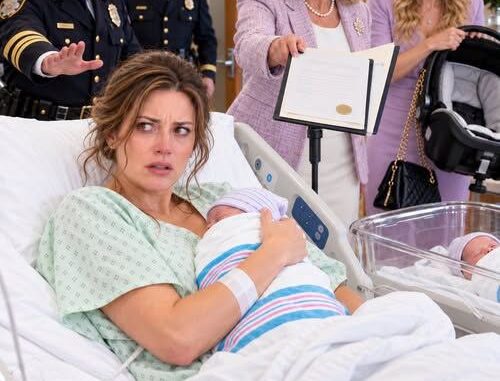
I never informed my mother-in-law about my position as a judge. To her, I was just an idle freeloader. Just hours after my C-section, she barged in with adoption documents, sneering, “You don’t deserve a VIP room. Give one twin to my childless daughter—you can’t manage two.” I held my babies tightly and pressed the panic button. When the police arrived, she accused me of being insane. They attempted to restrain me—until the chief recognized who I was…
Six hours post-C-section, my mother-in-law entered my hospital room with adoption papers, stating that one of my newborn twins belonged to her daughter.
She grinned as if she were dividing property instead of taking my child.
I was still numb from the waist down.
My incision throbbed with each breath.
My son Noah slept on my chest while Lily lay in the nearby bassinet, both just hours old.
Then Patricia came in unexpectedly.
Behind her was my sister-in-law Melissa, wearing designer sunglasses indoors and carrying an empty infant carrier.
Patricia surveyed the private recovery suite with a curled lip.
“You don’t deserve a VIP room.”
I stared at her.
She dropped a folder onto my blanket.
“Sign.”
“What is it?”
“Temporary guardianship. Eventually adoption.” Her tone was casual.
“Melissa can’t have children. You have two. Stop being selfish.”
Melissa gave me a thin smile.
“I’ve already picked the name Claire.”
My arms tightened around Noah.
“You named my daughter?”
Patricia rolled her eyes.
“This drama is precisely why my son should never have married you.”
To Patricia, I was unemployed.
When I met her son Daniel, I never discussed my career with his family.
Daniel was aware of my profession, but we decided to keep it private.
My work drew publicity, threats, and individuals who thought knowing a judge could lead to favors.
Patricia misinterpreted my silence as financial struggle.
For three years, she labeled me a freeloader.
She mocked my “cheap” clothing, never understanding I dressed conservatively because cameras sometimes awaited outside my courthouse.
She ridiculed my reluctance to discuss finances.
She assumed Daniel funded everything.
Now she loomed over my bed.
“You can barely sit up. How are you meant to raise twins?”
“Get out.”
Melissa approached Lily’s bassinet.
“We’re family.”
I pressed the nurse-call button.
Patricia grabbed my wrist.
“No nurses. Sign first.”
I glared at her hand gripping me.
“Let go.”
She tightened her grip.
“Or what?”
Then I noticed the papers.
They weren’t blank.
My name was already signed.
Not by me.
My blood ran cold.
“You forged my signature.”
Patricia’s smile briefly faded.
Then she leaned in closely.
“You’re exhausted. You won’t even remember signing.”
I reached beneath my blanket and pressed the bedside emergency panic button.
The silent alarm lit up.
Patricia laughed.
“What are you going to do, call security?”
I met her gaze.
“Yes.”
And for the first time that morning, I smiled…
Two hospital security officers arrived.
Patricia changed immediately.
Her voice softened; her shoulders quaked.
“Oh, thank God. She’s having some sort of breakdown.”
I almost admired the act.
Melissa pointed at me.
“She threatened us.”
“I did not.”
Patricia held up the forged documents.
“She agreed yesterday to let Melissa adopt one baby. Now she’s unstable after surgery.”
One guard hesitated.
The other glanced at the twins.
“Ma’am, are you feeling confused?”
“No.”
Patricia loudly whispered, “She hasn’t worked in years. She lives off my son. Pregnancy made her worse.”
Then two city officers entered.
Patricia rushed to them.
“She’s dangerous. Please take the babies away before she harms them.”
That changed everything.
I had spent fifteen years hearing liars in courtrooms.
The worst always overreached.
One officer approached my bed.
“Ma’am, I need you to put the baby down.”
“No.”
“For everyone’s safety—”
“My newborn son stays with me unless a physician or lawful court order states otherwise.”
His expression hardened.
“Don’t make this difficult.”
Patricia smiled behind him.
She thought she had triumphed.
Then Melissa made a misstep.
She picked Lily up from the bassinet.
My daughter screamed.
“Put her down,” I demanded.
Melissa held Lily against her chest.
“She’ll get used to me.”
I activated the bedside recording system.
The hospital system automatically saved audio during emergencies.
Melissa was unaware.
Neither was Patricia.
“You really thought we’d let you keep both?” Patricia said.
“Daniel already signed what we needed.”
That hurt more than my incision.
“Daniel signed?”
“He understands family obligations.”
The door opened again.
Hospital administrators entered with three additional officers.
Police Chief Raymond Cole stood among them.
He stepped into the room.
Then froze.
His expression changed.
“Judge Bennett?”
Silence.
The officer beside my bed blinked.
Patricia frowned.
“Judge who?”
Chief Cole turned to me.
“Your Honor, are you injured?”
Melissa nearly dropped Lily.
Patricia let out a nervous laugh.
“This is absurd.”
I faced the chief.
“My daughter is being held against my wishes. My signature appears to have been forged on adoption-related documents. I was physically restrained after surgery. I want both children medically examined and the documents preserved as evidence.”
Chief Cole’s voice became cold.
“Officer, return that infant to her mother. Now.”
Melissa stepped back.
“No. She promised—”
“I promised nothing.”
The chief took Patricia’s papers.
He examined the signature.
Then he looked back at me.
“Do you recognize this as yours?”
“No.”
Patricia finally comprehended.
Her face turned pale.
“You’re actually a judge?”
“Superior Court.”
Melissa whispered, “Daniel said you stayed home.”
“I was on maternity leave.”
Chief Cole ordered Patricia and Melissa to be separated.
Patricia suddenly shouted, “She’s abusing her position!”
I shook my head.
“No. Which is why I won’t handle this case.”
She looked bewildered.
I continued calmly.
“An independent prosecutor can manage the forgery, coercion, unlawful restraint, and attempted removal of my child.”
Then the door opened once more.
Daniel walked in.
He saw the officers.
He saw his mother.
Then the papers in Chief Cole’s hand.
His expression revealed that Patricia had been truthful about one aspect.
He knew.
“Emily,” Daniel whispered.
I had never heard fear in Daniel’s voice.
Now every syllable trembled.
“Tell me you didn’t sign those documents.”
He glanced at his mother.
Patricia spoke first.
“Don’t say anything.”
That was my answer.
Daniel sat down slowly.
“It wasn’t meant to happen like this.”
My chest tightened.
“There was a version of taking our daughter that was supposed to go better?”
“No! Mom said Melissa was desperate. She said the papers were just to establish temporary custody if you became overwhelmed.”
“You signed them?”
He buried his face in his hands.
“Yes.”
Patricia snapped, “Stop talking!”
Chief Cole promptly had Daniel separated from us.
A hospital attorney arrived, followed by another administrator.
The original documents were placed in a sealed evidence envelope.
The room Patricia had entered like royalty was now a crime scene.
I remained in bed.
I didn’t scream.
I didn’t threaten anyone.
I held both babies while trained professionals managed everything.
That frightened Patricia more than anger could.
“You’re destroying this family!” she yelled as police escorted her toward the exit.
I looked at her.
“No. You attempted to turn my daughter into compensation for Melissa’s infertility.”
Melissa broke into tears.
“You don’t understand what it’s like!”
“You’re right,” I said softly.
“But grief doesn’t grant you ownership of another woman’s child.”
Daniel tried to approach.
An officer blocked him.
“Emily, please. I made a mistake.”
“A mistake is forgetting an anniversary.”
I looked at the forged documents.
“This required meetings, signatures, planning, and an infant carrier.”
His face crumpled.
The investigation revealed far more than anticipated.
Patricia had contacted a private adoption facilitator two months before I delivered.
She falsely claimed I had untreated mental illness and had discussed surrendering a twin.
Melissa had purchased baby furniture.
Daniel had provided copies of my ID.
Investigators then discovered text messages.
Patricia: Once she’s medicated after surgery, she’ll sign anything.
Daniel: Don’t pressure her too hard.
Melissa: I’m not leaving without the baby.
That message shattered Daniel’s assertion that it was all a misunderstanding.
I recused myself from every related legal matter.
An outside prosecutor took the case.
Patricia eventually pleaded guilty to charges of forgery, attempted custodial interference, and assault.
She received jail time, followed by probation, plus a no-contact order covering me and the children.
Melissa avoided prison through a plea deal but received probation, mandatory counseling, community service, and the same no-contact order.
Daniel faced different repercussions.
I divorced him.
He lost unrestricted access to the twins while family court reviewed his involvement.
After months of hearings, he received supervised visits and had to complete parenting and psychological programs before seeking more.
He once asked me outside court, “Did you have to destroy everything?”
I studied him for a moment.
“I was lying open after surgery when your family attempted to take our daughter.”
He dropped his gaze.
“You destroyed it.”
A year later, I stood in my kitchen with Noah on one hip as Lily wobbled toward me.
My scar had faded.
The fear lingered, but no longer dominated the room.
I had returned to the bench months earlier.
On my first morning back, Chief Cole was at the courthouse on another matter.
He smiled.
“How are the twins?”
“Loud.”
He laughed.
That evening, after the babies fell asleep, I sat beside their cribs, watching them breathe.
Patricia once viewed me as an unemployed woman she could intimidate.
She believed silence indicated weakness.
She thought privacy equated to powerlessness.
She assumed motherhood made me vulnerable.
She was mistaken about all three.
I didn’t win because I was a judge.
I triumphed because when they tried to take everything, I remained composed and allowed them to reveal their true selves.
When the door finally closed behind them, my children stayed in my arms.
Exactly where they belonged.