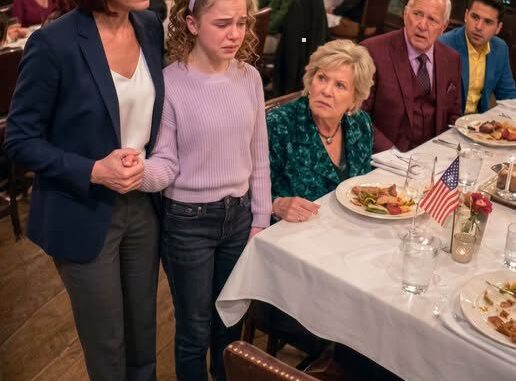
My mother glanced at my 13-year-old daughter and murmured, “we don’t sit with mistakes.” I took her outside without a word. That evening, my father inquired if I was still making the car payment. By dawn, every dollar was gone, but later, I discovered something on my daughter’s phone that…
I’m Marlo, and this is the account of the night my family revealed their true selves to me and the morning I decided to trust them.
I want to begin with a topic rarely addressed regarding family. Most harm doesn’t occur in one dramatic instance. It unfolds in the smaller moments—the overlooked birthdays, gifts without names, and gently posed questions that are really veiled judgments masquerading as concern.
By the time someone finally articulates the truth that shatters everything, it typically isn’t a true surprise.
You already knew.
You just kept wishing you were mistaken.
I had been wishing for years.
I adopted my daughter, Sole, when she was seven. Prior to that, she lived with me as a foster child for nearly a year—exactly eleven months.
Eleven months of discovering her favorite cereal, her anxiety about thunderstorms, and how she laughed wholeheartedly whenever something was truly amusing.
By the time the county paperwork was finalized and her last name changed on her school records, she already recognized the sound of my car in the driveway, how I preferred my coffee, and which drawer contained the Band-Aids.
She was mine.
Not just basically.
Not nearly.
Not “in every way that matters,” as if biology still had the final say.
She was completely, legally, and in every subtle way paperwork could never fully encompass.
She was the best choice I had ever made.
My parents never forgave me for it.
Not because they seemed cruel.
My mother prepared casseroles for church fundraisers.
My father coached Little League for fifteen years.
From the outside, they were the kind of family that appeared perfect in Christmas photos.
But beneath that facade was a different kind of calculation, one that evaluated people based on worth, bloodline, and utility.
From the moment I brought Sole home, she didn’t fit into their equation.
It didn’t start with a bang.
It never does.
My mother overlooked Sole’s birthday the first year.
I reassured myself she was still adjusting.
In the second year, she sent checks to my nephews and completely excluded Sole.
When I brought it up, Mom sighed and claimed she hadn’t yet figured out what Sole liked.
Sole was eight.
She enjoyed art supplies, mystery novels, and any film featuring animals.
I had informed Mom of that three times.
My father referred to her as “that girl” when he was irritated.
He avoided doing so around me whenever he could, but Sole overheard him once.
She was nine.
Later that night, she approached me quietly and asked, “Does Grandpa know my name?”
I responded, “Of course he does.”
I shouldn’t have said that.
Christmas gifts came in two categories.
For my nephews—my brother Chris’s sons—there were embroidered names, thoughtful selections, gifts that conveyed, I see you.
For Sole, there were clearance items still wrapped in plastic.
One year, a soap set.
Another, a candle.
Sole never complained.
She expressed gratitude every time with handwritten notes because that’s the kind of child she is.
They never replied.
Then came the inquiries, usually over coffee while Sole was elsewhere, posed in soft, concerned tones.
“Does trauma stick with kids like her?”
“Do children from those situations really attach the way typical children do?”
“Have you considered what you’ve sacrificed, Marlo? A real family? A real life?”
Each time I resisted, I was deemed too sensitive.
Each time I withdrew, I was accused of keeping them from their granddaughter.
And because I cherished the notion of family, because I had spent my life believing people could improve beyond their worst moments, I kept returning.
About a month before the dinner, I finally gave them a clear warning.
I sat across from Mom in her kitchen and said, “One more cruel remark towards Sole. Just one. And we are finished. Not a break. Not a cooling-off period. Finished.”
She stirred her coffee and nodded as though I had said something rational but not particularly serious.
I don’t think either of them took me seriously.
People seldom believe the individual who has spent years paying bills, resolving conflicts, and consistently showing up.
That person has always been there before.
The dinner took place at a local restaurant, one of those places adorned with warm string lights, nostalgic music, and an ambiance that makes everything seem alright even when it isn’t.
The hostess seated us near the front window.
Dad had already sent back his drink before we even glanced at the menus.
Mom kept adjusting her silverware.
Chris sat opposite me, checking his phone under the table and smiling at things he never shared.
Sole sat beside me in her cream blouse, back straight, napkin neatly folded in her lap.
She was trying so hard to be perfect that my heart ached.
She always did that around them.
That invisible bracing.
That careful stillness.
At home, she left shoes strewn across the floor.
She sang off-key to whatever was playing.
She dozed off on the couch with her book open across her face.
She was vibrant at home.
Around my family, she made herself smaller.
I had observed this for years and convinced myself it was shyness.
Sole focused on her plate.
Then the waiter brought the dessert menus.
Mom leaned toward Sole the way she did whenever she wanted something cruel to sound kind.
Her voice lowered, soft and almost gentle, but clear enough for everyone at the table to hear.
“We don’t sit with mistakes.”
The table fell silent.
Sole’s fingers tightened around her spoon until it clicked against the bowl.
Her shoulders curled inward.
Her eyes dropped so swiftly it resembled a light extinguishing.
My hand tightened around my water glass.
For one long, chilling second, I wanted to make Mom repeat herself.
Loudly.
At full volume.
In front of everyone.
I wanted those words to linger in the air long enough for the entire restaurant to grasp precisely what kind of woman she was.
I refrained.
I set down the glass.
I stood, intertwined my hand with Sole’s trembling one, and said quietly, entirely, “We’re leaving.”
Chairs scraped.
Dad looked offended before he appeared surprised.
Chris finally put his phone away.
Mom blinked up at me as if I had embarrassed her by refusing to let her continue.
“Don’t be dramatic,” she said.
I looked directly at her.
“You just referred to my daughter as a mistake.”
“She knows what I meant.”
“No,” I replied. “You know what you meant.”
Then I led Sole through the restaurant, past the hostess stand, the other tables, the small flag in the holiday centerpiece beside the door, while half the room feigned disinterest.
The cold outside was biting.
Sole climbed carefully into my car, almost as though she feared taking up too much space.
She buckled herself in and stared straight ahead with that dreadful stillness children use when trying not to break down.
I settled into the driver’s seat.
Neither of us spoke initially.
Then she whispered, “Am I?”
“Are you what?”
“A mistake?”
I turned toward her.
“No,” I said. “Never. Not for a second. You are the best decision I have ever made.”
Her mouth quivered.
I reached across the console and held her hand until her fingers slowly relaxed.
“They are wrong,” I told her. “And they don’t get to define who you are.”
That was when she finally cried.
At home, I prepared hot chocolate she barely touched.
I settled her on the couch beneath two blankets with a movie she had seen a hundred times.
I stayed beside her in silence because I didn’t yet trust the temperature of my own words.
The kind of anger that transforms your life isn’t loud.
It doesn’t come in shaking bursts.
It arrives quietly, cleanly, and certainly, like winter air seeping beneath a door.
That night, I felt it settle into me as if it had always been there.
At 10:14 p.m., Dad texted.
“You’re still making the car payment tomorrow, right?”
Not, Is Sole okay?
Not, Your mother went too far.
Not, I’m sorry.
Just the bill.
For three years, I had covered their car note, part of their utilities, Chris’s phone bill, and the pharmacy gap Mom referred to as temporary every month even though it had never been temporary.
I did it because after my divorce, I had more financial stability than they did.
I did it because I had been raised to believe caring for family was a virtue, not a transaction.
I had been mistaken about which one it was for them.
I opened my banking app.
Car payment canceled.
Utility transfer removed.
Chris’s phone autopay terminated.
Pharmacy account closed.
Then I reviewed every linked account, saved card, and automatic transfer.
I changed passwords.
Revoked access.
I updated security questions with answers none of them could guess because they had never paid sufficient attention to know the small details of my life.
Not Sole’s favorite cereal.
Not my first pet’s name.
Not the street where I resided before we moved.
They knew the bill schedule.
They did not know me.
By midnight, I had blocked Mom.
At 12:07, Dad.
At 12:11, Chris.
Then I sat at the kitchen table and picked up Sole’s phone.
She had once casually mentioned that Grandma had sent her a few messages.
She hadn’t seemed concerned.
I let it go.
I shouldn’t have.
There were three messages from Mom, all sent during the previous month, all masked as gentle concern.
“Do kids at school ever make you feel different?”
“Do you ever worry your mom regrets taking on so much?”
“Do you ever wonder where you truly belong?”
I sat at the kitchen table in the blue light of that phone and finally understood something I had refused to see for years.
My parents hadn’t simply been cruel at dinner.
They had been quietly undermining my child from the side, like people do when they wish to harm someone without being detected.
They had planted doubts in a thirteen-year-old girl’s mind.
Doubts meant to weaken her self-perception, create distance between us, and instill uncertainty in the one place and person she had always felt secure with.
I envisioned Sole at seven arriving at my door with one bag and a stuffed rabbit missing an eye.
At nine, quietly asking whether Grandpa knew her name.
At dinner, shrinking herself smaller and smaller, attempting to occupy so little space that no one would find a reason to look at her askance.
She had spent six years trying to earn something that should have been hers from the beginning.
And while she was doing that, Mom had been messaging her, questioning whether she thought I regretted her.
By morning, I had twenty-nine missed calls.
Dad left voicemails demanding explanations.
Mom lamented about betrayal, ingratitude, and everything she had supposedly done for me.
Chris called me selfish for fracturing the family over one remark.
One remark.
I stood at my kitchen counter and listened to every voicemail.
Not because any of them altered my decision.
Because I needed to hear clearly, one last time, what each person believed the actual issue was.
None of them mentioned Sole.
Not a single voicemail among twenty-nine calls contained the words, “Is she okay?” or “I went too far,” or even her name.
I deleted them all.
Then Sole’s phone lit up beside me.
Mom again.
I read the first line.
And unlike the dinner, the overlooked birthdays, or six years of quiet erosion, this time nothing within me wanted to explain.
Nothing wanted to issue one more warning.
Nothing wanted to hope they could become better than what they had shown me.
I took screenshots of every message Mom had sent Sole in the past month.
I forwarded them to my email.
I saved everything.
Then I did something I should have done years ago.
I called a family attorney.
Not because I sought anything dramatic.
Not because I intended to pursue a restraining order or court action.
Sole was safe, and I wasn’t afraid of my parents in that manner.
I called because I had spent three years financially supporting individuals who now had every reason to turn vindictive, and I needed to grasp exactly where I stood.
The attorney guided me through everything.
She confirmed that what I had done was legally sound.
No contracts.
No legal obligations.
No recourse.
The car.
Utilities.
Phone bill.
All voluntary.
My money.
My choice.
Gone.
“You’re free,” she said.
I hadn’t anticipated that word to feel so significant.
Two weeks elapsed.
Dad attempted to reach me through a cousin, urging me to be reasonable and consider what I was doing to the family.
I sent one message back through that cousin.
“I am not available for this conversation.”
Mom tried another route.
She contacted a woman from my church who knew both of us and hoped she would intervene.
The woman called me kindly.
She asked if I was okay, and when I explained what transpired at dinner and what I found on Sole’s phone, she didn’t pressure me toward reconciliation.
She simply said, “I had no idea. I’m sorry, Marlo.”
That meant more than she realized.
Chris sent one last text from an unfamiliar number.
“You think you’re better than us. You always have. Enjoy your perfect little life.”
I read it once.
I didn’t respond.
Some messages aren’t invitations to converse.
They are demands for a reaction.
And there is a unique strength in giving people absolutely nothing when that is what they deserve.
The more challenging part wasn’t cutting them off.
The more challenging part was Sole.
Not because she was angry with me.
She wasn’t.
In many ways, she seemed relieved, in that heartbreaking way children feel relief when something they always sensed but couldn’t articulate finally becomes clear.
The tougher part came later, when she would suddenly grow quiet during dinner or pause halfway through homework and look at me with something cautious in her eyes.
One evening, she asked, “Are you sad about it?”
I pondered for a moment.
“I’m sad about what I thought they could be,” I told her. “I’m not sad about what I did.”
She nodded slowly.
“Me neither,” she said.
That was when I realized Sole had known for a long time.
She had merely been waiting to see what I would do.
I think about that often.
I think about all the years she sat across from individuals who made her feel like a question mark and still showed up with a straight back and neatly folded napkin, trying to give them a reason to love her.
She deserved better.
She deserved someone who wouldn’t wait for a ninth incident, or a tenth, or a twenty-ninth voicemail.
She deserved someone who left the first time.
I was late.
But I left.
A few months after the dinner, I began making changes I had delayed for years.
I revamped Sole’s room with a new paint color, shelves for her books, and a light she chose herself that cast a soft golden glow at night.
We visited the museum she had been asking about for two years.
We drove three hours to see a band she adored and sang all the way home with the windows down.
I enrolled her in an art class.
Within six weeks, her teacher pulled me aside and said, “She has something real. I want you to know that.”
I already knew.
But I was pleased someone else finally recognized it.
I didn’t miss my family.
I want to be transparent about that because people often anticipate a different conclusion.
They expect grief.
Eventually forgiveness.
At least some ambivalence.
I felt none of it.
For the first time in a very long time, my home felt just right.
Like I could stop bracing for whatever came next.
Like the air around us had finally stopped feeling like it cost something.
Sole laughed more.
Not louder.
Just more freely.
More often.
From a deeper place.
She stopped making herself small.
She left shoes in the middle of the floor.
Sang off-key.
Fell asleep on the couch with a book over her face.
And I let her.
It was the most ordinary, beautiful thing I had ever witnessed.
During those months, we built something I cannot precisely name.
Not because it was complicated.
Because it was simpler than people expect.
Safety.
Warmth.
A home where no one had to earn their place at the table.
I heard from Dad one more time.
About four months after dinner.
Not a call.
Not a voicemail.
A handwritten letter sent to my house.
He expressed regret about the car payment situation.
He stated Mom had been under stress.
He mentioned family is family and surely I understood nobody is perfect.
He never referred to what Mom said to Sole.
Never mentioned the messages.
Never mentioned Sole’s name.
I read the letter once, folded it, and placed it into a folder in my desk.
Not because it held significance.
Because documentation matters, and I had learned that the hard way.
I never replied.
Here is what I understand now that I didn’t fully grasp before that dinner.
Protecting your child isn’t always dramatic.
It isn’t a speech, a scene, or a grand exit.
Sometimes it’s simply standing up, taking a hand, and walking toward the door.
The money wasn’t the point.
It never was.
The money was merely the last thing I had continued giving to those who had spent years harming my daughter.
And the most important thing—the message I want anyone hearing this story to grasp—is that waiting for people to become ready to treat your child properly isn’t patience.
It’s sacrifice.
And the one being sacrificed isn’t you.
Sole is fourteen now.
She still makes hot chocolate she doesn’t always finish.
Still reads past bedtime with a flashlight she believes I don’t know about.
Still laughs wholeheartedly when something is genuinely funny.
She is not a mistake.
She is the reason I finally stopped confusing tolerance with love.
I once believed that keeping a family together was always worth the cost.
I don’t anymore.
Some tables aren’t worth returning to.
Some seats were only ever offered with conditions.
And when someone shows you they are willing to trade your child’s sense of worth, that’s not a family disagreement.
That’s a line.
I crossed it by leaving.
I have never regretted the direction I walked.
If you have ever been faced with the choice between maintaining peace and protecting someone you love, I want to ask you something.
Looking back, do you think you made that choice too late, too early, or just in time?
Share your thoughts in the comments.
I read every single one.