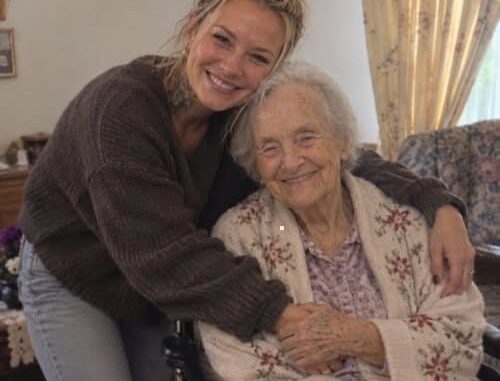
I responded to a flyer that offered $400 a week to act as an old woman’s granddaughter. What started as an unusual job turned into the closest experience to family I had ever encountered. Then Marianne passed away. Her nephew asserted that she left me nothing, but an old sewing box contradicted his claim.
I nearly walked past the flyer affixed to the pharmacy wall until I noticed the payout.
Wanted: a granddaughter for Sundays.
$400 per visit. No questions asked.
I was 27, raised in foster care, without friends or family. Four hundred dollars was more than half of what I made in two weeks.
So I called.
A frail voice picked up on the fourth ring.
“You’re seeking a granddaughter?” I inquired.
“Sunday at two. Wear something soft. The address is on the flyer.”
That was all.
On that Sunday, an 84-year-old woman answered the door, one hand against the wall for support. Her silver hair was held up with a comb.
“I don’t need a nurse,” she stated. “I just need someone to sit at my table and pretend this house still has a family.”
I shifted on the porch. “Pretending comes at an extra cost.”
She smiled. “Then you’re honest. Come in. I’m Marianne.”
Her kitchen was filled with the aroma of rosemary and aged wool. She served tea so bitter it made my eyes water, but I drank every last drop.
“You’re holding that cup as if someone will snatch it away,” she remarked.
“It’s a habit.”
“From where?”
“Nowhere worth mentioning.”
She nodded and slid a tin of shortbread toward me.
Every Sunday thereafter, I returned.
Marianne had been a seamstress and designer and had once owned her own shop. She shared stories about gowns she had crafted for senators’ wives and silk imported from Lyon. I listened and usually left with containers of soup stashed in my bag.
Soon, she began to notice details that no one else had.
“There’s a button missing on your coat,” she said one afternoon, opening her sewing tin and pulling out a needle.
“It’s fine.”
“Hand it over.”
I gave her the coat. She sewed quietly, then noticed the small burn on my wrist.
“How did you get that?”
“A fryer at work. It’s nothing.”
“It is not nothing.” She tied off the thread. “You flinch every time someone mentions the word mother. Did you know that? You’ve had a tough life, haven’t you, sweetheart?”
I couldn’t respond.
That was when our relationship shifted.
By the eighth Sunday, I stopped keeping track of the hours.
By the twelfth, I attempted to push her money back across the table.
“Keep it,” she insisted. “We have an agreement.”
“Marianne.”
“Shh.”
One day, she pushed her old tin sewing box toward me. Its lid was dented, and the painted roses had faded.
“You think I’ve lost my mind,” she said. “But one day, this box will save you.”
“Save me from what?”
“You’ll find out when it matters,” she replied.
I held the box on my lap during the entire bus ride home, and for the first time in my life, I allowed myself to cry without worrying who might see.
I left her house feeling genuinely loved for the first time, unaware it would be the last time I would see her alive.
The following Sunday, I lingered at work longer than expected, smiling through a customer slowly counting coins.
I wanted to bring Marianne fresh bread from the bakery near the bus stop. I called to let her know I was running late, but a man answered.
“Who is this?” he barked.
I froze. “I’m a friend of Marianne’s. I visit every Sunday. Who are you?”
“I was trying to reach Marianne. Is she alright?”
A bitter laugh echoed through the phone. “I’m her nephew, Arthur, and you’re the little con artist who tricked my aunt. Congratulations. She’s dead.”
The bread bag slipped from my fingers. “What did you just say?”
“You heard me. Two nights ago. And before you start crying fake tears, let me save you the trouble. She left you absolutely nothing.”
“I don’t want anything,” I whispered. “I just want to know what happened.”
The line went silent.
I scarcely remember the walk home. I recall closing the door, my knees hitting the kitchen tile, and the small sound escaping my throat when I realized I would never again sit at Marianne’s table.
I had never expressed to her how much she meant to me. Now I would never have the opportunity.
I crawled toward the tin sewing box I had left on the floor that morning, too exhausted to put it away. My hands trembled as I pulled it into my lap.
“I’m sorry,” I told the box, for there was no one else left to speak to. “I should have said it. I should have said it a hundred times.”
The cool metal pressed against my chest as I leaned forward, resting my forehead on the lid.
Then my thumb caught on something underneath.
There was a slight ridge along the bottom edge, barely larger than a fingernail. I had handled the box many times and had never noticed it.
I pressed it.
CLICK.
The lid sprang up an inch. Spools of red and gold thread rolled into my lap.
Peering inside, I realized a false bottom had opened.
Inside was a brass key and a folded piece of paper in Marianne’s neat, slanted handwriting.
My darling girl. I told you this box would save you. Because you haven’t received the real gift yet. Go to my house and open the cabinet in my sewing room. The brass key unlocks what matters.
I rushed to Marianne’s house.
The front door was ajar. Garbage bags piled on the porch, stuffed with silk and lace I recognized immediately—gowns Marianne had spent decades hand-sewing.
A man stepped outside carrying another bag and looked me over with disdain.
“You must be the con artist,” he said. “Bold of you to show your face.”
“I’m not here for money.”
“That’s good. Because there isn’t any for you.”
I ascended the steps, but he blocked the doorway with his arm.
“Did you hear me? Get off this property before I call the police.”
“Call them,” I replied. “I’d love to ask why you’re throwing her clothes in the trash before probate has even started.”
His jaw tightened. For a moment, he glanced toward the neighborhood, perhaps checking for witnesses.
That was enough.
I ducked under his arm and entered the hallway.
“Hey. HEY.”
I hurried down the hall, past the kitchen where Marianne had served me bitter tea every Sunday and the chair where she had once wrapped a blanket around my shoulders without making it a kindness I had to repay.
The sewing room door was still slightly open.
Arthur followed closely behind.
“You touch anything in here and I swear—”
“You’ll what?” I turned. “Sue me? Please. I want a lawyer in this room as badly as you don’t.”
His face flushed, but he remained in the doorway as I approached the tall antique cabinet in the corner. I had never seen it open before.
The brass key slid smoothly into the lock.
It clicked.
Inside hung a thick cream envelope tied with a thin ribbon, my name written across it.
My hands trembled as I broke the seal.
“What is that?” Arthur stepped into the room. “What are you holding?”
I silently read the first page.
Then the second.
My knees weakened, and I sat on Marianne’s sewing stool.
Dear Addie,
I told you that I used to work in my own store in the city, but what I didn’t reveal was that I still own that store. I left it in the care of Simon, the last person I mentored before retiring.
I’m leaving you the deed to that store, on the condition that you learn the trade and work there.
I have been telling Simon about you for almost a year. He agreed to take you on. The arrangement is his promise to me, and mine to you. You owe neither of us anything but the work.
“I asked you a question!” Arthur snapped.
“She left me the deed to her store in the city,” I replied.
“What?” Arthur stared at the paper. Then at me. Then at the cabinet, as if calculating what else might be concealed in the house. “That’s not legal. She wasn’t of sound mind.”
I raised another document. “Her lawyer notarized it eight months ago. Her doctor signed the competency letter. It’s all in here.”
“You manipulated her.” He stepped closer. “Give me that envelope.”
“No.”
“Hand it over before I take it.”
I stood. I wasn’t tall and had never won a fight in my life, but I held the envelope to my chest like the only piece of family I had ever been given—because it was.
“Touch me,” I said, “and you’ll discover exactly what Marianne taught me about standing up for myself.”
Arthur’s shoulders sagged briefly before his anger returned. He pointed a shaking finger toward the door.
“Get out. Take your papers and never come back.”
I gathered the envelope against my chest and walked past him without another word.
Weeks later, after the lawyers finalized probate, I took the train into the city.
Simon waited outside the small shop on a quiet corner. He was a gentle man in his 50s, with kind eyes and ink-stained fingers.
“You must be Addie, the one who visited Marianne every Sunday,” he said softly. “She told me you’d come.”
“She spoke about me?”
“Constantly. She said I’d recognize you by the way you held your shoulders. She was right.”
I followed him inside, inhaling the scent of fabric and lavender. Bolts of silk lined the walls, while half-finished gowns rested on wooden forms.
“So… how is this going to work?” I asked as I ran my fingers over a bolt of cloth.
“Marianne asked me to teach you everything I know,” Simon replied. “She told me you were a bright and honest woman with a wealth of unfulfilled potential. She said you needed a chance to prove yourself and build something special, so that’s what I’m offering you.”
Tears stung my eyes.
Marianne hadn’t only shown me love.
She had left me a future.