For six years, I’d worked at the same grocery store in the town where I grew up. I knew which customers needed help loading their cars and which ones counted their change twice before handing it over.
At forty, divorced and living alone in my late mother’s house, I liked having somewhere people expected to see me.
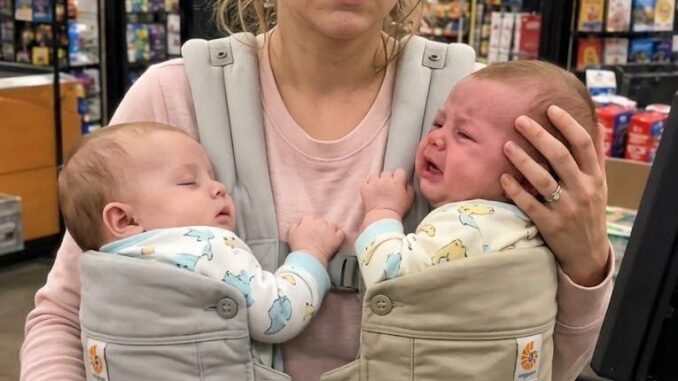
That Friday, a woman I didn’t recognize joined my checkout line. Two little boys rested against her chest in a double carrier. One slept with his mouth open while the other cried against her shirt.
She put milk, formula, and diapers on the belt, then searched her bag for her card.
“Sixty-seven eighteen,” I told her.
The card was declined. She rubbed it against her sleeve and tried again, although there was nothing wrong with the card itself.
Behind her, a man pushed his cart forward.
“Is another register open?”
The woman’s cheeks flushed.
“Take the diapers off, please.”
She checked her banking app, then showed me the balance as if she needed to prove she hadn’t meant to hold everyone up. She had $58.76.
“I can cover the rest,” I said.
Before she could argue, I entered a split payment and used my card for the remaining $8.42.
Her hand stayed on the diaper package.
“I don’t know when I could pay you back.”
“You don’t need to. You’ve got enough to carry already.”
She gave a shaky laugh, then wiped beneath one eye. As I handed her the bags, she glanced at my name tag.
“Audra?”
“That’s me.”
“Did you grow up here?”
“All my life. Audra Bell.”
Her expression changed so quickly that I wondered whether she knew someone in my family.
“Are you okay?”
“Yes. Sorry. I haven’t slept much.”
She thanked me again and left. By closing time, I was thinking about the frozen dinner waiting at home.
The next morning, my coworker Della met me beside the time clock.
“Warren wants you in his office. I’m covering your lane.”
“Did he say why?”
“Something about a customer yesterday.”
I walked down the hallway trying to remember whether I’d made a mistake with the split payment.
Warren looked up when I entered.
“Did you help a woman pay for diapers last night?”
“Yes. With my own money.”
“I know. Sit down.”
He pushed an envelope across his desk.
“She came back after you left. Asked me to make sure you got this.”
Eight dollars and forty-two cents slipped into my palm. Beneath the money was a photograph with bent corners.
My mother stood beside our old garden fence, wearing the blue dress she saved for church. I was pressed against her hip, holding a paper cup full of strawberries.
I sat down so suddenly that the chair scraped the floor.
Mom had kept a copy of that picture in her bedside drawer. After her funeral, I’d placed it there again because moving it felt wrong.
There was a note behind this one.
“My name is Merritt. I believe you’re the Audra my father has been looking for. Please come and see me. There’s something you should know.”
An address followed.
“Audra?” Warren asked. “Who is she?”
“I don’t know.”
I turned the photograph over. My mother’s handwriting ran across the back.
Audra, five. She grew these herself.
Warren gave me the morning off.
At the address, I found a small rental house with unopened boxes visible through the front window. The woman answered with a baby against her shoulder.
When she saw the photograph in my hand, she stepped outside and pulled the door nearly shut behind her.
“Where did you get this?” I asked.
“It was among my mother’s things.”
“Why would your mother have a picture of me?”
She shifted the baby higher.
“Because I think we have the same father.”
I looked past her at the hallway, where a tiny sock lay beside a moving box. Everything seemed painfully ordinary for a moment I could barely understand.
“What’s his name?”
“Vaughn Mercer.”
My mother had told me that name when I was sixteen. I’d written it down and searched the phone book after she went to bed.
There had been no listing.
Merritt invited me inside. I sat at her kitchen table while she laid the baby beside his brother.
“My mother died three years ago,” she said. “I found your picture with some letters. Dad finally told me about you.”
“And you’ve known for three years?”
“Yes.”
The answer hurt more because she didn’t try to soften it.
“He asked me not to contact you until he’d worked out what to say. I should have questioned that sooner.”
“Why now?”
“When the boys were born, I started asking what he was waiting for. Eventually, he gave me your mother’s old address. I moved here last week after my lease ended. I needed somewhere cheaper, and I wanted to find you.”
“You could have knocked on my door.”
“I drove past twice. Both times, I talked myself out of it.”
She looked toward the grocery bags still sitting on the counter.
“Yesterday wasn’t planned. When you told me your surname, I went home and checked the photograph. Then I borrowed the money to repay you and went back.”
I stared at my mother’s handwriting.
“He knew where we lived?”
“Yes.”
For years, I’d imagined my father far away, unaware of the house or the school I attended. Knowing he’d had an address made his absence feel different.
Merritt reached for a folder but stopped when I stood.
“I need to go.”
“Will you take his number?”
I almost refused. Then I thought of all the questions my mother could no longer answer.
I took it.
Two days later, Vaughn opened the door of a brick house forty minutes from mine.
He was older than I’d pictured, with thinning hair and one hand curled around a walking stick.
“Audra,” he said.

I stayed on the doorstep.
“How long have you known where I lived?”
He lowered his eyes.
“A long time.”
Inside, photographs covered a cabinet: Merritt in a graduation gown, Merritt getting married, Vaughn holding the twins.
I wondered what it felt like to grow up certain your father would attend things.
“Your mother told you I chose my wife,” he said.
“Didn’t you?”
“Yes.”
He sat slowly, leaving me the chair opposite him.
“My wife was ill when your mother became pregnant. That was the reason I gave for staying. But I was also afraid of losing my home, my marriage, everything people thought of me.”
“So Mom lost everything instead.”
He didn’t answer.
She had owned a bakery once, inherited from her father. When I was little, she sold it and took a job stocking shelves at the grocery store. She said the sale paid our debts and helped buy our house.
I remembered her soaking her feet after late shifts and falling asleep before she finished her tea.
“I offered money,” Vaughn said. “She sent it back.”
He showed me letters. I recognized the handwriting before I read a word.
In one, Mom told him she wouldn’t accept secret visits arranged around his wife’s schedule. In another, she wrote that I’d waited by the window on a Sunday he hadn’t come.
I read that sentence twice.
“You met me?”
“Twice. You were very small.”
“And then?”
“Your mother told me to stay away unless I was prepared to be dependable.”
I placed the letter on the table.
“That sounds reasonable.”
“It was.”
“You had decades to become dependable.”
His mouth trembled, but I couldn’t comfort him. I was thinking about a little girl at a window, a memory I didn’t even know belonged to me.
As he gathered the letters, a tax statement slid from the folder. I recognized the address immediately.
“Why do you have paperwork for Mom’s bakery?”
Vaughn’s hand stopped.
“I own the building.”
I waited, certain I’d misunderstood.
“When she put it up for sale, I bought it through a company. She needed a fair price quickly. I could at least make sure she got one.”
“Did she know?”
“Not until afterward.”
Every few months, I still walked past that bakery. The faded lettering remained above the windows, although the businesses on either side had changed several times.
“Why leave it empty?”
“I kept thinking she might want it back.”
“She worked herself sick while you waited for her to ask?”
“I offered. She wouldn’t take it.”
I understood her anger, but I wished she’d accepted something. I wished pride and hurt hadn’t cost her quite so much.
Vaughn leaned forward.
“I can help you now, Audra.”
“With what?”
“Your house. Money. Whatever you need.”
I looked at the photographs on his cabinet again.
“I needed you when there was a father-daughter breakfast at school. Mom asked my uncle, but he couldn’t leave work.”
Vaughn wiped his face.
“I’m sorry.”
I picked up my bag. At the door, I paused.
“Would you really give me the bakery?”
“Yes.”
“Even if I’m not ready to have you in my life?”
He took a moment before answering.
“Yes.”
I asked for the transfer to go through a lawyer. I wanted the paperwork explained to me, including the costs I would inherit. Vaughn agreed without asking for anything in return.
The building was worse inside than I remembered. Rain had stained the ceiling, the wiring needed replacing, and the old refrigerator was beyond repair.
One evening, I sat on an overturned bucket with a contractor’s estimate in my lap and cried.
Merritt found me there after Della told her where I was.
“You don’t have to open next month,” she said, crouching beside me.
“What if I can’t open at all?”
“Then we figure that out after you’ve eaten.”
She brought sandwiches the next evening and helped scrape old paper from the windows. We began talking about ordinary things while we worked: my divorce, her separation, how frightened she’d been when she learned she was expecting twins.
Sometimes I resented how easily she spoke about our father. She listened when I told her, even when it made her cry.
I kept my grocery job, used part of my savings, and borrowed enough to make the bakery safe. Instead of a full menu, I planned weekend orders and a small counter.
Vaughn offered to pay for everything. I declined, but when he asked whether he could clear the overgrown yard, I said yes.
For several Saturdays, he arrived at nine. If rain delayed him, he called.
I noticed, although I wasn’t ready to tell him.
We opened eight months after Merritt came through my checkout lane.
Della handled the register while Merritt settled the twins into high chairs. My mother’s handwritten recipe cards stood behind the counter, protected beneath glass.
Vaughn arrived carrying flowers and waited near the door.
I could see him checking my face, unsure how far he was welcome to come.
There were still questions I hadn’t asked him. Some days, hearing his voice made me angry all over again. But that morning, I brought him a plate with a warm cinnamon roll.
“Mom always made the edges a little darker,” I said. “I’m still working on it.”
He took a bite and sat quietly for a moment.
“She used to save those pieces for herself.”
“I know. She said they were the best ones.”
Merritt called my name from the counter. A customer wanted to place an order, and another was asking when the next tray would be ready.
I turned to go, then looked back at Vaughn.
“We close at two. You can stay for lunch if you’d like.”
He nodded and carefully set the flowers on the empty chair beside him.
I went back behind the counter, where my sister was waiting to help me.