I rang my son, seeking an explanation, but a peculiar woman picked up instead: “We’re on vacation. Stop bothering us.” I didn’t argue. I recorded the call and tracked his location… and that’s when I realized his mother wasn’t with him either.
Part 1
“Grandma, please help me… I’m freezing.”
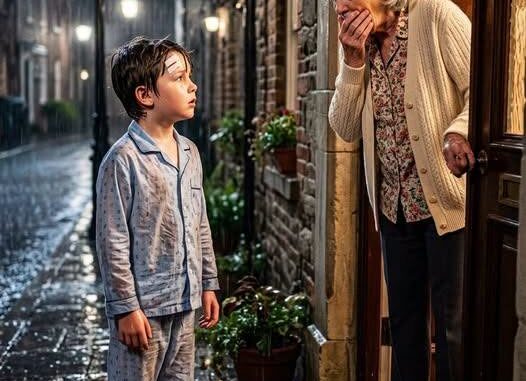
At 2 AM, amidst a torrential downpour, I opened my front door in suburban Illinois to find my seven-year-old grandson, Leo, on the porch. The rain had soaked through his thin pajamas, clinging to his small frame. He was barefoot, shaking uncontrollably, and his skin felt alarmingly hot.
“Leo? Oh my God!”
I lifted him into my arms. When I touched his forehead, he felt like he was on fire. His fever must have been around 104 degrees.
“Mom said Dad was with you…” he cried, his tiny body quaking against mine. “And Dad said Mom was with you. I thought you were all together.”
A cold knot formed in my stomach.
My son, Ryan, and his wife, Sarah, lived nearly a mile away. This sick, barefoot boy had traversed dark suburban streets in a torrential downpour because he genuinely believed his parents were at my house.
I dried him off, put him in clean clothes, gave him some fever reducer, and called Ryan immediately.
A young woman answered.
“Is that your wife calling again, babe?” she laughed in the background. “Tell her to stop ruining our weekend.”
I froze, ice coursing through my veins.
“This is Elena, Ryan’s mother,” I said, my voice lowering. “Put my son on the phone. Now.”
Silence.
“His… mother?”
The call dropped.
I called back right away. Straight to voicemail.
I opened the family location-sharing app on my phone. Ryan’s GPS dot wasn’t anywhere near town. He was at a luxury resort and spa two hours away in Geneva, Illinois.
Next, I checked Sarah’s location. She wasn’t at home either. Her phone placed her at a high-end boutique hotel downtown—miles away from her husband.
I glanced down at Leo, who was curled up under my heaviest blankets on the sofa.
“Mom told me Dad was working on your house tonight,” he murmured, half-asleep. “And Dad said Mom was helping you with groceries. Since they both said they were with you… I came here.”
The truth hit me like a physical blow.
They weren’t away together. They were both cheating on each other. And both had used me as their unwitting alibi to abandon their sick child.
I took screenshots of their GPS locations and waited until Leo’s fever subsided. At dawn, I called my neighbor and lifelong friend, Martha, to watch him for an hour while I went over to Ryan and Sarah’s house with my spare key.
What I found inside made my stomach turn.
The thermostat was completely off, leaving the house icy. The refrigerator held nothing but craft beer, energy drinks, and two containers of moldy takeout in the back. On the kitchen counter lay two hundred-dollar bills and two handwritten notes.
The first note, in Ryan’s handwriting, read: “Leo: Dad has to work late with Grandma. Mom will be home tonight. Don’t open the door for anyone.”
The second, written by Sarah, read: “Honey: I’m helping Grandma clean her house and sleeping over there. Dad will be home later. Here’s $200 for food.”
I sank into a kitchen chair.
Each parent had assumed the other would return. Neither had bothered to check. Leo had read both notes and drawn the most innocent conclusion: both of his parents were together at his grandmother’s house.
I photographed everything—the notes, the empty fridge, the cold house.
I entered Leo’s bedroom. His clothes were outgrown, his sneakers were worn through at the toes, and his school backpack was tossed in a corner. I packed his clothes, shoes, favorite toys, and birth certificate into two duffel bags. I wasn’t yet sure what legal steps I would take, but I knew one thing with absolute certainty: Leo would never sleep in this house again.
Back at my home, I made chicken noodle soup. Leo ate with a desperate, ravenous speed.
“This is so good, Grandma,” he said between bites. “I haven’t had hot food in a long time.”
It broke my heart to hear him say that. “Does your mom not cook anymore?”
“When they both work late, they just leave me two hundred-dollar bills,” Leo explained casually. “I call them ‘Two-Hundred-Dollar Days.'”
“How often does that happen?”
“Tuesdays and Fridays,” he replied, as if it were the most normal thing in the world.
My stomach churned. I logged into his school portal. His second-grade teacher had left several concerning notes over the past two months: Leo fell asleep at his desk on Wednesday. Leo arrived without lunch on Friday and asked for seconds from the cafeteria. Leo seemed anxious and unwashed.
This wasn’t a one-time lapse in judgment. This was a pattern.
While sorting through his school papers, I found a bank folder with Leo’s name on it. I had opened a high-yield college savings account for him when he was born, contributing money on each birthday and holiday.
I logged into the online portal to check the balance.
Remaining balance: $83.14.
Over the past three years, tens of thousands of dollars had been systematically drained from my grandson’s college fund. And just yesterday—hours before abandoning Leo in a freezing house—someone had withdrawn $2,400 in cash.
I stared at the two hundred-dollar bills I had photographed on their kitchen counter.
They had pilfered their seven-year-old son’s future to fund their secret affairs, leaving him a fraction of his own stolen money to survive on.
When I pulled the complete ten-year transaction history from the bank portal, I realized that $2,400 was merely the tip of the iceberg.
And what I was about to uncover about my own son and daughter-in-law proved that this storm was only just beginning.
Part 2
Over $18,000 had been siphoned from Leo’s account over the years.
There were debit charges matching upscale steakhouses, weekend getaway deposits, and luxury spa packages. While their son subsisted on cold cereal and fast food, Ryan and Sarah treated his college fund like an unlimited personal slush fund.
I immediately called Child Protective Services (CPS) and reported the entire situation: the sick child walking alone in the dark, the contradictory notes, the location screenshots, the lack of food, and the stolen funds.
The caseworker on the line fell silent for a moment. “Mrs. Vance, keep every single piece of evidence you have. This requires an immediate emergency child protection assessment.”
Next, I called a locksmith. By noon, every deadbolt on my house had been changed. Ryan had held a spare key to my home for years, and I wasn’t taking any chances.
When Leo saw the new keys on the counter, his eyes widened. “Grandma… why did you change the locks?”
I knelt in front of him, taking his small hands in mine. “Because starting today, this is your safe zone. No one gets to walk in here and take you away unless it’s safe for you.”
Tears welled in his eyes. “Not even Dad?”
“No one is forcing you out of this house tonight.”
Leo wrapped his arms around my neck, sobbing softly. “I don’t ever want to be left alone in the dark again.”
By Sunday afternoon, Ryan’s and Sarah’s location dots began moving back toward town. The party was over.
At 5:00 PM, my phone rang.
“Mom!” Ryan panicked over the speaker. “Is Leo with you? He’s not at the house!”
“Yes, he’s here.”
I heard him let out a dramatic sigh. “Thank God. Sarah was supposed to be watching him, but—”
“How was Geneva?” I interrupted coldly. “Did you enjoy the spa?”
Silence.
“What?”
“The boutique hotel, Ryan. The young woman who answered your phone when I called at 2 AM.”
In the background, I heard Sarah scream, “What woman, Ryan? Who was on your phone?!”
I let out a bitter laugh. “And Sarah, don’t act innocent. I saw your geotag at the downtown hotel—two champagne glasses and a man’s hand that definitely doesn’t belong to my son.”
Now they were both screaming at each other over the line.
“I also found both of your notes,” I continued, my voice cutting through their chaos like a knife. “I took photos of the kitchen counter. I have your GPS records, and I have the bank statements showing you drained Leo’s college fund.”
“Mom, listen to me, it was a misunderstanding!” Ryan shouted.
“A misunderstanding happens once!” I snapped. “Leo knows what ‘Two-Hundred-Dollar Days’ are, Ryan! His teacher has been flagging his malnutrition and exhaustion for months! Your seven-year-old son walked a mile in a freezing rainstorm with a 104-degree fever because you were both off cheating!”
Neither of them spoke.
“I have already filed a report with CPS, and I am meeting with a family law attorney in the morning.”
Ryan lost his temper. “You’re going to ruin my career! You’re my mother—how could you do this to me?!”
He didn’t ask if his son was okay. He didn’t ask if the fever had broken. He only cared about himself.
At 7:00 PM, there was a loud pounding on my front door.
“Mom, open the damn door!” Ryan yelled from the porch.
Leo curled into a ball on the couch, trembling. “Grandma… are they mad at me because I left the house?”
I knelt beside him, framing his face in my hands. “You did nothing wrong, Leo. The adults were supposed to protect you, and they failed. You are safe here.”
The pounding continued. I walked over to the smart video doorbell and pressed the talk button.
“If you knock on my door one more time, I am calling 911,” I said clearly. “CPS already has an open investigation on both of you for child endangerment. You can explain to the police officers why you left a sick seven-year-old home alone all weekend.”
Ryan’s face paled on the camera screen. Sarah stopped yelling. A minute later, they retreated to their cars and drove off.
On Monday morning, I submitted my evidence to CPS and met with a family law attorney, Patricia Salgado. She carefully reviewed the photos, bank records, school reports, and call logs.
“Elena, you did everything right,” Patricia said, removing her glasses. “We are filing for emergency temporary custody and an ex parte protective order immediately.”
The legal process began, but the emotional battle was just starting.
When Sarah realized she was backed into a corner, she ran to her parents, claiming I had “kidnapped” Leo over a minor marital dispute. Her mother, Teresa, called me furious.
“How dare you take my daughter’s child away over a marriage issue!” Teresa shouted.
“Teresa,” I replied calmly, “ask Sarah where she was from Friday night to Sunday afternoon.”
“She told me she was helping you!”
“She wasn’t here. Neither was Ryan. They left Leo alone with two hundred dollars and a locked door. He walked to my house in the rain with a 104-degree fever.”
Silence fell over the line.
“Check her bank transactions,” I added. “And ask her why over $18,000 is missing from Leo’s college account.”
I could hear Sarah crying frantically in the background, but Teresa’s tone changed instantly. Two days later, Teresa called me back, her voice humbled and broken. “Elena… we checked everything. We had no idea. Please… protect Leo.”
Ryan and Sarah’s corporate employers eventually learned of the CPS investigation during routine background and security checks. The lies they had carefully constructed crumbled like a house of cards. Ryan had taken paid time off claiming he had a family emergency; Sarah had claimed she was attending a work conference.
Their marriage fell apart within days. They turned on each other viciously, blaming one another for leaving the house first. But neither could answer the magistrate’s most basic question during our initial hearing:
“Why didn’t either of you call to make sure your son was safe?”
Because checking on him would have ruined their weekend.
Part 3
The complete financial forensic report arrived three weeks later.
It wasn’t just $18,000.
When the accountant factored in unauthorized credit lines opened using the account as collateral, the total amount stolen from Leo’s trust reached $21,600.
I brought the binder to my attorney.
“This establishes a clear, undeniable pattern of criminal child neglect and financial abuse,” Patricia noted. “They treated this child like an inconvenience and his future like their personal piggy bank.”
CPS granted me temporary legal and physical custody while the formal investigation continued. The school received strict court orders: neither parent was allowed to pick up Leo without a court-appointed supervisor present.
For the first time in months, Leo began to change.
During his first week with me, he would timidly ask before doing the simplest things.
“Grandma, can I have a juice box?”
“Of course, sweetheart.”
“Even though I had one yesterday?”
“You can eat or drink whenever you’re hungry, Leo. You don’t need permission to eat.”
He would ask permission to turn on the TV, to use drawing paper, even to take a second slice of toast. One afternoon, he accidentally knocked over a glass of water, and his face drained of all color. He began sobbing hysterically.
“I’m sorry! I’m sorry! I’ll pay for it out of my two hundred dollars!”
I wrapped him in a tight hug, holding him close. “Glasses break, Leo. It’s an accident. You never, ever have to pay to exist in this house.”
He went rigid in my arms, then collapsed into tears, releasing months of repressed trauma. He had conditioned himself to be invisible so he wouldn’t be a burden to two parents who treated him like an afterthought.
I enrolled him in pediatric trauma therapy. His therapist confirmed that Leo suffered from severe separation anxiety and a profound fear of abandonment.
I was sixty-two years old, working part-time at a local dry cleaner, and living on a modest pension. To be home for Leo every day after school, I had to further reduce my working hours. Finances were tight, and I found myself pinching pennies to cover his clothes, groceries, therapy copays, and school supplies.
But every afternoon, when Leo burst through the front door shouting, “Grandma, I’m home!”, I remembered that rainy night. I would gladly count quarters for the rest of my life before I ever let him feel unloved again.
A month later, Patricia organized a formal mediation session with Ryan, Sarah, and their respective lawyers.
My son looked like he had aged ten years. Sarah had lost her polished appearance; her eyes were sunken and tired. They sat at opposite ends of the conference table, refusing to look at each other.
Patricia laid the thick financial and medical binder on the table.
“We are proceeding with a permanent custody petition,” Patricia stated neutrally. “Moreover, Mrs. Vance is filing for full restitution of the $21,600 stolen from Leo’s trust account.”
Ryan buried his face in his hands. “I don’t have that kind of money!”
Sarah pointed an impeccably manicured finger at him. “He spent way more of it than I did!”
“Me? What about your hotel bills? Your shopping trips?!”
They erupted into a bitter shouting match across the table.
I watched them in silence for a long moment before speaking up.
“Does either of you want to know how Leo is doing in school?”
The room fell silent.
Ryan looked at me, his eyes pleading. “Mom… I was under so much stress. Work was demanding, Sarah and I were arguing constantly… I just needed an escape.”
Sarah broke down in tears. “I felt invisible! I just wanted to feel like I had a life again!”
“Then get a divorce,” I replied, my voice steady and unyielding. “Change jobs. Go to counseling. End your marriage. But you do not make a seven-year-old child pay the price for your adult failures.”
I pushed a copy of the medical report across the table. “Leo walked a mile through a thunderstorm with a 104-degree fever because you both abandoned him.”
I pushed the school records toward them. “He was falling asleep at his desk because he was terrified to close his eyes at night.”
Finally, I pushed the bank statements across. “And while he was learning to survive on fast food, you were draining his future.”
Ryan dropped his head onto the table. “Mom… I’m so sorry.”
“Save your apology for Leo,” I said softly. “Maybe one day, when he is older and healed, he will choose to hear it. But you won’t use an apology to make yourself feel better today.”
Facing criminal neglect charges and overwhelming evidence, both Ryan and Sarah signed a consent decree. They surrendered primary physical custody to me, agreed to court-monitored supervised visitation, and consented to a mandatory wage garnishment order to repay the $21,600 into a court-protected trust.
Part 4: The Final Part
Months later, the family court judge finalized the custody order.
The judge reviewed the mountain of evidence, the CPS reports, and the child psychologist’s recommendation. When the judge spoke directly to Leo in chambers—without his parents present—the seven-year-old said something heartbreakingly simple:
“When I come home from school at Grandma’s house, I know someone is actually there waiting for me.”
That was all he wanted. Not lavish vacations or expensive gadgets. He just wanted someone to be home.
The judge granted me permanent legal custody. Ryan and Sarah were ordered to complete mandatory parenting classes and individual therapy before any expansion of visitation could even be considered.
When I stepped out of the courthouse that afternoon, my hands were trembling. I didn’t feel a sense of victory. I felt a deep, aching sadness.
I sat on a bench outside the courthouse and wept. For my entire life, I had believed that a good mother defends her child no matter what errors they make. But that day, I understood a harder truth: Ryan was my adult son, but Leo was an innocent child who needed a champion to survive.
Protecting the most vulnerable person meant confronting my own blood.
The monthly wage garnishments began shortly after. Small amounts from both Ryan and Sarah were deposited directly into Leo’s new, court-locked college fund. I kept every receipt, not out of spite, but because that money belonged to my grandson’s future.
In the months that followed, the consequences of their actions unfolded. Ryan lost his corporate management position due to the public legal scandal and ended up renting a modest one-bedroom apartment across town. Sarah moved back in with her parents and took a retail job to pay off her legal fees. Their divorce was finalized quietly.
I didn’t take pleasure in any of it. Their choices had brought their world crashing down.
My focus was entirely on the boy sitting at my kitchen table.
Every morning, Leo and I made breakfast together. He learned to scramble eggs while I sliced fresh fruit for his lunchbox. In the afternoons, we did homework together at a small oak desk I bought secondhand.
Slowly, the scars began to fade.
He stopped asking permission to open the refrigerator. He stopped hoarding granola bars in his backpack. He stopped waking up in the middle of the night to check if the front door was locked.
One rainy evening a year later, I heard soft footsteps in the hallway. Leo appeared at my bedroom door, clutching his stuffed dinosaur.
My heart instantly contracted. “What’s wrong, sweetheart? Is the storm scaring you?”
I prepared to comfort him, assuming the rain had triggered memories of that dreadful night.
But Leo just offered a sleepy, contented smile. “No, Grandma. I just wanted to make sure you closed the living room window so the rug doesn’t get wet.”
That was it.
He wasn’t panicked. He wasn’t afraid of being abandoned. To him, the rain was just rain again.
I smiled, my heart swelling. “Let’s go check it together.”
We walked down the hall and closed the latch. As we walked back toward his bedroom, Leo pointed to the new set of brass keys hanging on the hook by the entryway.
“Grandma? Remember when you said those were magic keys?”
“I do,” I chuckled.
He shook his head, his eyes bright. “I know they aren’t magic now.”
“Oh, really?”
“Yeah,” he said, wrapping his arms around my waist. “You’re the one who protects me.”
I had to bite my lip to keep from crying right there in the hallway. I knelt down and hugged him tight.
“No, Leo,” I whispered. “You are safe here because you matter. And as you grow up, I want you to promise me that you will never let anyone make you feel worthless again.”
“I promise,” he whispered back. “Night, Grandma. Can we make pancakes tomorrow?”
“Pancakes it is, kiddo.”
He grinned, crawled into bed, and fell asleep within minutes.
I walked back out to the kitchen and sat down at the table. Looking at the latest bank statement for Leo’s trust, I knew it would take years for his parents to fully repay what they had stolen.
But what we had restored inside that house couldn’t be measured in dollars and cents.
Leo had reclaimed his right to be a child—to be hungry without guilt, to make mistakes without fear, and to sleep soundly knowing that when he woke up, someone would be there loving him.
I had lost my savings, my quiet retirement, and the relationship I once believed I had with my son.
In exchange, a little boy got his life back.
If anyone ever asks me whether a mother should protect her child no matter what they do, my answer will never be simple again.
Sometimes, loving your child means stopping them from harming others. And sometimes, true family isn’t just the blood you share—it’s the person who opens the door at 2 AM, wraps you in a warm blanket, and promises that you will never have to walk alone in the rain again.