The Morning Everything Changed
On the morning my husband requested a family court in Connecticut to grant him primary custody of our six-year-old daughter, he entered wearing a charcoal suit that I recognized all too well, as it was the same one he had purchased for the small courthouse ceremony where we reaffirmed our vows five years ago, back when I still held the belief that promises mattered simply because two individuals voiced them while gazing into each other’s eyes.
I was seated across the aisle in a simple blue dress, my hands resting on my lap, when Grant Holloway arrived alongside his attorney.
He glanced my way and smiled.
It was not a warm smile, nor one filled with anger. It was the composed expression of a man who thought the hardest part was already behind him.
Grant sought nearly everything we had built over our eleven years of marriage: our colonial home outside Hartford, the majority of our savings, and, most painfully, primary custody of our daughter, Sophie.
His filing characterized me as impulsive, emotionally unstable, irresponsible with finances, and incapable of providing the stable environment Sophie supposedly required.
His attorney, a polished individual named Richard Hale, reiterated those claims with such ease that for a few moments, I felt an odd sensation that everyone in the courtroom was talking about another woman who just happened to share my name.
Behind Grant sat his mother, Margaret, adorned with pearls and a light lavender jacket. Next to her was Natalie Price, Grant’s administrative coordinator, who had somehow morphed from an employee I had met twice at company holiday parties into a “close family friend” genuinely worried about Sophie’s welfare.
I noticed the silver bracelet on Natalie’s wrist.
I had seen it before.
Months prior, I had found the receipt for it tucked away in Grant’s car console.
I remained silent.
Silence had become beneficial for me.
For most of our marriage, Grant had mistaken silence for defeat.
Judge Rebecca Whitmore, an older woman with silver hair and a steady demeanor, examined the paperwork laid out before her.
“Mrs. Holloway, I see that you do not have legal representation with you today.”
“That’s correct, Your Honor. I will be speaking for myself.”
Richard glanced at Grant.
Grant lowered his head, concealing a smile.
They thought I was alone because I had run out of options.
What they had overlooked was what I had done before Sophie was born.
For nearly nine years, I had worked as a financial compliance investigator, scrutinizing corporate records, tracing irregular payments, and identifying patterns that people assumed would go unnoticed. I had left that profession when Sophie was a toddler because Grant’s business was growing, and we agreed that one parent should have more flexibility at home.
However, during our separation, I began examining our finances as I once did with questionable corporate records.
What I discovered changed everything.
There were transfers to unfamiliar accounts, invoices from companies that seemed to provide no real services, payments linked to Natalie’s family, and funds discreetly moved from accounts I could access.
But the money was only part of what alarmed me.
Grant had also started telling Sophie that certain matters were “family secrets.”
Whenever she returned home from a weekend with him, she appeared quieter.
One Sunday evening, while I was assisting her with washing her hair, she asked me if judges became angry when children said the wrong thing.
I turned off the faucet.
“Why do you ask that, sweetheart?”
She immediately looked down.
“I don’t know.”
I chose not to press her.
That decision might have been more significant than anything else I did.
The Little Girl in the Pink Sweater
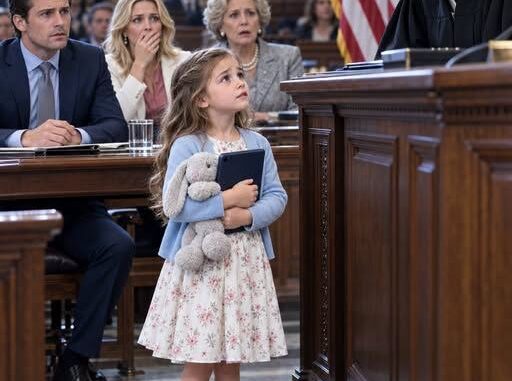
Sophie entered the courtroom later that morning with a court-appointed child advocate, carrying a stuffed gray bunny she had had since preschool.
One button on her pink sweater had been fastened into the wrong hole.
The sight of it nearly broke me.
She looked so small among all those dark suits and wooden benches.
Her eyes found mine first.
Then she looked toward her father.
Grant straightened in his chair.
His lips moved.
I couldn’t hear him, but I knew what he said.
“Remember what we practiced.”
Sophie tightened her grip on her bunny.
Judge Whitmore noticed it too.
The hearing continued.
Richard stood and stated that Grant had stable employment, a large home, financial resources, and nearby grandparents, while I had only recently started rebuilding my career.
Then Margaret was given the floor.
She recounted arguments between Grant and me, instances when I had cried, and one evening when I had locked myself in the bathroom.
What she did not clarify was that the argument had begun after Grant changed the password to our joint bank account and informed me that I no longer needed access to “his” money.
When I attempted to provide context, Grant sighed.
“Please, Emily. Not in front of Sophie.”
There was something almost impressive about how naturally he performed concern.
Then Judge Whitmore turned to me.
“Mrs. Holloway, do you have documentation addressing the financial accusations or the issue of household stability?”
“Yes, Your Honor.”
I opened the folder in front of me.
Richard immediately stood.
“We object. We have not had the chance to review whatever Mrs. Holloway intends to present.”
I pulled another sheet from the folder.
“The documents were electronically delivered to Mr. Hale’s office Thursday afternoon. His paralegal acknowledged receipt fourteen minutes later.”
Richard’s expression shifted.
I handed the confirmation to the clerk.
Judge Whitmore read it carefully.
“The court will review the documents.”
Grant’s smile faded.
Over the next twenty minutes, I explained the transactions without embellishing anything.
There was $64,000 transferred into an account linked to Margaret’s previous surname. There were consulting payments to a small business run by Natalie’s cousin. There was a lease on a furnished apartment Grant had never mentioned to me, partially paid with marital funds. There were also financial applications in which Grant had portrayed our household situation very differently from what he was currently telling the court.
I did not label him dishonest.
I did not need to.
The documents were speaking for themselves.
Richard attempted to frame the transactions as ordinary business affairs.
Grant eventually leaned toward his microphone.
“Emily has always had a habit of turning numbers into narratives. This is exactly the type of behavior I’m referring to. Sophie needs calm and consistency.”
At the mention of her name, Sophie lowered her head.
Judge Whitmore noticed.
“I would like to hear from the child advocate.”
The advocate began to rise.
Then a tiny hand appeared beside her.
Sophie had raised it.
What Sophie Had Kept Secret
Judge Whitmore’s expression softened.
“Do you want to say something, sweetheart?”
Sophie hesitated, then nodded.
She looked at me, and I could see she was trying very hard not to cry.
“Can I show you something Mom doesn’t know about?”
For several seconds, nobody spoke.
Then I heard Grant’s chair scrape against the floor.
“Sophie—”
Judge Whitmore turned toward him immediately.
“Mr. Holloway, do not interrupt your daughter.”
Sophie reached into the small fabric bag she had brought and pulled out an old purple phone.
I recognized it.
Grant had given it to her so she could watch children’s videos and play games while staying with him.
“I made a recording,” she said.
My heart began racing.
“Why did you record something?” Judge Whitmore asked gently.
Sophie rubbed one thumb over the bunny’s ear.
“Because Daddy said grown-ups wouldn’t believe me if I told them.”
The room fell completely silent.
The child advocate examined the phone first, then passed it to the clerk. After a brief discussion about how to handle the recording, Judge Whitmore allowed it to be played solely for the purpose of understanding Sophie’s concerns.
The first voice we heard was Grant’s.
“When they ask questions, you tell them Mommy yells a lot and makes you nervous. Okay?”
There was movement in the recording, then Sophie’s quieter voice.
“But I don’t want to say something that isn’t true.”
Grant responded more firmly.
“You’re not lying. You’re helping everybody. If you explain things the right way, Daddy can keep the house and you can stay here more. Grandma might even get you that puppy you wanted.”
My fingers clenched around the edge of the table.
Then Margaret’s voice entered the recording.
“Sweetheart, sometimes children have to trust the adults who understand these things.”
Sophie asked another question.
“What if Mommy gets sad?”
Grant answered after a pause.
“Then that’s her choice. You aren’t responsible for it.”
A few moments later, he instructed her not to mention Natalie, the apartment, or conversations she had overheard regarding money.
Then another voice appeared.
Natalie.
“You’re worrying too much. Emily doesn’t have the resources to keep this going forever.”
The recording ended.
Nobody spoke.
Judge Whitmore slowly removed her glasses and set them on the desk.
Grant immediately began to explain.
“Your Honor, this sounds completely different without context. Sophie is six. She doesn’t understand adult conversations.”
Richard leaned toward him.
“Grant, let me handle this.”
But Grant persisted.
“Emily must have encouraged her to do this.”
For the first time that morning, I looked directly at him.
“I didn’t know the recording existed.”
Sophie left the advocate’s side and approached me.
When I wrapped my arm around her, I could feel her trembling.
Judge Whitmore looked at Grant.
Her voice remained steady, which somehow made the moment feel even more serious.
“A child should never be placed in the position of believing she must choose the correct words to keep one parent satisfied.”
Grant looked down.
Then I opened the last folder I had brought.
The Records He Thought Were Gone
The financial documents I had presented earlier were merely summaries.
The final folder contained the supporting evidence.
There were account statements, payment histories, correspondence regarding the apartment, company invoices, and a signed statement from Grant’s former payroll supervisor, Melissa Carver.
Melissa had reached out to me several weeks earlier after leaving Grant’s company.
She informed me that Grant had instructed her to remove several accounting entries and reclassify payments linked to outside vendors. She had refused and kept copies of the records she believed should remain accessible for review.
I had verified what I could independently before bringing anything to court.
Judge Whitmore spent several minutes reading.
The atmosphere in the courtroom changed completely.
What had begun as a dispute over my capability to care for my daughter was now raising questions that had little to do with my character and a great deal to do with documented actions.
Judge Whitmore issued temporary orders that afternoon.
Sophie would primarily remain with me while the custody evaluation continued. Grant’s parenting time would be supervised for the time being. The disputed financial accounts would be preserved pending review, and the appropriate professionals would examine the company records and the recording.
Margaret was instructed not to discuss the legal proceedings with Sophie.
Natalie exited the courthouse without speaking to Grant.
I did not feel triumphant.
That surprised me.
For months, I had envisioned that if the truth finally emerged, I would experience an overwhelming rush of victory.
Instead, all I felt was fatigued.
And relieved.
As we descended the courthouse steps, Sophie held my hand.
Halfway to the parking lot, she halted.
“Mom?”
I crouched beside her.
“Yeah, baby?”
“Are you mad that I kept the phone secret?”
I pulled her close.
“No. But from now on, you never have to carry grown-up secrets alone. Ever.”
She pressed her cheek against my shoulder.
“Okay.”
That one word meant more to me than anything the judge had said.
The House With Blue Shutters
The following months were not straightforward.
Real life rarely concludes as neatly as courtroom stories suggest.
There were meetings, financial reviews, custody evaluations, paperwork, and difficult discussions. Grant’s business underwent a more thorough audit, and several transactions had to be amended. Natalie eventually left the company. Margaret returned funds that investigators determined had originated from marital assets.
Grant and I sold the large house because neither of us could realistically maintain it under the circumstances.
Strangely, losing that house felt liberating.
I found a smaller townhouse about twenty minutes away, with blue shutters, wide front windows, and a patch of backyard just large enough for Sophie to believe we owned an estate.
I returned to financial compliance work, initially part-time and eventually as an independent consultant.
The first few months were draining.
But every paycheck with my name on it reminded me that independence does not always arrive dramatically. Sometimes it comes through ordinary things: paying the electric bill yourself, choosing groceries without worrying about someone criticizing the receipt, opening a bank statement without feeling afraid of what has been concealed from you.
Sophie changed too.
She stopped asking whether she had said the “right” thing.
She began leaving her bedroom door open again.
One spring Saturday, almost seven months after that morning in court, we planted flowers beside the front steps.
Sophie insisted on daisies because she claimed roses were “too fancy and too pokey.”
She was kneeling in the dirt wearing purple gardening gloves several sizes too large when she suddenly grew quiet.
“Mom?”
“Hmm?”
“Are things normal now?”
I looked at her.
For a moment, I contemplated telling her yes.
But children deserve better than comforting words that aren’t entirely true.
“Things are different now,” I replied. “But different can still be good.”
She pondered that while pressing soil around a tiny daisy.
Then she looked up.
“Do I ever have to make you and Dad happy at the same time?”
My throat tightened.
I sat beside her on the porch step.
“No, sweetheart. That isn’t your responsibility. Your job is to be six, go to school, make friends, play, ask a million questions, and leave your socks in places that make absolutely no sense.”
She laughed.
“Behind the couch?”
“Especially behind the couch.”
She leaned against me, leaving a streak of dirt across my sleeve.
That afternoon, the sun poured over our little yard while Sophie moved from flower to flower with her watering can, giving each plant far more water than it needed.
For years, I had thought strength meant knowing how to endure quietly.
My daughter taught me something different.
Sometimes strength is speaking the truth even when your voice is small.
Sometimes it is refusing to repeat the words someone else has chosen for you.
And sometimes the bravest person in the room is a six-year-old girl in a crooked pink sweater, cradling a stuffed rabbit in one hand and the truth in the other.