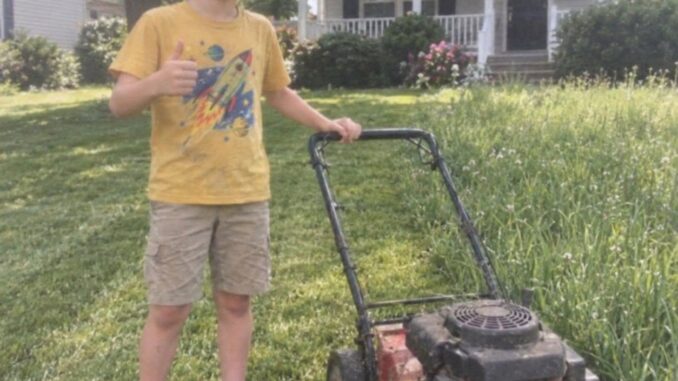
He wanted Evelyn’s daisies, her rosemary bush, and one small rose plant near her back porch. “She always tells me not to mow near that rose,” he explained.
I called Clara. She was silent for several seconds before whispering, “Yes. Please.”
So Saturday morning, we dug up the plants. Ethan treated every root like it was made of glass. We loaded everything into my car along with gardening tools and drove to Evelyn’s new residence. A maintenance worker had already cleared a narrow garden bed beneath her ground-floor window.
Ethan started with the daisies, digging meticulously in the soil. Halfway through planting the rosemary, I heard a patio door open.
Evelyn stepped outside accompanied by Clara. She looked at me, then at Ethan. Her face was completely blank.
For the first time, Ethan looked like a helpless kid who had arrived to fix something he couldn’t touch.
Evelyn’s eyes drifted toward the gardening tools beside him. Her expression shifted slightly.
“You’re the lawn boy,” she said.
Ethan immediately smiled, his eyes lighting up. “Ethan.”
Evelyn studied him for a long beat, then gave a small nod. “Right. Ethan.”
He pointed beneath her window. “I brought part of your yard.”
She walked over slowly and leaned down. Her fingers brushed the green leaves of the rosemary bush. She pinched one leaf, rubbed it between her fingers, and smelled it.
“Smells like home,” Evelyn smiled softly.
Ethan looked down quickly at his dirt-covered hands, but not before I saw his eyes brim with tears.
The following Saturday morning, the night before school started, I heard the garage door opening early. I smiled, assuming my son was finally retrieving his bike.
I walked to the front door and looked outside.
Ethan was walking down the driveway wearing his grandfather’s old work gloves. He had no lawn mower this time. Instead, he was carrying a bright blue watering can.
I stepped onto the porch. “Where are you going?”
He turned around like the answer should have been obvious. “Evelyn’s.”
“I thought you retired from lawn care.”
“From mowing,” Ethan rolled his eyes playfully, turning back toward the sidewalk. He lifted the watering can over his shoulder and grinned. “Evelyn’s flowers aren’t going to water themselves.”
FINAL PART
I stood on the porch and watched my twelve-year-old son walk down the sidewalk, the bright blue watering can swinging at his side.
For the rest of that fall, every Saturday morning followed the exact same routine. Ethan would finish his homework on Friday night, wake up early on Saturday, fill his watering can, and have me drive him over to the assisted living center.
At first, the visits were centered entirely around the small garden bed beneath Evelyn’s window. Ethan would weed the soil, trim the dead leaves from the rose bush, and carefully water the daisies. Evelyn would sit in a patio chair nearby, wrapped in a knitted cardigan, watching him with quiet interest.
Some days were good days. On those Saturdays, Evelyn would recognize Ethan immediately, calling him “the lawn boy” with a warm, mischievous smile, and tell him stories about how her father used to cultivate roses when she was a little girl in Ohio.
Other days were harder. On those Saturdays, she would stare at him with polite confusion, asking him three times in twenty minutes who he was and why he was tending her flowers.
The first time it happened, I saw Ethan’s shoulders tense, a flicker of hurt passing across his face. But he didn’t laugh, and he didn’t walk away.
“I’m Ethan,” he would say patiently every single time, offering her a warm smile. “I’m just taking care of your yard.”
And somehow, that simple reassurance was always enough to put her at ease.
By late October, as the autumn frost began to set in and the garden bed went dormant for the winter, Ethan’s visits didn’t stop. Instead, they moved inside to the community room. He would bring his school reading assignments, sitting across from Evelyn at a small card table while she worked on large-piece jigsaw puzzles.
Clara, Evelyn’s niece, visited often as well. The cold tension that had existed between us in Evelyn’s kitchen that frantic August afternoon had completely evaporated, replaced by a deep, mutual respect.
“I used to feel so guilty,” Clara admitted to me one Saturday in November as we watched Ethan help Evelyn place the final piece into a puzzle of a countryside barn. “I thought I was a terrible niece for not realizing how bad her memory was getting. But seeing Ethan with her… he gave her a dignity that preserved her independence for just a little bit longer. He gave us time to catch her before she fell.”
When spring arrived six months later, the tiny rose bush beneath Evelyn’s window bloomed with three vibrant, deep-red roses.
Ethan brought Evelyn outside to see them. She leaned over her walker, her frail fingers gently touching the velvet petals, a look of pure, childlike wonder on her face.
“They’re beautiful, aren’t they?” Ethan asked softly.
Evelyn looked up at him. For a brief, shining moment, her eyes were completely clear, devoid of the foggy haze that usually clouded her gaze.
“You took good care of them, Ethan,” she said, her voice clear and strong. “Thank you for coming back.”
She didn’t call him “the lawn boy.” She called him Ethan.
That night, after we drove home, Ethan sat at the kitchen table eating a bowl of cereal. He was taller now—his legs stretching out under the table, his shoulders broadening as he grew out of his seventh-grade clothes.
“Mom?” he said quietly, looking down at his cereal.
“Yeah, honey?”
“I used to think helping people meant fixing things,” he admitted, tracing the rim of his bowl with his spoon. “Like fixing a broken lawn mower or cutting tall grass. But with Evelyn… I couldn’t fix her memory.”
I sat down across from him, resting my hands on the table. “No, you couldn’t fix it. Nobody could.”
Ethan looked up, his brown eyes clear and thoughtful. “So I guess helping just means showing up anyway. Even when you can’t fix it.”
My heart swelled so much I could barely swallow the lump in my throat. I reached across the table and squeezed his hand—the same hand that had pushed an ancient lawn mower through the summer heat, dug up rose roots in the dirt, and held a watering can every Saturday morning.
“That’s exactly what it means, Ethan,” I whispered. “That’s the most important part of all.”
Ethan smiled, took another bite of cereal, and went back to complaining about his math homework. He was still a twelve-year-old boy who left his socks on the living room rug and forgot to put the milk back in the fridge. But as I watched him, I knew that whatever challenges the world brought his way, he had a heart strong enough to face them—one lawn, one flower, and one Saturday at a time.