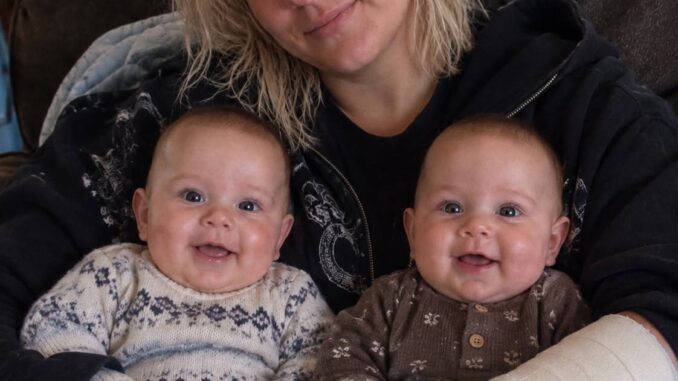
“Tell her I broke my arm,” I said, listing each fact slowly. “Tell her I asked you to help me, and tell her you said moms don’t get sick days.”
Silence filled the line.
Then Mason spoke again, his voice dropping into a desperate hiss. “You’re humiliating me.”
That was the exact moment I truly understood his entire perspective.
“You weren’t embarrassed when you said it,” I reminded him.
“What?” he asked.
“You weren’t embarrassed when I was begging you for help,” I said firmly. “You’re just embarrassed that someone else might find out.”
My hand was trembling so hard that I had to end the call immediately. Mom noticed the tension in my posture right away. She reached over gently toward my lap.
“Give him here,” she said, referencing Noah.
“I can hold him,” I insisted reflexively.
“I know,” she said quietly.
That simple response was so profoundly different from “You can’t.” I breathed out a long sigh and let her take him.
Mason arrived at my mom’s front door the very next evening looking absolutely furious. “My mother called me,” he said abruptly as soon as I stepped onto the porch to let him in. “She wanted to see you and the boys, so I had to tell her you weren’t home.”
“And?” I asked, watching him closely.
“She asked why,” he admitted, his jaw tightening.
“What did you tell her?” I asked.
“The truth, apparently,” he muttered, rubbing his neck.
That answer genuinely surprised me. Mason glanced past my shoulder toward the cozy living room.
“She asked whether I’d been helping since you broke your arm,” he continued.
“What did you tell her?” I pressed again.
“I told her you’re home with the boys, and I’m at work all day.”
I stood there and waited for the rest. Mason rubbed the back of his neck again, unable to meet my gaze directly.
“Then she asked why you had to leave the house just to get someone to help you,” he admitted softly.
“What did you say?” I asked.
“Nothing,” he whispered.
“Why not?”
His jaw tightened hard. “Because I knew how it sounded.”
Before I could say another word, Noah started crying from inside the house. Mason instinctively turned his head toward me, panic flashing across his eyes.
“Brianna?” he asked nervously.
I stayed right where I was on the porch step. “You’ve got him.”
“I don’t know what he wants,” Mason protested quickly.
“Neither do I yet,” I answered.
“You usually know,” he argued.
“I usually find out,” I corrected.
He hesitated for a long moment before stepping into the living room and lifting Noah from the crib. The crying immediately grew louder and sharper.
“See?” Mason called out in frustration. “I’m making it worse.”
“You’ve held him for ten seconds,” I noted, walking in slowly.
“What do I do?” he asked desperately.
A dozen quick answers lined up in my head, but I forced myself to hold them back. Instead, I simply said, “Start paying attention.”
He began pacing across the carpet far too quickly. Noah cried even harder against his chest. Mason caught himself, slowed his steps down to a gentle rhythmic sway, and within a minute, the infant’s crying softened into quiet sniffling.
“He’s stopping,” Mason said, sounding genuinely shocked.
“Yeah,” I said softly.
Mason looked down at the tiny baby in his arms. “You make this look so easy.”
“You told me I do nothing,” I reminded him softly.
“I know,” he admitted, bowing his head.
“Why?” I asked him directly.
He swallowed hard, his posture dropping. “Because every time I came home, you already knew what they needed, and I didn’t.”
“You could’ve learned,” I pointed out.
“I know.”
“Then why didn’t you?” I asked.
His voice dropped to a barely audible whisper. “Because I felt useless. Every time you asked for help, it just reminded me that I didn’t know what to do.”
“So you wanted me to stop asking,” I realized aloud.
He nodded slowly, looking down as Noah curled a tiny fist tightly into the fabric of his button-down shirt.
“Being scared doesn’t excuse what you said to me,” I told him firmly.
“I know,” he repeated.
For five long months, I had desperately wanted to see Mason holding one of our sons like that, with quiet care. Now he finally was.
A few days later, Mason sent a quick photo to my cell phone showing our sparkling, spotless kitchen counters at home.
“Cleaned everything. Come home?” the attached text read.
I stared down at the glowing screen for a minute, then typed back: “What time does Noah usually take his last bottle?”
The little animated typing dots appeared on my screen, stopped completely, appeared again, and then vanished. No text answer ever came back.
That same evening, Mason drove straight over to Mom’s house. “What do you want me to do, Brianna?” he asked as soon as he walked through the door.
“I want you to stop waiting for instructions,” I told him plain and simple.
“I’m trying,” he said, sounding exhausted.
“Then try without making me your manager,” I countered.
He sat down across from me on the armchair. “I cleaned the whole house, Brianna. I really thought you’d be happy about that.”
“I’d be much happier if you knew why Noah cries differently from Liam,” I answered.
Mason looked down at his own hands. “Then teach me.”
I almost yielded right then and there. The old version of me would have grabbed a pen and made another detailed list before he could even finish his sentence. Instead, I shook my head slowly.
“No,” I told him. “Watch them. Learn them. Be here long enough to actually know.”
His face tightened with sudden vulnerability. “And if I mess up?”
“You will,” I said plainly.
He looked up at me, startled by my response.
“So will I,” I added gently.
That realization clearly surprised him. I glanced down at the hard plaster cast encasing my forearm.
“I’ve spent weeks feeling like I’m failing because I can’t even lift my own sons,” I confessed softly.
“Brianna,” he began, taking a step forward.
“Let me finish,” I insisted, stopping him. “When this cast comes off, I get another chance to feel like their mother again. You can have a second chance too.”
Mason leaned forward eagerly. “At us?”
“At being better than you’ve been,” I clarified. I held his gaze without flinching. “But I’m not dragging you there.”
Over the next few weeks, Mason started showing up consistently before I even thought to ask. He left his office right on time twice a week, added the boys’ pediatric appointments directly to his personal work calendar, and learned through trial and error that Liam settled much faster against his chest while Noah usually needed constant rhythm before falling asleep. He still got things wrong from time to time, but I stopped stepping in to rescue him every single time he stumbled.
Three weeks later, my injured arm was healing exceptionally well, so I finally brought a few of our personal things back to the house. I did not bring everything back, however, and Mason noticed the remaining bags right away.
“You’re keeping clothes at your mom’s place?” he asked carefully.
“Yes,” I replied truthfully.
“Because you don’t trust me?” he asked, a hint of hurt in his tone.
“Because I’m learning to trust myself,” I explained calmly. “If this ever falls apart again, I won’t wait until I’m completely broken to do something about it.”
Late that night, Noah started crying loudly from the nursery down the hall. I reflexively started to rise from the bed, my bad arm held close to my body.
Mason was already moving before I could stand up. “I’ve got him,” he said smoothly, throwing off his covers. “That’s his tired cry.”
He vanished quickly down the dimly lit hallway. A minute later, the infant’s crying softened into complete silence. I reached over to the nightstand and picked up my warm cup of herbal tea. It was still perfectly hot.
For months, I had foolishly believed that being a good mother meant carrying every burden alone until I snapped. Then I broke my arm and learned something infinitely better. Good mothers do not have to prove how much pain they can survive, and fathers should never have to be begged to be fathers.