PART ONE — THE TWENTY MINUTES MY CHILDREN GAVE ME
The Camera Above the Pantry
“You sold Dad’s farm for three million dollars, and you’re keeping all of it? What kind of mother does that?”
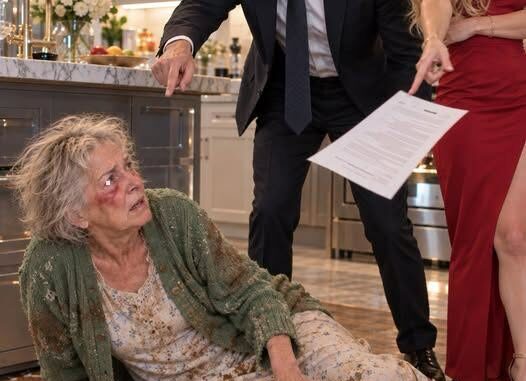
My daughter Rachel stood in my kitchen, brandishing a copy of the sale agreement at me. Next to her, my eldest son, Marcus, held a document he refused to let me see. Twenty minutes later, I would be en route to the hospital with a fractured rib, while both of my children would be explaining their actions to the sheriff.
But when Rachel first showed up that morning, I still held out hope that we could discuss things.
“Rachel, put the papers down. I’ve already clarified how I’m using the money.”
“You’ve clarified nothing. You keep saying it’s taken care of, as if we’re just a couple of kids asking for pocket money.”
“You’re forty-one years old. You don’t need pocket money.”
Marcus interjected, stepping between us.
“Be careful how you speak to her, Mom. We’re trying to resolve this reasonably.”
He was wearing the pricey navy jacket I had helped him buy for a job interview two years ago. He never secured that job, but he kept the jacket, apparently believing it made him look authoritative.
“Then sit down and talk to me,” I said.
“Fine. Sign this first.”
He set the document on the counter.
It was a power of attorney granting extensive authority over my finances. My name, Eleanor Carter, appeared at the bottom in a signature that closely resembled mine.
I hadn’t signed it.
“Where did you get this?”
Rachel exchanged a glance with Marcus.
“Our attorney prepared it,” she replied.
“What attorney?”
“Does that really matter?”
“It matters when someone has forged my signature on a document I haven’t seen.”
Marcus’s expression turned stern.
“Don’t start accusing us of things. We came here to help you make the right choice.”
I glanced at the small black camera positioned above the pantry door.
Its indicator light was illuminated.
Neither of them noticed.
What They Thought I Owed Them
My husband, Daniel, and I dedicated forty-three years to transforming Carter Farm from a neglected lot into nearly eight hundred productive acres. We raised cattle, cultivated apples, and leased some fields to nearby growers.
Daniel worked until his hands were permanently rough. I managed the accounts, negotiated equipment purchases, and learned to repair machinery because hiring someone for every tractor breakdown would have bankrupted us.
We raised Rachel and Marcus in that farmhouse.
They had cozy beds, meals on the table, college tuition, and every opportunity we could reasonably offer.
Neither had any interest in farming.
Marcus pursued business consulting, although he changed jobs so frequently that I eventually stopped asking where he was employed. Rachel opened a boutique with money Daniel and I lent her. When it failed, we helped settle her debts.
After Daniel passed away seven years ago, I continued to support them.
I paid off the last of Marcus’s student loans. I covered Rachel’s rent when she separated from her husband. Whenever either child needed assistance, I found a way to help.
The problem was that my help gradually morphed into something they came to expect.
Marcus no longer expressed gratitude for paying a bill. He complained if I didn’t pay it fast enough.
Rachel stopped asking if I could afford to help; she simply told me what she needed.
When my health began to hinder farm work, I decided to sell.
I offered both children a chance to take over the property on favorable terms. Neither showed interest.
“I’m not spending my life smelling like livestock,” Rachel told me.
Marcus’s reply was even more succinct.
“Sell it, Mom. You can split the money later.”
I didn’t argue.
Instead, I started discussions with Luis Mendoza, our longtime field manager, about forming a cooperative that would allow the people working the land to become its owners.
The process took nearly two years.
By the time the sale was finalized, I had arranged for the proceeds to fund agricultural scholarships, land preservation, and aid for struggling farming families.
I also set aside enough assets for my own retirement and medical needs.
I informed Rachel and Marcus that I wouldn’t be distributing the farm proceeds to them.
They were outraged.
Rachel insisted I stay at her house while I prepared to move into a smaller cottage on the property. She claimed she didn’t want me living alone during the transition.
I agreed, thinking she was being considerate.
Within a month, I found myself cleaning her bathrooms, doing her laundry, and preparing meals for people who hardly spoke to me.
One afternoon, I sat down because my back was hurting.
Rachel entered the kitchen, noticed the dirty dishes, and sighed.
“Mom, if you’re going to stay here, you could at least help out.”
“I’ve been cleaning since breakfast.”
“Well, I work all day. I can’t come home and do everything.”
I wanted to remind her that she hadn’t paid rent for almost six months because I was covering her mortgage.
Instead, I finished the dishes.
That was how I had managed my children for years.
I gave them what they wanted, hoping they would eventually stop asking.
The Forged Signature
Two weeks before the closing, I returned to my farmhouse.
Rachel called three times that first evening.
Marcus came by the next morning and demanded to know why I had changed the locks on the office.
“Because it’s my office,” I replied.
“You don’t have to be so secretive.”
“And you don’t need access to my financial records.”
He left without a word.
That afternoon, I contacted my attorney, Samuel Reed.
Samuel had been assisting me in organizing the sale and establishing the charitable trust. I informed him about Marcus’s visit and Rachel’s increasingly aggressive demands.
“Have either of them threatened you?” he asked.
“Not directly. But Marcus has grabbed my arm before, and Rachel keeps insisting I don’t grasp my own finances.”
Samuel fell silent for a moment.
“Eleanor, I don’t want you meeting with them alone regarding money anymore.”
He advised me to document their communications and enhance the house’s security.
I upgraded the cameras, activated cloud recording, and arranged for a monitored emergency alert.
I hoped I would never need any of it.
Then Rachel and Marcus arrived together on the morning of the closing.
Marcus pushed the forged power of attorney toward me.
“All we’re asking is for you to let us manage the money. You’re getting older, Mom. There’s no shame in admitting this is beyond your capabilities.”
“I’ve managed this farm’s finances since before you were born.”
“And you’ve made plenty of mistakes,” Rachel snapped. “Look how much money you wasted keeping this place running.”
I stared at her.
“That place funded your education. It paid for your wedding. It provided shelter when your business failed.”
“There it is,” she said. “Every time we disagree, you remind us of everything you’ve done. You love holding money over our heads.”
“I don’t want to hold anything over you. I want you to stop demanding what isn’t yours.”
Marcus slammed his palm against the counter.
“Enough. Sign the papers.”
“No.”
“Mom, don’t make this ugly.”
“It already is.”
He grabbed my arm.
I pulled away.
He shoved me against the counter, and when I attempted to move past him, he struck me hard in the side.
The pain took my breath away.
I stumbled into a bowl of apples, scattering them across the kitchen floor. My lip collided with the counter as I fell, and I tasted blood.
Rachel stood beside the refrigerator.
She didn’t help me.
“You see what happens when you push people too far?” she said.
I looked at my daughter, shocked more by Marcus’s violence than by the indifferent way she excused it.
“Rachel, call an ambulance.”
She crossed her arms.
“Sign the papers, and we’ll discuss getting you checked out.”
Marcus crouched beside me.
“Bank name. Account number. Password.”
I pressed my hand against my aching ribs.
“No.”
He glanced at Rachel.
“She still thinks she can wait us out.”
Then he took a folded paper from his jacket.
“Twenty minutes, Mom. That’s how long you have to cooperate.”
I glanced at the camera above the pantry.
The emergency alert had already been triggered.
“No, Marcus,” I said quietly. “You have twenty minutes.”
The Call They Didn’t Know About
Marcus believed I was bluffing.
He pulled a chair away from the table and sat down, keeping the forged document in front of him.
Rachel paced near the kitchen window.
“We don’t need to do this,” she muttered. “Mom, just tell us where the money is.”
“I told you. The proceeds are going into the trust.”
“You’d rather give millions to strangers than help your own children?”
“Those strangers worked alongside your father for decades.”
“So did we!”
I looked at her.
“Rachel, you left for college at eighteen. Marcus visited twice during the last harvest. Neither of you wanted the farm.”
Marcus leaned forward.
“We wanted what Dad intended us to have.”
“Your father wanted you to build your own lives. He never promised you the proceeds from selling our land.”
Rachel’s eyes brimmed with angry tears.
“You always thought we let him down.”
I took a painful breath.
“No. He was proud of you when you made an effort. He was concerned when you stopped taking responsibility for your choices.”
She looked away.
For a moment, I thought she might finally comprehend.
Then Marcus stood.
“I’m done listening to this. Where’s your phone?”
“In my pocket.”
He took it.
“You’re not calling anyone until we finish.”
I didn’t resist.
The security system had already sent its alert to the monitoring service. I knew that didn’t guarantee immediate help, and I was scared enough to feel every second ticking away.
But I also understood that arguing with Marcus while he was this enraged could escalate the situation.
He opened a drawer, searching for my checkbook.
Instead, he discovered a blue folder.
It contained copies of the correspondence I had sent both children three years earlier, offering them the chance to take over the farm.
Marcus unfolded his letter.
I observed his expression shift.
“You kept this?”
“Of course.”
Rachel moved closer.
“What’s that?”
He didn’t respond.
I recalled the email he had sent after receiving my offer.
Farming isn’t a serious future for me. Sell it and divide the cash.
Rachel had laughed when I asked if she’d consider managing the orchard.
Now she retrieved her own letter from the folder.
“That was years ago,” she said.
“Three years.”
“People change their minds.”
“You had three years to inform me.”
Marcus tossed the papers onto the table.
“We’re not discussing the farm anymore. We’re talking about three million dollars.”
He reached inside his jacket.
Rachel noticed what he was holding before I did.
Her face went pale.
“Marcus,” she whispered. “What are you doing?”
He placed a small handgun on the table.
“Making sure Mom finally listens.”
PART TWO — WHAT THE CAMERA RECORDED
The Moment Rachel Changed Her Mind
Rachel stepped back from the table.
“You told me we were only going to scare her into signing.”
Marcus regarded her with visible irritation.
“And that’s what we’re doing.”
“Not with that thing sitting there.”
“Then get her to cooperate.”
I remained in my chair, one hand pressed against my side. Every breath hurt, and I was afraid to move too quickly.
Marcus slid the forged document toward me.
“Last chance, Mom.”
“I can’t sign away money that isn’t mine to distribute.”
“You keep saying that as if we’re fools.”
“I’m telling you the truth.”
Rachel leaned over the table.
“Marcus, what if she’s right? What if the transfer is already arranged?”
He stared at her.
“You said Samuel hadn’t completed the paperwork.”
“I said I didn’t know if he’d finished.”
“That’s not what you told me yesterday.”
The argument shifted.
Until then, they had spoken as though they were united against me. Now Marcus was looking at his sister with the same suspicion he had directed toward me.
I watched Rachel avoid his gaze.
“What else haven’t you told him?” I asked.
“Stay out of this, Mom.”
“You brought him here. You gave him the papers. Did you inform him I offered you both the farm?”
Marcus looked at her.
“You knew about that?”
“Of course I knew. She sent us both letters.”
“You told me she was cutting us out without warning.”
Rachel’s cheeks flushed.
“Because that’s what she’s doing now!”
“No,” I said. “I asked you to help keep the farm in the family. You both refused. Now you’re demanding the money because someone else was willing to do the work.”
Marcus stared at the blue folder.
He picked up the letter again.
For the first time that morning, he seemed uncertain.
Then a vehicle door closed outside.
He turned toward the window.
“Who’s here?”
Rachel approached the curtains.
“I don’t know.”
Marcus picked up the handgun.
“Don’t touch those.”
She halted.
I could hear voices outside, although I couldn’t make out the words.
Marcus looked at me.
“Did you call someone?”
“You have my phone.”
His gaze shifted toward the pantry.
Then he noticed the camera.
“Is that thing recording?”
I remained silent.
He looked at Rachel.
“You told me she disconnected the security system.”
“She told me she was changing providers!”
I kept my voice steady.
“The new system records to the cloud. There’s also a monitored emergency alert.”
Marcus stared at the camera.
“How long has it been on?”
“Since before you arrived.”
Rachel sank into a chair.
“Oh, Marcus.”
He turned on her.
“Don’t start blaming me. You wanted the money as much as I did.”
“I didn’t want you to hurt her!”
I looked at my daughter.
“You watched him do it.”
She opened her mouth, then closed it.
For once, she had no response.
The Officers at the Door
A voice rang out from outside.
“Sheriff’s Office! Everyone inside, stay where you are and keep your hands visible!”
Marcus stepped back.
Rachel began to cry.
“Put it down,” I urged him.
“Be quiet.”
“Marcus, listen to me. Whatever you think you’re owed, this isn’t going to get it for you.”
He glanced toward the door.
“Tell them it’s a family disagreement.”
“They already know someone was hurt.”
“Then tell them Rachel did it.”
Rachel stared at him.
“Excuse me?”
“You forged the papers. You wanted her money. Tell them you got angry.”
“You hit her!”
“And you stood there cheering me on!”
Their voices escalated until neither seemed to hear the other.
I glanced at the blue folder lying open on the table. Daniel’s handwriting appeared on one of the old letters, a note he had added when we first offered the farm to our children.
We hope you’ll consider it. Whatever you decide, we’ll always love you.
I remembered him writing those words.
He believed giving our children a choice was the right thing to do.
So did I.
Outside, the deputy repeated his instruction.
Marcus was breathing heavily. He looked at the handgun, then at Rachel.
“You ruined this,” he told her.
“No,” she replied, wiping her face. “We both did.”
He reached for the table.
“Don’t,” I warned.
He halted.
“Mom, tell them to go away.”
I shook my head.
“I can’t do that.”
For a moment, he resembled the boy who used to come to me when he’d broken something and wanted me to fix it before Daniel found out.
But I couldn’t fix this.
And I wasn’t going to lie for him again.
Marcus slowly withdrew his hand from the weapon.
“I’m putting it down,” he called toward the door.
He stepped back and raised his hands.
Rachel did the same.
When the deputies entered, they secured the handgun, separated my children, and brought paramedics inside.
I was taken to the hospital with a fractured rib and injuries to my face.
Rachel and Marcus were arrested.
As a deputy escorted Marcus toward the patrol car, he turned to me.
“Mom, you can’t let them do this. Tell them we didn’t mean it.”
I looked at him.
“I warned you to leave.”
“We’re your children!”
“I know.”
He waited for more.
There was nothing else I could say.
What Was Inside the Blue Folder
Samuel Reed visited me at the hospital that afternoon.
He carried the same blue folder the deputies had photographed in my kitchen.
“How are you feeling?” he asked.
“Like someone dropped a tractor on me.”
He smiled briefly.
“The doctor says you’ll recover, but you need to rest.”
“What happened with the sale?”
“It closed this morning. The proceeds have been distributed according to the documents you signed before today.”
I exhaled.
“And the trust?”
“Funded. The trustees will begin administering it under the terms we established.”
I closed my eyes.
For months, I had worried that my children would somehow interfere with the sale.
Now the farm belonged to the cooperative, and the funds were allocated for the purposes Daniel and I had discussed long before his passing.
Samuel opened the folder.
“There’s something else we should discuss.”
He showed me a copy of the forged power of attorney.
“The document they presented wasn’t valid. Your signature appears to have been copied from another record. The authorities will investigate how it was prepared.”
“Rachel claimed an attorney made it.”
“We haven’t found evidence that an attorney authorized the document. But the police will need to determine who was involved.”
I stared at my name.
It looked nearly perfect.
Rachel had observed me sign checks and contracts for years. Marcus had access to old business files. Either of them could have replicated my signature.
“They genuinely believed they could take everything,” I said.
Samuel closed the folder.
“They were relying on you being frightened enough to cooperate.”
I gazed out the hospital window.
“For years, I gave them money because I thought it would maintain the peace.”
“And did it?”
I shook my head.
“No. It merely made the next demand larger.”
The Farm They Refused to Inherit
Three weeks later, I visited Carter Farm for the first time since the attack.
Luis met me beside the old barn.
He had worked with Daniel for twenty-six years, starting as a seasonal employee before becoming our field manager. He knew every drainage ditch, every troublesome fence, and every apple tree that needed extra care.
Now he represented the cooperative that owned the property.
“You should still be resting,” he said when I climbed out of the car.
“I’ve been resting for three weeks. I’m going stir-crazy.”
He chuckled.
“Come on. I’ll show you what we’ve accomplished.”
We walked slowly past the equipment shed.
Several workers were repairing irrigation lines. Near the orchard, two younger employees were discussing plans for next season’s crop.
Luis explained that forty-three families held membership interests in the cooperative.
“Nobody gets rich overnight,” he said. “But they’ll have a voice in how the farm is managed. That’s something they never had before.”
I looked toward the fields.
“Daniel would have appreciated that.”
“He would have argued about the equipment budget.”
I laughed, then winced at the pain in my side.
“He certainly would.”
Luis stopped beside the west orchard.
“You know, Eleanor, when you first talked about selling to us, I thought you were joking.”
“Why?”
“Because most owners don’t give workers a chance to buy the land. They sell to whoever offers the highest price.”
“You helped us build this place.”
He nodded.
“And you provided us a way to keep it going.”
For the first time since that morning in my kitchen, I felt something other than sorrow or anger.
The farm was still thriving.
That mattered more than seeing my name on a deed.
The Consequences My Children Couldn’t Avoid
The criminal case took several months.
Investigators utilized the camera recordings, the forged document, medical records, and witness statements to establish what transpired.
Marcus’s attorney attempted to portray the confrontation as a heated family argument that escalated.
But the footage depicted him demanding my banking information, striking me, and brandishing a weapon while coercing me to sign.
Rachel’s attorney contended that she hadn’t anticipated Marcus becoming violent.
The recording also showed her refusing to assist me and using my need for medical attention as leverage.
Both ultimately accepted plea agreements involving criminal penalties and restitution obligations.
Marcus received a prison sentence. Rachel received a shorter sentence and was required to participate in court-ordered programs addressing her conduct.
I attended the sentencing hearings.
Marcus wouldn’t look at me.
Rachel did.
Before she was taken away, she asked if I would visit.
“I don’t know,” I replied.
She began to cry.
“I’m sorry, Mom.”
“I hope you mean that.”
“I do.”
I wanted to trust her.
But I was finally learning that believing someone and trusting them were not the same.
Months later, I received a letter from Rachel.
She wrote about working in the facility’s laundry department and how much she disliked being ordered around all day.
Then she wrote something that made me stop reading.
I keep thinking about how I treated you when you lived with me. I called you lazy while you cleaned my house and paid my bills. I never considered what that must have felt like.
I read the letter twice.
Then I placed it in a drawer.
I didn’t respond immediately.
For once, I allowed myself to decide what I wanted rather than what someone else expected.
A Different Kind of Inheritance
By autumn, I had moved into the cottage beside the west orchard.
My younger sister, Clara, came to assist me in settling in. We hadn’t been particularly close for years, partly because she disagreed with how much money I gave Rachel and Marcus.
One evening, we sat on the porch with mugs of tea.
“You know what Daniel used to tell me?” Clara asked.
“He told everyone plenty of things.”
She smiled.
“He said you could negotiate with the toughest equipment salesman in three counties, but you couldn’t say no to your own children.”
I looked down at my mug.
“He was right.”
“You were trying to protect them.”
“I was trying to shield myself from seeing them disappointed.”
Clara nodded.
“That sounds more accurate.”
The cooperative held its first harvest celebration in October.
Families gathered beside the barn, children carried baskets of apples, and Luis gave a brief speech about the people who had kept the land productive for generations.
The trust announced its first scholarships for students from farming families.
One recipient was Luis’s grandson, Mateo, who aspired to study agricultural engineering.
Another was a young woman whose parents had nearly lost their dairy farm after a series of tough seasons.
I watched them receive their certificates and reflected on the money Rachel and Marcus had demanded.
They had labeled it their inheritance.
But the farm had always been more than something to inherit.
It had been a place where people worked, learned, struggled, and built lives.
Now it would continue to do that.
The Letter I Finally Answered
Nearly a year after the attack, another letter arrived from Rachel.
This one was shorter.
Mom, I know saying I’m sorry doesn’t mean you have to forgive me. I’ve spent a lot of time blaming Marcus for what happened, but the truth is I wanted your money, and I treated you terribly long before he hurt you. I don’t expect you to send anything. I just wanted you to know I’m trying to change.
I sat at the kitchen table for a long time.
Then I took out a sheet of paper.
Rachel,
I hope you continue making better choices. I want you to have a good life, but I won’t pay your debts or take responsibility for your decisions anymore.
I am willing to speak with you when you’re ready to respect those boundaries.
Love, Mom.
I mailed it the next morning.
Marcus also wrote to me, although his initial letters were mostly complaints about his attorney and accusations that I had ruined his life.
I didn’t respond to those.
Eventually, he sent one that began differently.
Mom, I know I hurt you. I know I frightened you. I don’t have an excuse.
I kept the letter.
I wasn’t ready to reply.
Perhaps someday I would be.
The Orchard in October
Two years later, I stood beneath the oldest apple tree on the farm, watching the cooperative prepare for another harvest celebration.
Luis was assisting a group of teenagers unload folding chairs. Clara was cheerfully arguing with a volunteer about where the food tables should be placed.
My granddaughter Lily, Rachel’s daughter, ran toward me carrying a small brass compass that had belonged to Daniel.
“Grandma, does this still work?”
I took it from her and opened the lid.
The needle trembled, then settled toward north.
“It certainly does.”
“Mom said Grandpa used to carry it everywhere.”
“He did. Even when he knew exactly where he was going.”
Lily laughed.
“That’s silly.”
“He said it reminded him to pay attention.”
She examined the compass.
“Can I keep it?”
I hesitated, recalling Daniel slipping it into his pocket before heading to the fields.
Then I closed her fingers around it.
“I think he’d like that.”
Across the orchard, Rachel waved to us.
She had completed her sentence and was rebuilding her life. She had found work, rented a small apartment, and started paying her own expenses.
Our relationship was still cautious.
We met for lunch occasionally. She called before visiting. When I said I was busy, she accepted it without arguing.
Marcus remained responsible for rebuilding his own life as well. I hadn’t promised him a place on the farm or access to the trust.
Those decisions were no longer mine to make.
Lily ran back toward her mother, holding the compass carefully in both hands.
I watched Rachel kneel to listen as her daughter excitedly explained how the needle worked.
Then Luis called me over to see the new orchard equipment.
I walked toward the barn, passing workers who greeted me as I went.
Behind us, the fields stretched into the afternoon sunlight.
The farmhouse where Daniel and I had raised our children was no longer mine, but the land was still being tended to. The people who worked it had a future there.
And in my cottage, the little black camera above the pantry remained switched on.
I hoped I would never need its recordings again.
That evening, when the celebration concluded, I returned home to find a basket of fresh apples waiting beside my door.
There was a note from Luis.
First harvest from the cooperative. We thought you should have the first basket.
I carried the apples into the kitchen, washed one, and placed the rest in a bowl on the counter.
Then I sat down at my own table, in my own home, and
enjoyed the tranquility.