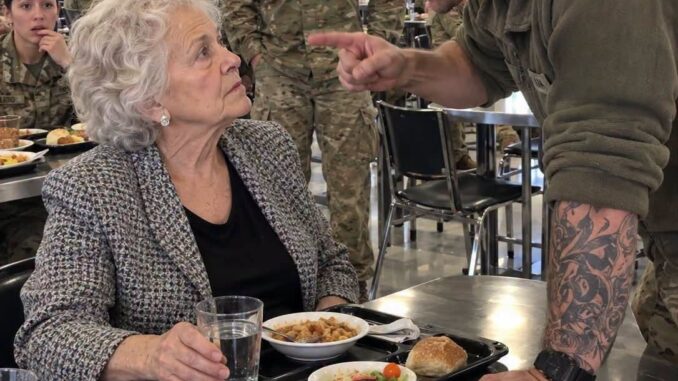
“Hey, Grandma. What was your rank back in the Stone Age?”
I didn’t glance up. I had driven forty minutes for that chili.
“I’m addressing you, ma’am.”
Three of them loomed over my table. The one speaking appeared to be around twenty-seven. He had a neck like a fence post and arms to match, with a voice accustomed to being heard.
The name tag on his chest read REESE. Three chevrons and a rocker. A staff sergeant.
I’m Quinn Braddock. I’m eighty-one years old. I reside alone in Clarksville, Tennessee, in a yellow house with too many stairs. I worked as a school nurse at Burt Elementary for thirty-one years.
Before that, a long time before that, I was something different.
That Thursday in October, I sat in the large dining facility at Fort Campbell, Kentucky. I wore my nice gray wool coat and my church shoes. Everyone else in that room was clad in camouflage and young enough to be my grandchild.
“This is a military base,” Sergeant Reese stated. “You need a pass to be in here. Or did you just wander over from the retirement home for a free lunch?”
His two companions chuckled.
The atmosphere began to shift. You know how it goes. The chatter diminishes. You start hearing forks scraping against trays. People are listening while attempting to look nonchalant.
I set my spoon down next to the bowl.
That seemed to infuriate him more. He placed his tray on the next table and laid both of his hands flat on mine. He had a tattoo of an eagle on his right forearm.
“Look at me when I’m speaking to you. We have standards here. We don’t allow just anyone to stroll in and occupy a table in my dining facility. So I’ll ask you again. Who are you, and what are you doing on my post?”
A young private at the adjacent table glanced up. She couldn’t have been twenty. She opened her mouth to say something. Then she noticed his stripes and closed it again.
I finally turned my head and met his gaze.
He had a decent face beneath all that hostility. He resembled a boy who’d been told his whole life he was the strongest one in the room, and never once had a reason to doubt it.
I looked at his name tag. I examined the patch on his left shoulder.
Then I focused on the small enameled crest pinned above his right breast pocket. The one that indicates which battalion a soldier belongs to.
A blue shield featuring a white heron with wings spread wide.
I didn’t utter a word. I picked up my water glass.
“What, are you deaf?” one of the others remarked.
“I asked you for ID,” Sergeant Reese stated. He snapped his fingers twice, right in front of my face. “Now. Let’s see it.”
He had no authority to ask. A sergeant can’t demand identification from a visitor in the chow line. That’s the job of the military police. Everyone in that room was aware of it.
I had a visitor’s pass. It was in my purse, on a blue lanyard, with my photo on it, issued that morning at the Gate 4 visitor center.
I didn’t pull it out.
I possess a stubborn streak that my late husband, Walt, used to call the eighth wonder of the world. I hadn’t come all that way to present my papers to a boy.
I took a sip of water. My hand was steady. It’s the one part of me that still is.
His face had turned red. He’d initiated this in front of two hundred soldiers, and it wasn’t unfolding as he had envisioned.
“That’s enough,” he said. “You and I are going for a walk to the gate. Stand up.”
I didn’t stand up.
He straightened himself. He scrutinized me, from my white hair down to my church shoes, searching for something else to use against me.
And he found it.
On the collar of my gray coat, there’s a pin. It’s small. The brass has darkened with age. The blue enamel is chipped on one corner.
It’s a blue shield with a white heron, wings extended wide.
It’s identical to the one on his chest. Mine’s simply fifty-six years older.
He stared at it.
Then he jabbed his finger at it, an inch from my throat.
“Where did you acquire that?”
I set my glass down.
“That’s my battalion’s crest,” he said. His voice trembled now. With anger. “Men bled for that. Men died for that. You don’t purchase it at some flea market in Hopkinsville and pin it on your coat for a free lunch. Remove it.”
“No,” I replied.
It was the first word I’d spoken to him.
“Remove it. Or I’ll take it off for you.”
The young private at the next table rose. I shook my head at her slightly, and she halted.
I gazed up at that young man. Then I looked past his shoulder. At the wall over the serving line.
There are words painted on that wall. Blue letters, a foot high, spanning thirty feet of cinder block. He’d eaten his lunch beneath them every day for three years.
“Sergeant,” I said. “Before you lay your hands on me, I’d like you to turn around and read what it says on that wall.”
He didn’t move for a moment.
“I know what it says,” he replied.
“Then it won’t take you long. Read it to me. Aloud.”
The room was so silent now you could hear the steam table hissing.
Something in my voice must have resonated with him. Because gradually, Staff Sergeant Reese turned around.
And he read it.
“We Carry Our Own.”
That’s the battalion motto. Every soldier in that unit learns it on their first day.
“Keep going,” I urged.
Below the motto, in smaller blue letters, there was a second line. Most soldiers never bother to read it. It’s merely part of the wall. Like a fire extinguisher. Like the clock.
He read it slowly. I observed his lips move.
“This dining facility is dedicated to First Lieutenant Quinn Hollis, Army Nurse Corps, who carried forty-one of ours home. May 1969.”
He paused.
He remained there with his back to me for a long time.
Then, very slowly, Staff Sergeant Reese turned around and looked down at the woman in the gray coat.
“Ma’am,” he said. His voice had softened. “What did you say your name was?”
“I didn’t,” I replied. “You never asked. You asked my rank.”
I folded my hands on the table.
“It was first lieutenant,” I stated. “And my maiden name was Hollis.”
You could have heard a pin drop in that dining hall.
Sergeant Reese’s face shifted from red to white so quickly I thought he might faint.
His two companions had retreated about three steps. One of them was staring at the wall as though he’d never seen it before in his life.
And from the back of the room, near the double doors, I heard a deep voice.
“Staff Sergeant Reese.”
The entire room turned.
A tall man in his fifties was striding down the center aisle between the tables. Gray at the temples. Four stripes, three rockers, and a star in the middle on the front of his uniform. The command sergeant major of the battalion. The senior enlisted man in the entire unit.
Alongside him walked a lieutenant colonel. The battalion commander. A wiry man named Gerald Ortiz, holding a clipboard under his arm.
They had come to meet me. We had a one o’clock appointment. I had arrived early for the chili.
Command Sergeant Major Darnell Hayes halted beside my table. He looked at Reese. Then he glanced at me.
Then he did something I’ll always remember.
He stood at attention. Right there between the tables. Heels together. Shoulders back.
And he saluted me.
“Ma’am,” he said. “Welcome home to the Herons.”
Every soldier in that room, two hundred of them, stood up simultaneously. Chairs scraping on the linoleum. Trays rattling.
The young private at the next table was in tears.
Sergeant Reese stood frozen beside my chair. He didn’t know what to do with his hands.
I stood up. It took me a moment. My knees aren’t what they were in 1969.
I returned the salute. Not as sharp as it used to be. But I still remembered how.
“At ease, Sergeant Major,” I said. “Please. Everyone take a seat. Your chili’s getting cold.”
Nobody sat down.
Lieutenant Colonel Ortiz stepped forward and shook my hand with both of his.
“Mrs. Braddock,” he said. “I’m very sorry. We were coming to get you at the visitor center. You arrived before us.”
“It’s Chili Thursday,” I replied. “I wasn’t going to miss it.”
Then he turned to Sergeant Reese.
He didn’t raise his voice. He didn’t need to.
“Staff Sergeant,” he said. “My office. Thirteen-thirty. Bring your first sergeant.”
“Roger, sir,” Reese replied. His voice cracked on it.
He looked at me. His eyes were moist.
“Ma’am,” he said. “I’m…”
“Not now, son,” I said softly. “You go on. We’ll discuss it later.”
He exited that dining hall with two hundred soldiers observing him leave, and the double doors swung shut behind him.