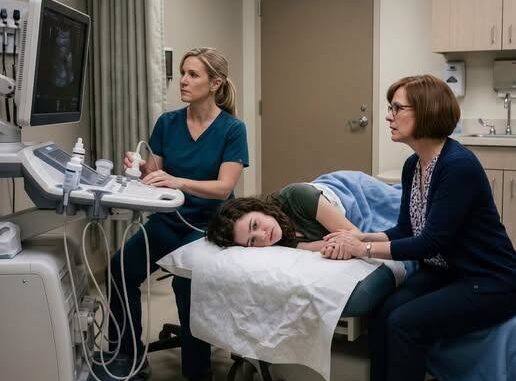
My daughter was fifteen when she finally looked at me and quietly said, “I stopped telling Dad when it hurts. He claims I’m just seeking attention.”
The next afternoon, I signed her out of school and took her to the hospital without informing my husband. Midway through the scan, the technician abruptly fell silent.
Then the doctor entered, shut the examination room door, and posed one chilling question: “How long has her father been aware of this?”
The room was filled with the sharp scent of sanitizer, and the paper beneath my daughter crinkled each time she moved. I stared at the doctor, as his question made no sense.
“He doesn’t know,” I replied. “I didn’t inform him we were coming.”
The doctor looked at my daughter, then back at me.
“I’m not inquiring about today.”
He turned the monitor towards me and opened an older entry in her medical records. Five weeks prior, my daughter had been assessed for precisely the same pain.
Her father was listed as the parent who had brought her in. The note indicated that additional imaging had been advised because her symptoms warranted further investigation.
I hadn’t known there had been a prior visit.
My daughter pulled the sleeves of her gray hoodie over her hands and focused on the edge of the examination bed.
“Did Dad take you?” I inquired.
She nodded.
The doctor maintained a calm tone. What they were observing now needed urgent attention and further testing. He wasn’t blaming anyone; he was attempting to understand why the recommended follow-up had never occurred.
So was I.
My name is Rebecca Mitchell. I’m forty-one years old, and until that afternoon, I believed my husband and I made every significant decision regarding our daughter together.
Our daughter, Grace, had always been a joyful, diligent teenager who loved drawing, playing volleyball, and spending Saturday afternoons baking chocolate-chip cookies with me.
She wasn’t the type of child to complain easily. Even when she fractured her wrist from falling off a bicycle at eleven, she apologized for interrupting our dinner.
So when she began mentioning ongoing pain in her lower abdomen, I sensed something was amiss.
Initially, the discomfort fluctuated.
Grace described it as a dull ache on her right side, sometimes radiating toward her back. Occasionally, it became sharp enough to disrupt her focus.
I suggested scheduling a doctor’s appointment.
My husband, Daniel, quickly dismissed the suggestion.
“She’s fifteen, Rebecca. Teenagers get stomachaches. Stop teaching her to panic over every minor discomfort.”
Daniel was a senior sales executive at a regional construction firm. He was assertive, outspoken, and used to having the final say.
Throughout our seventeen years of marriage, I gradually learned that disagreeing with him often led to prolonged arguments and uncomfortable silence.
He wasn’t always unkind.
He could be warm and generous, especially in front of others. But at home, he had little tolerance for anything that disrupted his plans.
As Grace’s illness progressed, his impatience intensified.
One evening, she came downstairs clutching her side.
“Dad, it really hurts tonight.”
Daniel barely glanced away from the television.
“Then stop eating junk food.”
“I haven’t eaten anything unusual.”
He sighed dramatically.
“Grace, not everything needs to become a medical emergency. You’re always looking for attention lately.”
She fell silent.
I recall how her shoulders slumped before she turned and went upstairs.
I followed her, but she insisted she was fine.
Now I comprehend why.
She had learned that admitting pain could lead to another argument.
In the weeks that followed, Grace became more withdrawn. She stopped going to volleyball practice and began spending most evenings curled up in her bed.
Her appetite diminished.
She lost weight.
Sometimes, when I checked on her at night, I found her awake, pressing a heating pad against her abdomen.
I asked Daniel again to help set up an appointment.
He told me he had already taken care of it.
“I took her to a clinic while you were working,” he said. “They said it was probably nothing serious.”
I felt relieved.
“What did they suggest?”
“Rest. Better eating habits. The usual.”
“Did they prescribe anything?”
“No.”
I inquired if there was any paperwork.
Daniel grew annoyed.
“Rebecca, do you need a written report every time I do something for our daughter?”
I withdrew from the conversation.
That choice would haunt me later.
Because Daniel had taken Grace to a hospital.
And the doctors hadn’t assured him everything was fine.
Five weeks before our second hospital visit, Grace had experienced severe pain at school. The nurse contacted Daniel since I was attending an out-of-town conference.
He picked her up and took her to the emergency department.
The physician examined Grace, ordered preliminary tests, and identified an abnormal finding that needed further imaging and specialist follow-up.
But Daniel didn’t arrange the appointment.
Instead, he brought her home and told her that the doctors believed she was exaggerating her symptoms.
Grace trusted him.
Why wouldn’t she?
He was her father.
She relied on him to inform her of the truth about her health.
The first time I realized how scared she had become was on a Tuesday evening when I found her sitting on the bathroom floor.
Her face was pale.
She had one arm wrapped around her stomach.
“Grace?”
She looked up quickly.
“I’m okay, Mom.”
I knelt beside her.
“You don’t look okay.”
She attempted a smile.
“It’s just the same pain.”
I touched her forehead.
“Sweetheart, why didn’t you tell me it was getting worse?”
Her eyes brimmed with tears.
Then she whispered the words I will never forget.
“I stopped telling Dad when it hurts. He says I’m just doing it for attention.”
Something shifted within me.
I had spent months trying to maintain harmony between my husband and daughter, believing his harshness stemmed from mere frustration.
But gazing at Grace, I finally realized that our silence was costing her something far more vital than peace.
It was costing her the confidence to seek help.
I cradled her face gently in my hands.
“Listen to me, sweetheart. Pain is not something you need permission to discuss.”
She began to cry.
“I don’t want Dad to be angry.”
“He doesn’t have to agree with us for you to see a doctor.”
The next afternoon, I signed Grace out of school and drove straight to the hospital.
I didn’t contact Daniel.
I didn’t seek his approval.
I simply told my daughter that we were going to discover what was wrong.
At the hospital, Grace underwent blood tests and an ultrasound examination. The technician carefully maneuvered the probe across her abdomen while observing the monitor.
For several minutes, everything seemed standard.
Then the technician grew unusually quiet.
She adjusted the machine, took additional images, and asked Grace to stay still.
I noticed her expression change.
“Is something wrong?” I asked.
She explained that the radiologist would evaluate the images and that a physician would discuss the results with us.
Twenty minutes later, Dr. Andrew Collins entered the examination room.
He closed the door.
Then he inquired about Daniel.
When he showed me the previous medical record, I felt as though the ground had vanished beneath me.
Five weeks.
For five weeks, my husband had known doctors wanted further investigation.
For five weeks, he had told our daughter she was seeking attention.
And for five weeks, he had allowed me to believe that a medical professional had already ruled out anything serious.
“What are you seeing now?” I asked.
Dr. Collins pulled up the latest images.
“There appears to be a sizable mass near your daughter’s right ovary. We need further imaging and specialist evaluation to determine exactly what it is.”
My heart began to race.
“A mass?”
He nodded.
“Many ovarian masses in adolescents are benign, but this one requires prompt assessment, especially due to her worsening pain.”
Grace gazed at the monitor.
“Do I have cancer?” she whispered.
The doctor turned toward her.
“We don’t know that, Grace. And I don’t want you to assume the worst. We’re going to investigate thoroughly and explain each step.”
I reached for her hand.
It was cold.
The doctor continued to explain that the mass could be related to an ovarian cyst or another condition. Further testing would help determine the safest treatment.
He also stressed that certain complications, including twisting of the ovary, could cause severe pain and necessitate urgent surgery.
Grace’s symptoms concerned him enough to request immediate consultation with the gynecology team.
I tried to focus on his words.
But one question kept echoing in my mind.
Why had Daniel concealed this?
When Dr. Collins stepped outside, I turned to Grace.
“Sweetheart, what transpired during your first hospital visit?”
She pulled her knees closer.
“Dad said they were wasting our time.”
“Did the doctor discuss another scan?”
She nodded.
“He mentioned wanting to examine more closely. But Dad got upset because he had an important meeting.”
I closed my eyes.
Grace continued quietly.
“He told the nurse we couldn’t stay. Then he said he’d schedule another appointment.”
“Did he?”
She shook her head.
“Every time I asked, he said I was being dramatic.”
Tears streamed down her cheeks.
“I thought maybe I really was making it worse in my head.”
I moved beside her and wrapped my arms around her shoulders.
“You weren’t imagining anything.”
She began to sob.
“I’m sorry, Mom.”
I held her tighter.
“You have absolutely nothing to apologize for.”
A few minutes later, my phone rang.
Daniel.
I looked at his name on the screen.
I didn’t answer.
He called again.
Then a message appeared.
“School called. Why did you take Grace out early?”
I typed a brief reply.
“We’re at the hospital. She’s being evaluated.”
His response came almost instantly.
“Are you serious? I told you there was nothing wrong with her.”
I stared at the words.
Then I wrote:
“The doctor found the record from five weeks ago. We need to discuss why you never informed me.”
For several minutes, there was no reply.
Then my phone rang again.
This time, I answered.
Daniel didn’t bother with a greeting.
“Rebecca, you’re making a huge mistake.”
I stepped into the hallway.
“What mistake?”
“Letting doctors scare Grace over something harmless.”
“Daniel, they found a mass.”
There was silence.
Then he said, “They mentioned something like that before.”
My stomach tightened.
“You knew?”
“It wasn’t confirmed.”
“They recommended more tests.”
He sighed.
“I had work responsibilities. We couldn’t spend every day running to hospitals.”
I leaned against the wall.
“Grace has been in pain for weeks.”
“She’s always complaining about something.”
For the first time, I didn’t try to soothe him.
“Stop.”
He fell silent.
“Do not label our daughter an attention seeker again. She’s frightened, she’s hurting, and she’s receiving medical care.”
Daniel’s voice grew stern.
“I’m her father.”
“And I’m her mother. Right now, I’m with her.”
I ended the call.
My hands trembled, but I felt oddly clear-headed.
There would be time to confront Daniel later.
At that moment, Grace needed me.
Later that afternoon, additional imaging confirmed a large ovarian mass requiring surgical evaluation. The medical team explained the possible causes and treatment options.
They also clarified that imaging alone couldn’t reveal every detail, and that the final diagnosis might depend on findings during surgery and laboratory analysis afterward.
Grace was admitted for monitoring.
A specialist named Dr. Elena Ramirez came to speak with us that evening.
She sat beside Grace’s bed rather than standing over her.
“Grace, I want you to understand something important,” she said. “You did the right thing by telling your mother you were in pain.”
Grace looked down.
“I thought I was being a nuisance.”
Dr. Ramirez shook her head.
“Your symptoms are real. You deserve to be listened to.”
I saw my daughter’s eyes well up with tears.
The specialist explained that the team was worried about the size of the mass and the potential for complications. Surgery was recommended.
They would aim to preserve healthy ovarian tissue whenever possible.
Grace listened attentively.
Then she asked if she would be able to play volleyball again.
Dr. Ramirez smiled gently.
“That’s certainly something we hope for. First, we’re going to help you recover safely.”
That night, Daniel arrived at the hospital.
I was sitting beside Grace when he appeared in the doorway.
He looked irritated rather than alarmed.
“Why didn’t anyone inform me she was being admitted?”
Grace immediately tensed.
I stood.
“Let’s talk outside.”
Daniel glanced at our daughter.
“Grace, this has gotten completely out of hand.”
I stepped between them.
“Outside, Daniel.”
In the hallway, he lowered his voice.
“Rebecca, you’re embarrassing me.”
I stared at him.
“Our daughter may require surgery, and you’re concerned about being embarrassed?”
He rubbed his forehead.
“You don’t understand how costly all these tests can become.”
“We have insurance.”
“That doesn’t mean everything is free.”
I felt a wave of disbelief.
“Is that why you didn’t arrange the follow-up?”
He hesitated.
Then he confessed that he had been worried about medical bills and missing work during a time when his company was assessing employee performance.
He had convinced himself that Grace’s symptoms would eventually subside.
And when they didn’t, he grew angry because her pain reminded him of a problem he had chosen to ignore.
I listened without interrupting.
Then I asked one question.
“Did you ever consider how scared she must have felt?”
Daniel looked away.
“She knew I was trying to help.”
“No,” I said. “She thought you didn’t believe her.”
He didn’t respond.
I told him that Grace needed calm, supportive adults around her and that I wouldn’t permit him to dismiss her symptoms during treatment.
He accused me of turning our daughter against him.
I refused to argue.
Instead, I asked the nurse to help ensure Grace’s wishes regarding visitors were honored while the medical team continued her care.
Daniel left shortly after.
The following morning, Grace underwent surgery.
I waited in the family lounge for nearly three hours, staring at the same page of a magazine without absorbing a single word.
My younger sister, Claire, arrived with coffee and sat beside me.
When I explained what had happened, she held my hand.
“You couldn’t have known what he kept from you.”
I shook my head.
“But I knew Grace was in pain. I should have pushed harder.”
Claire squeezed my fingers.
“You’re here now. Focus on what she needs next.”
Eventually, Dr. Ramirez entered the waiting area.
I stood so quickly that my coffee spilled.
“Is she okay?”
The doctor smiled reassuringly.
“Grace is stable. The surgery went well.”
My knees weakened with relief.
She explained that the team had removed a large ovarian cystic mass and had been able to preserve healthy tissue. Samples were sent for pathology testing.
The final laboratory results would take several days.
When I was permitted to see Grace, she was resting in a recovery room, her face pale but serene.
She opened her eyes when I approached.
“Mom?”
“I’m here.”
“Did they fix it?”
I brushed her hair away from her forehead.
“They removed the mass, sweetheart. The doctors are taking excellent care of you.”
She offered a small smile.
“Does that mean I’m not dramatic anymore?”
The question nearly broke me.
I leaned closer.
“You were never dramatic, Grace. You were courageous enough to keep telling us something was wrong.”
She closed her eyes.
For the first time in weeks, she appeared relieved.
Three days later, the pathology report confirmed that the mass was benign.
I cried when Dr. Ramirez told us.
Grace cried too.
But the doctor reminded us that benign didn’t mean harmless. The mass had caused significant symptoms and required treatment.
We were thankful that Grace had received care before more serious complications arose.
When Daniel learned the results, he sent a message.
“See? I told you it wasn’t cancer. Everyone overreacted.”
I read it twice.
Then I realized that he still didn’t grasp the situation.
The issue had never been whether the mass was cancerous.
The issue was that our daughter had suffered while he dismissed her pain and concealed medical recommendations.
That evening, I met Daniel at our house while Grace stayed with Claire.
I brought copies of the medical records.
We sat across from one another at the kitchen table.
“Daniel, I need you to comprehend what transpired.”
He sighed.
“Rebecca, I’ve already acknowledged that I made a mistake.”
“A mistake is forgetting an appointment. You knew doctors recommended further tests, and you told Grace she was pretending.”
His expression tightened.
“I didn’t want her to panic.”
“She was already frightened. You made her afraid to seek help.”
For several moments, neither of us spoke.
Then I told him I needed space to determine what our marriage would look like moving forward.
I wasn’t prepared to continue living in a home where our daughter’s health concerns could be dismissed to avoid inconvenience.
Daniel looked taken aback.
“Are you leaving me over one incident?”
I shook my head.
“No. I’m reconsidering our marriage because of the pattern this incident revealed.”
He stared at the table.
I explained that I would be staying with Claire temporarily while Grace recovered. I also intended to seek legal advice about medical decision-making and our parental responsibilities.
For once, Daniel didn’t argue.
The following weeks were challenging.
Grace needed time to heal physically and emotionally. She attended follow-up appointments, rested at home, and gradually returned to school.
I arranged counseling after she admitted that she still felt anxious whenever she experienced even minor discomfort.
She had learned to distrust her own body because someone she loved repeatedly told her that her pain wasn’t real.
Reversing that damage would take time.
Daniel began attending individual counseling after I insisted that apologies alone weren’t sufficient to rebuild trust.
He also wrote Grace a letter acknowledging that he had dismissed her symptoms and failed to arrange the recommended follow-up care.
I didn’t tell her she had to read it.
That choice belonged to her.
Eventually, she opted to open it.
Afterward, she entered the kitchen holding the folded pages.
“Mom?”
“Yes, sweetheart?”
“Dad says he’s sorry.”
I nodded.
“How do you feel about that?”
She pondered for a moment.
“I want to believe him. But I’m still upset.”
I set down the dish towel.
“It’s okay to feel both things.”
She appeared relieved.
“I don’t have to forgive him right away?”
“No. You can take the time you need.”
She embraced me.
That evening, I realized how much our family had transformed.
For years, I had thought that maintaining our household meant avoiding conflict.
Now I recognized that a peaceful-looking home wasn’t necessarily a safe or emotionally healthy one.
Sometimes, protecting a child involves asking uncomfortable questions, challenging someone you care about, and refusing to accept comforting words without proof.
Two months after surgery, Grace resumed light physical activity with her doctor’s approval.
She was thrilled when she was finally allowed to return to volleyball practice, although she couldn’t participate fully at first.
I watched her from the bleachers.
She laughed with her teammates, tied her hair into a ponytail, and moved around the gym with a confidence I hadn’t seen in months.
After practice, she climbed into my car.
“Mom, can we get ice cream?”
I smiled.
“Absolutely.”
We stopped at a small shop near the school and ordered our favorite flavors.
As we sat outside, Grace suddenly grew quiet.
“Can I ask you something?”
“Anything.”
“Why didn’t Dad believe me?”
I regarded her carefully.
I could have made excuses.
I could have told her he was stressed or tired or worried about money.
But she deserved the truth.
“Your dad made a serious error. He chose what he wanted to believe instead of listening to what you were telling him.”
Grace gazed at her ice cream.
“Was it because I complain too much?”
I reached across the table.
“No, sweetheart. His choices were not your fault.”
She nodded slowly.
Then she asked, “What if something hurts again?”
I smiled gently.
“Then you tell me, and we get the help you need.”
She looked directly into my eyes.
“Even if Dad says it’s nothing?”
“Even then.”
A small smile appeared on her face.
“Okay.”
That single word meant more to me than she could possibly realize.
Our future as a family remains uncertain.
Daniel has begun taking responsibility, but trust doesn’t return simply because someone finally recognizes what they did wrong.
Grace’s well-being will always be my priority, regardless of what happens to our marriage.
I still remember the moment Dr. Collins turned the monitor towards me and displayed the medical record from five weeks earlier.
I recall the date.
I remember Daniel’s name listed as the accompanying parent.
And I remember looking at my daughter, realizing she had been bearing not only physical pain but also the belief that nobody would take her seriously.
That was the part that hurt the most.
Not the hospital bills.
Not the missed appointments.
Not even the fear of surgery.
It was knowing that my fifteen-year-old daughter had learned to conceal her suffering because she thought asking for help made her a burden.
Today, Grace is recovering well. Her laughter has returned, and she’s beginning to trust herself again.
Last weekend, I found her seated at the kitchen table, sketching in her notebook.
She showed me a drawing of a girl standing beneath a storm cloud, holding a bright yellow umbrella.
“What does it signify?” I asked.
Grace smiled.
“It’s about understanding that you don’t have to stand in the rain just because someone says you’re not getting wet.”
I stared at the drawing.
Then I embraced her.
Because in that moment, I realized that my daughter had learned something far more significant than either of us anticipated.
Pain doesn’t become imaginary just because someone refuses to acknowledge it. And a child’s suffering doesn’t become less serious because an adult finds it inconvenient.
My husband had known about the recommended follow-up for five weeks.
He had chosen silence.
My daughter had opted for silence because she was afraid of his response.
And I had nearly permitted that silence to persist because I wanted to believe everything was fine.
But the day I took Grace to the hospital, that silence finally ended.
The doctor uncovered the medical issue. The hidden records revealed the broken trust. And my daughter learned that her voice deserved to be heard.
If there is one promise I will uphold for the rest of my life, it is this:
No matter how faint her voice becomes, no matter who dismisses her, and no matter how inconvenient the truth may be, I will never again allow my daughter to think she has to suffer in