PART 1
When I first spotted the imposing biker enter our NICU, I assumed he had taken a wrong turn.
He was the type of person people noticed before he even spoke.
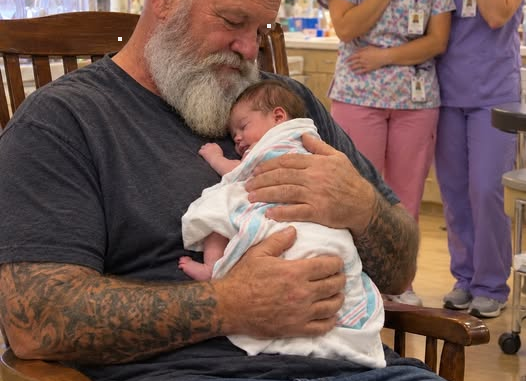
Close to six-foot-seven. Broad shoulders. Shaved head. Thick white beard. Tattooed arms. And hands so large and marked they seemed more suited for welding steel than cradling something as delicate as a newborn.
His black leather vest had to be left outside the unit due to hospital policies. Yet even in a blue disposable gown, Marcus “Bear” Miller still appeared entirely out of place under the gentle lights of St. Jude Children’s Hospital.
I had been a NICU nurse for thirteen years. I knew that room intimately. The soft beeping of monitors. The warm light over incubators. The hushed prayers of parents who thought no one could hear them. I had witnessed fear, hope, sorrow, and miracles all bundled into the same tiny blankets.
But Marcus did not seem like someone who belonged near babies born too soon.
Then the baby in bed nine began to cry. And everything shifted.
His chart simply read Baby Boy Montgomery. No first name. No family photos taped beside his incubator. No stuffed animals. No balloons. No proud grandparents waiting in the hallway.
He had entered the world too early. Too small. And far too alone.
His mother, Chloe Montgomery, was young and overwhelmed, caught in issues no single hospital room could resolve. She had left before the paperwork was complete. No father signed in. No relatives called.
Some infants arrived with entire families surrounding them. Baby Boy Montgomery had only a bracelet, a temporary name, and a cry that sounded too weary for someone who had just begun life.
That morning, we tried everything. We checked his temperature. Adjusted his swaddle. Dimmed the lights. Reviewed his feeding schedule. Monitored every tiny breath and every number on the monitor.
Still, he cried.
Marcus turned toward the sound. Then he looked at me and asked in a voice much softer than I anticipated, “Is that the little one who needs someone to sit with him?”
I glanced at his volunteer badge. He had passed the checks. Completed the training. Been approved for the infant comfort program.
Still, I hesitated. And I regret the reason.
I looked at his hands. They were enormous. Rough. Scarred. For a brief moment, I wondered if hands like that could be gentle enough.
But Marcus washed his hands exactly as he had been instructed. He followed every guideline. He sat down carefully in the approved rocking chair, his large frame stiff with caution, as if he feared one wrong breath could be too much.
When I placed Baby Boy Montgomery against his chest, he cried even harder. Two nurses glanced over. A doctor paused near the doorway.
Marcus simply lowered his chin and whispered, “Easy now, little cub. I’m right here…”
PART 2
The baby did not stop right away.
That’s not how it happens. Not in movies, not in reality.
For about ninety seconds, Baby Boy Montgomery screamed against Marcus’s chest, and I stood close enough to step in if the monitors indicated anything concerning.
Marcus didn’t flinch. He didn’t look up for reassurance. He didn’t check my expression to see if he was doing it correctly. He just rocked, slow and steady, and continued speaking in that low rumble, words I couldn’t fully grasp, something about bears and mountains and a river he knew somewhere.
Then the crying softened. Then it ceased.
The room didn’t fall silent in a dramatic way. The monitors continued beeping. Someone’s IV pump beeped twice down the hall. A colleague of mine, Sarah, was typing at the nurses’ station with her usual rhythm.
But the baby stopped crying. And Marcus closed his eyes. Just for a moment. Like he was the one who needed it.
I noted it in my records and returned to my duties.
The Chair He Didn’t Leave
During the first hour, I checked on them every fifteen minutes. In the second hour, I extended it to twenty. By hour four, I had to stop hovering because other infants needed my attention and, honestly, watching them made it hard to concentrate on anything else.
Marcus remained in that rocking chair as if he had been fastened to it. He accepted water when Sarah offered it. He used the restroom once, carefully handing the baby to another nurse, and returned before I finished documenting the handoff.
He didn’t use his phone. He didn’t read. He just sat there with this tiny, nameless baby against his chest and rocked. Slow. Steady. Patient.
A few parents glanced at him from across the room. One father, a young man named David who had been here eleven days with his own premature daughter, approached around hour six and simply nodded at Marcus. He didn’t say anything. Marcus nodded back.
That was sufficient.
By hour eight, the day shift nurses who had seen Marcus come in were beginning to leave, and the night crew was arriving. They got the briefing. A couple of them stared. One of them, a newer nurse named Julia, quietly asked me if we should “do something about the large man in the rocking chair.”
I informed her he was a volunteer.
She replied, “He’s been there since this morning.”
I said, “I know.”
She looked at me. I looked at her. We left him undisturbed.
The Wrist
It was around hour twelve when Sarah noticed it.
She had gone over to check Baby Boy Montgomery’s temperature, which required leaning in close, meaning being near Marcus’s arm, which rested along the side of the chair.
His sleeve had ridden up.
On the inside of his left wrist, just below the palm, there was a tattoo. Not the large pieces on his forearms, the eagle and the flames and what looked like a road map of everywhere he’d been. This one was small. Different. The ink was older, grayer, sitting softer in the skin.
A name. And a date.
Sarah read it. She didn’t say anything. She finished checking the baby’s temperature, recorded it, and returned to the station.
She leaned over to me and said, very quietly, “His son.”
That was all.
I didn’t inquire how she knew it was a son. You just know, sometimes, the way you recognize when a parent is praying versus when they’re bargaining.
I glanced over at Marcus. He was watching the baby’s face the way you observe something you’re afraid might vanish if you stop looking.
I calculated the date without intending to. The tattoo was about nine years old, give or take.
I went to the break room and stood there for a moment. Just stood there.
What He Told Me
I didn’t ask him directly. I’m not that type of person. Some things you wait for.
But around hour thirteen, when Baby Boy Montgomery had been fed and changed and was sleeping again against that broad chest, Marcus looked up and caught me observing.
He didn’t appear embarrassed.
He said, “His name was Dylan.”
I sat down in the chair next to him. The one families used.
“He was five weeks early,” Marcus said. “Back in 2015. Hospital about three hours east of here.” He looked down at the baby. “There wasn’t a program like this one back then. No volunteers. His mama had some complications afterward. She couldn’t be there the first couple of days.” He paused. “And I didn’t know how to ask if I could just sit with him. I thought they’d tell me to go wait in the hall.”
He gently rubbed his thumb along the edge of the baby’s swaddle.
“So I waited in the hall.”
He stated it without self-pity. Just presented it, the way you state a fact you’ve had nine years to accept.
Dylan had been in the NICU for eighteen days. He had a heart defect that nobody detected early enough. He made it home. He had two years and four months of life, Marcus said, and he was the kind of child who laughed at everything, even the things that weren’t funny, especially those.
Marcus paused for a moment.
Then: “When I heard about this program, I thought, well. I know how to sit still. I know how to be quiet. Figured that counted for something.”
It counted for more than that. But I didn’t say it. I just sat with him for a few minutes, the same way he was sitting with the baby.
What the Night Shift Saw
By the time Marcus finally handed Baby Boy Montgomery back, it was past ten o’clock at night.
He stood up slowly. His knees were stiff. He was sixty-one years old, I knew from his volunteer file, and he had just spent a significant part of a day in a chair designed for someone much smaller.
He stretched his back. Winced once. Didn’t complain.
He watched Julia settle the baby back into the incubator. Baby Boy Montgomery stirred, made a sound as if he was about to protest, then went quiet again.
Marcus nodded at the incubator as if saying goodnight to someone.
Then he turned to leave.
At the door, he paused and looked back at me. “Same time Thursday?” he asked. “I’m on the schedule.”
I told him we would see him Thursday.
He departed.
The unit was calm. The monitors beeped. Somewhere down the hall, a mother was singing something softly and tuneless to her daughter.
Sarah came and stood beside me.
“You know what strikes me,” she said, not really asking. “He figured out how to give somebody else’s child what he couldn’t give his own.”
She returned to the station.
I lingered for another moment.
Thursday. And After.
Marcus returned on Thursday. And the Thursday after that.
Baby Boy Montgomery remained in our unit for six more weeks. During that time, Chloe Montgomery came back twice, briefly, and we connected her with a social worker named Evelyn who excelled at the kind of quiet, patient work that doesn’t appear in any chart. That’s a longer story, and it belongs to Chloe, not to me.
What I can share is that by week four, the baby had a name written on a small card taped to his incubator. Not a legal name, not yet, but a name the nurses had begun using among themselves.
Cub.
Marcus hadn’t suggested it. He had never referred to him that way in front of us, only in that first whispered moment. But somehow the name had moved through the room on its own, as things do in a unit where everyone is observing everyone else more closely than they let on.
He eventually went home. Healthy enough. The paperwork took longer than the medical care.
Marcus continues to volunteer. He has been doing it for two years now. He has a regular Thursday slot and a backup Wednesday if someone cancels. He holds babies that nobody visits. He sits in that chair for hours and talks to them in that low rumble about bears and mountains and rivers.
He never makes it about himself.
But on his left wrist, every time his sleeve rides up, there’s Dylan.
Five letters and a date.
And I believe that’s why his hands are so gentle.
FINAL PART
Three years after that first long Thursday in the NICU, our unit celebrated the tenth anniversary of the Infant Comfort Volunteer Program.
We held a small gathering in the hospital’s courtyard. Doctors, nurses, social workers, and families of former patients mingled around folding tables adorned with punch bowls and platters of cookies.
Marcus stood near the brick perimeter wall, appearing as out of place among the pastel decorations as he had on his first day in the nursery. He wore his black leather vest over a clean flannel shirt, his thick beard neatly trimmed, holding a tiny paper cup of lemonade that looked absurdly small in his enormous hand.
As I approached to join him, a young woman pushing a stroller came from the main entrance.
She appeared healthy, confident, and settled. Next to her walked Evelyn, our department social worker, smiling broadly.
“Marcus,” I said gently, touching his forearm. “There’s someone here who wants to meet you.”
Marcus turned. As his eyes landed on the woman and the little boy in the stroller, he froze completely.
It was Chloe Montgomery.
And strapped into the stroller, holding a plastic toy truck, was a healthy, chubby-cheeked three-year-old boy with bright brown eyes and a tousle of curly hair.
Chloe halted a few feet away, her hands gripping the stroller’s handles. She looked up at Marcus—at his six-foot-seven frame, his tattoos, and his broad, weathered face—without a hint of fear.
“You’re Marcus,” she said, her voice small but steady.
Marcus nodded slowly, removing his leather cap. “I am. Ma’am.”
“Evelyn told me about you,” Chloe said, tears brimming in her eyes. “She told me about those long Thursdays when I couldn’t be here… when I was too broken, too lost, and too scared to face that room.”
She stepped closer and took Marcus’s huge, scarred right hand in both of hers.
“You held my son when his own mother couldn’t. You gave him warmth when I had nothing left to offer. I never got to thank you.”
Marcus looked down at her, his eyes softening. “You don’t need to thank me, Chloe. You did the hard work. You came back for him.”
He slowly crouched down, his stiff knees popping, until he was at eye level with the little boy in the stroller.
The three-year-old stopped playing with his toy truck and stared at Marcus. Then, without hesitation, the boy reached out his small hand and patted the thick white beard framing Marcus’s chin.
A soft chuckle rumbled deep in Marcus’s chest—a sound as warm and familiar to our unit as the gentle sway of that old chair.
“Hey there, little cub,” Marcus whispered softly. “Look at you now. Strong as an oak.”
The boy giggled, handing his toy truck up to Marcus.
Chloe wiped a tear from her cheek and smiled. “His legal name is Caleb now,” she said. “But at home… I still call him Cub.”
Marcus stood up slowly, handing the toy back to the boy with infinite care. He looked at Chloe, then at Caleb, and finally at the small gray tattoo resting on his left wrist beneath his watch band.
For three years, I had observed Marcus dedicate hours of his life to nameless, vulnerable babies in the dim corners of the hospital. But standing there in the warm afternoon sunlight, witnessing Dylan’s memory flourish into life, healing, and hope for another family, I realized something profound.
Marcus hadn’t just saved a lonely baby on a cold Thursday morning three years prior.
By opening his enormous, scarred hands to the world’s most fragile lives, he had allowed the world to heal him in return.