Part 1: The Green Book on My Porch
The green book had a strip of yellowed tape on one corner, and the last time I saw it, a little girl was clutching it to her chest at my son’s funeral. “Your son wasn’t at that river by accident,” said the woman on my porch, while the boy beside her hugged a red truck with a missing wheel. I almost closed the door. Then she opened the cover, and I saw Weston’s handwriting.
The knock came at 2:10 on a Saturday afternoon in October. I was standing at the kitchen counter with my orange-handled scissors, clipping coupons for a dinner I’d be eating alone.
I almost didn’t answer. Nobody knocked on my door on Saturdays except people selling gutter guards.
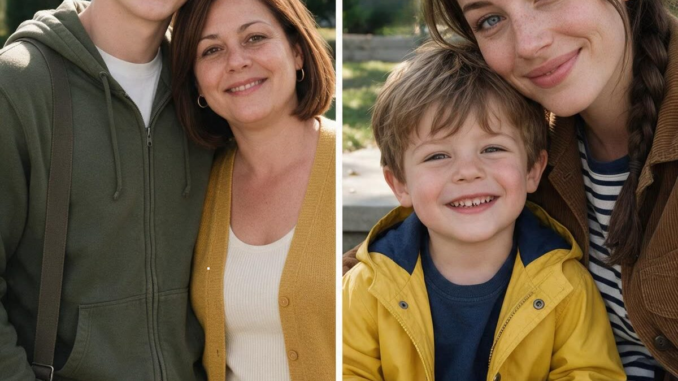
A young woman stood on the welcome mat. Dark hair in a loose braid over one shoulder, a camel corduroy jacket, and a worn green book pressed flat against her chest. Next to her stood a boy of about five in a yellow rain jacket, gripping a red toy truck.
The truck had three wheels. The fourth axle was bare.
“Are you Weston’s mother?” she asked.
Nobody had said my son’s name on that porch in years. My mouth went dry before I could answer.
“Yes,” I said. “I am.”
She glanced down at the boy, then back at me. Her knuckles were pale around the book. “My name is Sloane.”
The floor seemed to tilt. I caught the edge of the door and held it the way you hold a railing on a ship.
“Sloane,” I repeated. “The little girl from the river?”
“Mommy,” the boy whispered, tugging her sleeve. “Is this the lady?”
“Yes, Charlie. This is the lady.”
I couldn’t stop looking at the book. I knew that faded green cover the way you know a face in a crowd.
To understand why my knees nearly gave out, you have to know about the last morning.
Weston was nineteen. In eleven days he was supposed to drive two hours north to Westbrook University, and his bedroom had turned into a warehouse. Cardboard boxes covered the carpet. Lists in his slanted handwriting were taped to the closet door, the dresser, even the mirror.
I was working as a billing coordinator at Harlan Family Dental then, and the mortgage was $1,140 a month whether I felt like paying it or not. His scholarship covered tuition but not the gap, and I’d been picking up Saturday hours at the front desk to cover the rest. That particular Saturday I had the day off, which felt like a luxury I didn’t know what to do with.
He came downstairs at eleven, carrying a box labeled DESK STUFF. It held tangled phone chargers, a calculator with a cracked screen, and three pens that hadn’t worked since high school.
“You’re taking garbage to college,” I told him.
He grinned over a bowl of cereal. “Sentimental garbage.”
“Sentimental garbage costs extra on the moving truck.”
“We’re not renting a truck, Mom. We have my car.”
He had a point. He usually did, which was infuriating.
He rinsed his bowl, snagged his keys from the hook, and kissed my cheek on the way past. On the closet door upstairs there had been a new line on one of his lists, something about a Saturday and a last chapter. I’d glanced at it that morning and assumed it was a summer reading assignment, because I assumed a lot of things about my son back then.
“Home for dinner?” I called.
He turned around in the doorway with the sun behind him.
“Of course, Mom.”
At 1:45 that afternoon, two police officers stood on my porch with their hats in their hands.
I remember the younger one wouldn’t quite look at me. I remember the screen door’s spring squeaking while he talked. I remember almost nothing else, only fragments. A river outside town. A little girl in the water. A strong current. My son going in without waiting for anyone else.
He had pushed her close enough to the bank that a man could grab her arm and pull her out. Then the water took him.
Weston had left that morning expecting dinner. By dinnertime, I was sitting on the bathroom floor with a pot roast cooling on the stove, and the whole house smelled like a day that wasn’t going to happen.
The newspapers called him a hero. Strangers mailed flowers, and a woman I didn’t know brought a casserole. I was grateful and furious and proud all at once, and none of it fit together.
At the funeral, a family stood at the back of the church. A small girl with dark hair, in a pale blue dress, held a green book against her chest as though somebody might take it from her.
Her mother leaned toward me. “She wanted to come. We can leave if it’s too much.”
“Please don’t,” I said.
The girl’s lips moved, but nothing came out. I knelt beside her, my good black skirt creasing at the knee, and told her she didn’t have to say anything. She gripped the book tighter and burst into tears, and her father carried her out into the sunlight.
I thought the book was a comfort thing, like a stuffed rabbit. I didn’t know my son’s handwriting was inside.
Within a year, Sloane’s family moved away. Reporters had recognized her at grocery stores and asked questions no seven-year-old should have to answer, and her parents wanted her to have an ordinary childhood. I understood. I didn’t like it, but I understood.
Weston’s room became a guest room. I kept one box in the closet and went back to work. When people asked if I had children, I learned to smile, and sometimes I said, “I have a son,” and sometimes I said, “I had a son.” Neither one ever felt right.
Now Sloane stood on my porch, twenty-five years old, with a child of her own.
“I should have come years ago,” she said. Her voice shook. “I wrote you letters. I never sent them.”
“Oh, honey.”
“Mrs. Hale, I need to tell you the truth.” She drew a breath. “Your son wasn’t at that river by accident.”
I tightened my hand on the doorframe. “What are you talking about?”
Sloane looked at her little boy, then back at me, and said the one sentence I had never imagined hearing.
“Weston went there to meet me.”
Part 2: The Boy Who Waited
I should have asked her to leave. Eighteen years of carefully built silence were cracking, and every sensible part of me wanted to keep the door closed.
But my son’s name had just come out of a stranger’s mouth like a key, and I stepped aside.
“Come in,” I said. “Please.”
Charlie spotted the bookshelf in the living room right away. He marched over, borrowed an old wooden train that had belonged to Weston, and carried it to the rug as though I’d invited him to take it. I let him. I couldn’t have said no to that boy if my life depended on it.
Sloane sat across from me on the edge of the sofa. She kept the green book on her knees with both hands on top of it.
“Did Weston know you’d be at the river?” I asked.
“Yes.”
My stomach turned. “Did he know something was going to happen?”
“No.” She shook her head fast. “No, nothing like that. Nothing bad. We were supposed to read together.”
I stared at her. “Read?”
“That summer he volunteered at the reading program at the community center.” She ran her thumb along the yellowed tape on the book’s corner. “Tuesday and Thursday afternoons. I was in his group.”
I remembered the program. I remembered a flyer on our refrigerator and Weston muttering that it was only forty hours of volunteering for his college application. He had told me about some of the kids. He had never told me how often he went, or that he stayed after the other children left.
“I was terrible at reading aloud,” Sloane said.
“You were seven.”
“I knew the other kids were better.” She smiled faintly at the book. “When I got stuck on a word, everybody jumped in and said it for me. They meant well. I hated it.”
I could picture it. Seven years old, cheeks burning, an entire circle of children rushing to rescue her.
“What did Weston do?”
“He waited.”
The word landed in my chest.
“Sometimes I’d stare at one word for what felt like a year,” she said. “He’d just sit there, chin on his hand. Not helping, not sighing. Just waiting until I tried.”
I looked down at my own hands. Weston used to do that with me.
Whenever I forgot a neighbor’s name or lost the end of a sentence, he’d sit and let me search for it. It drove me out of my mind. I’d snap, “Just say it, Weston,” and he’d say, “You’ll get there.”
“He could be stubborn,” I said.
Sloane laughed, a short, surprised sound. “He really could.”
The clock in the hallway ticked. Charlie made a soft chugging noise as he rolled the train along the rug.
“The program ended a few days before the accident,” she went on. “Weston was getting ready for college. But I hadn’t finished my favorite book yet. We were stuck on the last chapter.”
“And you were upset.”
“I cried in the parking lot.” She winced at herself. “I thought he’d leave before I could read the ending.”
“What did he say?”
“He told me we’d find another afternoon.” She hesitated. “I told him my parents were taking me to the riverside park that Saturday for a picnic. He knew the place. He said he’d come and listen to the last pages.”
I closed my eyes. For a second I saw that line on his closet door again, his large crooked S. I opened them. Sloane was watching me anxiously.
“I didn’t tell my parents,” she said. “I wanted to surprise them. I thought if they watched me read the whole last chapter, they’d finally stop worrying.”
Then she stopped. She looked at the book, then at the window, then at the book again. Her mouth opened and closed.
I felt the old reflex rise in me, the one that wanted to fill the silence, to say it’s all right, you don’t have to go on, let me pour you some tea. It was the reflex of a mother who’d learned to tiptoe around grief. It was also, I realized, exactly what had made seven-year-old Sloane hate reading aloud.
So I did something I hadn’t done in eighteen years. I kept my mouth shut.
I folded my hands in my lap and waited.
The clock ticked. Charlie’s train rattled over the rug. The refrigerator hummed in the next room.
Eventually, Sloane’s shoulders loosened, and she let out a long breath.
“Thank you,” she said quietly.
“For what?”
“For not finishing it for me.”
I nodded. “I learned from the best.”
She told me the rest slowly, one careful piece at a time. Her parents had been unloading the picnic basket and folding chairs near the parking lot. She had wandered toward the water holding her favorite hat, which she’d been wearing to look older. A gust had taken it. She went after it, and the muddy edge of the bank slid under her shoes.
“I don’t remember being scared,” she said. “I remember being embarrassed. I remember thinking, I’m going to ruin my book.”
She stopped again, and again I waited. This time it didn’t take as long.
“Weston was already there,” she said. “He’d arrived early. He was sitting on a bench with a sandwich, looking for me. I never told anyone that part. By the time I was old enough to say it out loud, we’d moved away and nobody remembered to ask.”
For eighteen years I had pictured my son jogging past the river, hearing a scream, making a split-second choice. That’s what the newspapers said. That’s what I’d told myself every time the grief got too big.
But that wasn’t how it happened. He had been sitting on a bench with a sandwich, keeping a promise to a seven-year-old girl who wanted to finish a book.
He hadn’t gone there to save anyone. He had gone there because he’d said he would.
I pressed my fingers against my mouth. Sloane waited, in her turn, and I understood that I’d just been taught the lesson twice.
“Mrs. Hale,” she said, after a minute. “I need to show you something. I’ve never shown it to anyone except my husband.”
She turned the book around on her lap, and her hand trembled as she touched the faded green cover.
“I kept my promise to Weston for eighteen years,” she said. “But I’m not sure I’m ready for you to read what he wrote on the first page.”
Part 3: Save the Last Page for Me
She lifted the cover.
On the inside, in blue ink that had faded to the color of old denim, Weston had written five words and a name.
For Sloane. Save the last page for me.
I reached for my reading glasses, which were hanging on a cord around my neck, and put them on. I wanted to see it properly.
The letters were uneven. The capital S was far too large, the way he’d always made it, as though his own name needed more room than the rest of the alphabet.
“He wrote this?” My voice sounded thin.
Sloane nodded. “The last day of the program. He gave it to me when I was crying in the parking lot. He said it was a promise.”
“You brought it to the funeral.”
“I wanted to show you.” Her eyes were wet. “My mom kept asking what I was holding. I tried to say it, but all I could do was stand there. I thought if I opened my mouth, I’d be in trouble for what happened.”
“Oh, sweetheart.”
The word slipped out before I could think. She looked up at me, startled, and then her face crumpled.
I touched the page. The ink had a faint ridge, the way pen strokes do when someone presses hard. I could feel the pressure he’d used, nineteen years old and meaning every letter.
“Did you ever finish the book?” I asked.
“Yes.”
“When?”
“Much later.” She wiped her cheek with her wrist. “For a long time I couldn’t open it. I’d stand in front of the shelf and my hands would just stop. Then one day, in college, I wanted to know how it ended.”
I nodded. That was a perfectly good reason.
“I read the last page out loud to an empty room,” she added. “Like he was sitting there.”
Charlie turned a wooden train car over in his hands, humming. I watched him for a moment and then looked at Sloane.
“Why now?” I asked. “After eighteen years?”
She took her time answering. I let her.
“My parents moved us because they thought it would help me forget,” she said. “But I didn’t forget. I just stopped talking about it. I wrote you letters. Seven of them. I kept them in a shoebox and never mailed one, because I didn’t know if seeing me would hurt you.”
“It might have,” I admitted.
“I know. That’s what scared me.”
She glanced toward Charlie. “Six weeks ago, he started asking about the people in our family. Grandparents. Cousins. People who’d died. His preschool had a family tree project.”
Charlie looked up at the sound of his name. “I asked about the river boy,” he announced.
Sloane smiled sadly. “Yes, you did.”
“He helped Mommy.”
“That’s right, sweetie.”
He went back to his train, satisfied. Sloane turned toward me again.
“He asked if the river boy had a mother,” she said. “And I realized you might never have known why he was there. I’d let you carry that question for eighteen years because I was afraid.”
We sat quietly. It wasn’t an uncomfortable quiet. It was the kind that happens when two people finally set down something heavy at the same time.
Then Sloane took out her phone and showed me a photograph of a classroom. Small desks. Alphabet posters. A bookshelf crowded with picture books.
“I’m a reading specialist now,” she said.
I looked up. “You teach children to read?”
“I work with the ones who need extra time.”
I studied the picture. On the third shelf, I spotted a second copy of the same green book, its spine uncracked.
“Do you tell them about Weston?”
“Not usually.” She smiled. “But sometimes a child gets stuck on a word, and everyone around them is dying to jump in. And I remember how he used to sit there and wait.”
My eyes burned. “He did that at home too.”
“I thought he was the only person in the world who could be quiet for that long.”
“He wasn’t always patient,” I said. “You should have seen him trying to put together a bookcase.”
She laughed, and so did I. For a few minutes we talked about Weston without talking about the river. We talked about how he hummed when he was concentrating, how he ate cereal for dinner whenever I wasn’t looking, how his left shoelace was always undone.
It felt like opening a window in a house that had been shut for years.
Then, abruptly, Sloane started apologizing. For waiting so long. For turning up without calling. For bringing Charlie into the middle of my afternoon.
I stopped her gently.
“Sloane. Do you think you owe me something?”
She looked startled. “I…”
Her eyes filled again. She picked at the tape on the corner of the book.
“Sometimes I think I should have done more,” she said.
“More what?”
“With my life.” She said it very quietly. “I have a good job. I have a husband who’s kind, and I love my son. Most days I’m happy. But then I remember that Weston was nineteen and had his whole life, and I was seven and I got to keep mine.”
“Oh, dear.”
“Sometimes ordinary happiness doesn’t feel like enough,” she whispered.
I looked at Charlie, who was trying to reconnect two train cars with his tongue poking out in concentration. Then I looked back at her.
Part of me wanted to say something wise and polished. Instead I said the truest thing I knew.
“Weston didn’t go into that water expecting anything from you. He wanted you out of it.”
Sloane began to cry in earnest, her shoulders shaking. I moved over beside her, wrapped an arm around her, and for the first time in eighteen years, I was the one holding someone else up.
“He’d have been glad you got to grow up,” I said into her hair. “Ordinary happiness is the whole point.”
When she could breathe again, she wiped her face and asked a question I wasn’t expecting. “Have you ever gone back to the riverside park?”
“Not once,” I said. “Not in eighteen years.”
“There’s a bench there. Where we used to read.” She hesitated. “Would you like to see it?”
I looked at the green book in her lap. I thought about all the roads I’d driven the long way around so I wouldn’t pass that exit.
“Tomorrow afternoon,” I said. “If you’ll take me.”
She nodded, and we agreed on two o’clock.
After they left, the house felt different, as if someone had moved the furniture an inch to the left. I climbed the stairs to the guest room and opened the closet. Weston’s box was still on the shelf, under a folded quilt.
I lifted the lid. Photographs. A stack of college papers. A roll of packing tape he’d somehow never gotten around to using.
And underneath it all, folded into quarters, was a sheet of notebook paper I hadn’t looked at in years. His last to-do list, torn from the closet door the week after the funeral.
I unfolded it with shaking fingers. Most of it was ordinary. Buy shower shoes. Call the bank. Pack winter coat.
The final line, in his large crooked handwriting, read: Sat 12:30, riverside. S. is finishing her last chapter. Don’t be late.
I had read that line a hundred times, and not once had I asked who S. was.
Part 4: Grandma Demi
I barely slept. At four in the morning I found myself in the kitchen, holding the list under the stove light, comparing his handwriting to the green book’s inscription in my memory. Same slant. Same enormous S.
He had written her name on his to-do list the way other people write dentist appointments, as something that mattered enough to be on the door.
At 1:50 the next afternoon, I parked at the riverside lot. My hands stayed on the steering wheel for a full minute.
Sloane’s gray sedan was already there. She stood beside it with Charlie, who was wearing his yellow jacket again, though the sky was perfectly clear. She didn’t hurry me. She just lifted a hand in a small wave and waited.
So I got out of the car.
We stayed on the paved walking path, well back from the water. I could hear the river, a low, steady sound, but I kept my eyes on the trees and the maple leaves turning orange along the bank.
“It’s this way,” Sloane said gently.
The bench was weathered wood, with a small brass plate screwed into the backrest. Someone had added it years ago. It said only: In memory of a boy who kept his promises. I hadn’t known it was there.
“The community center put it up,” Sloane said. “After the funeral. I didn’t know whether you’d been told.”
“No,” I said. My throat tightened. “Nobody told me.”
I sat down on the bench, the old slats cool through my coat, and ran my fingers over the brass. Charlie climbed up next to me, swinging his legs.
“Did he ever talk about college?” I asked.
Sloane smiled and sat down on my other side. “He said it sounded exciting, but he was scared he’d miss everybody.”
I turned toward her. “He never told me that.”
“He said you’d cry if he did.”
A laugh broke out of me, wet and unexpected. I wiped my eyes with the heel of my hand.
“He was right,” I said.
We sat there for a long time while the river went by. Sloane read me two pages of the green book, and her voice didn’t stumble once. When she finished, she closed the cover and set it on her knee. Nobody said anything, and it was exactly the right amount of nothing.
Three weeks later, on a gray Sunday afternoon, my doorbell rang. I’d just finished clipping the week’s coupons, and I had the orange-handled scissors still in my hand when I opened it.
Sloane and Charlie stood on the porch again. This time, a tall man in a green flannel shirt stood behind them, holding a casserole dish with both hands. “My husband, Marcus,” Sloane said. “He insisted on bringing something. I told him you probably have enough food.”
“No one has enough casserole,” I said, and took the dish.
Before they came in, I’d done something. I’d gone through Weston’s box one more time and found a photograph I’d forgotten: Weston in his bedroom, standing among half-packed boxes, with a strip of packing tape stuck between his teeth like a pirate. He was laughing at whoever held the camera. I’d taken it that August, two days before the river.
I’d made a copy at the drugstore for $1.29 and slipped it into an envelope.
Sloane stared at the photograph for a long time.
“That’s him,” she said finally.
“That’s him.”
“I never saw him laugh like that. He was always serious with me. Like he was trying to be a good grown-up.”
“He was nineteen,” I said. “He was only pretending.”
She held it with both hands, the way she’d held the book. “Can I keep it?”
“It’s yours. I made it for you.”
She had brought the old green book again. Charlie scrambled onto the couch between us, kicking off one sneaker, and tugged on her sleeve.
“Can we read?”
Sloane opened the book to a page near the middle. “Your turn, sweetheart.”
He took a deep breath and started, following the words with one small finger. His voice was slow and serious. Halfway down the page, he stopped, frowning at a long word with too many letters.
He tried it. Got it wrong. Tried again.
Sloane leaned forward, and I saw her mouth open on the word, the old reflex. Then she stopped herself, pressed her lips together, and sat back.
She waited.
I watched my son’s face in that room, in the way her hands rested quietly on the book, in the stillness she’d learned from him. I thought of my kitchen table, of Weston patiently watching me hunt for a forgotten name, saying, You’ll get there.
Charlie sounded out the word a third time. His eyes lit up.
“Elephant!”
“Good job,” Sloane whispered.
He beamed at both of us, and then turned to me, as casual as asking for juice.
“Next page, Grandma Demi?”
The name stopped me. Nobody had ever called me that. Nobody had ever been supposed to.
Sloane looked over, a little alarmed, ready to correct him. I shook my head very slightly and let the warmth of it settle in my chest, the place that had been empty for eighteen years.
I smiled, and turned the page.
“All right, Charlie,” I said. “Let’s see what happens next.”
Have you ever kept a promise that changed someone’s whole life without you ever knowing it?
Disclaimer: This story is a work of fiction inspired by real-life themes. Names, characters, places and events are fictionalized, and any resemblance to real persons is purely coincidental. Images are for illustration purposes only.