Part 1: The White Box
After seven years of effort, my daughter Emily finally welcomed three healthy baby girls into the world. That afternoon, I stood in the hospital hallway with tears streaming down my cheeks, not caring who witnessed my joy. Seven years filled with hope, disappointment, and silent prayers culminated in the sweetest sound I had ever heard—three tiny voices crying simultaneously.
Our entire family was ecstatic. My husband David, who seldom displayed his emotions, held the first grandchild and was at a loss for words. Emily, exhausted yet radiant, lay in bed while her husband laughed and dabbed at his eyes, as though he couldn’t believe the nurse had truly handed him three babies. For one perfect evening, everything felt right in the world.
The next morning, I returned to the hospital early, bringing coffee and a bag of blankets that Emily had left behind. I had just entered her room when a nurse knocked and entered, carrying a large white box adorned with a satin ribbon.
“Someone dropped this off at reception for your family,” she said. “There’s no name on it. The front desk thought it might be a gift for the babies.”
Emily smiled sleepily from her bed. “Oh, how lovely. Open it, Mom.”
I unfastened the ribbon and lifted the lid. Nestled within layers of tissue paper were three miniature wedding dresses.
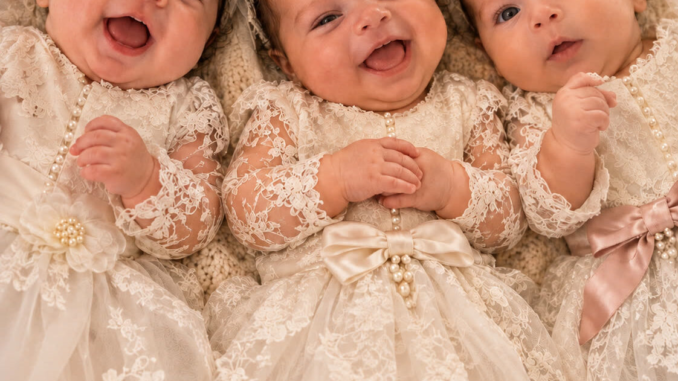
They were authentic. Tiny white gowns with lace sleeves, rows of pearl buttons, and delicate veils, each small enough for a newborn. Whoever crafted them had dedicated weeks to the task. The lace was hand-stitched, the pearls sewn on individually, and the veils as light as a whisper.
“Who would send something like this?” Emily murmured. She lifted one of the gowns with her fingertips. “They’re stunning. But why would anyone send wedding dresses to newborns?”
I had no answer. At the bottom of the box lay a cream-colored card, and I read the handwritten line aloud before I thought to stop myself.
“Three brides. Just as we agreed.”
My stomach tightened. The room suddenly felt colder.
“Agreed?” Emily looked at me, puzzled. “Mom, did we agree to anything?”
“No,” I replied. “Nobody agreed to anything.”
I flipped the card over. The back was blank. I searched the box for a receipt, a name, or a phone number, but there was nothing. I attempted to laugh it off. Perhaps a friend with a peculiar sense of humor had sent it. Maybe a coworker of Emily’s husband had gone a bit overboard. I voiced those thoughts, but neither of us believed them.
An hour later, my mother-in-law arrived. Margaret was seventy-nine, a proud and meticulous woman who still ironed her pillowcases and had never missed a family birthday. She entered the room with her handbag on her arm, smiling at the thought of meeting her great-granddaughters.
“Where are my girls?” she asked warmly.
Emily pointed to the bassinets by the window. Margaret walked over, bent down to see the three sleeping infants, and pressed her hand to her heart. “Oh, look at them,” she murmured. “Look at those little fingers.”
Then she noticed the dresses laid out on the table.
I watched the smile vanish from her face. It did not fade gradually; it simply stopped, as if someone had flicked off a switch. Her complexion turned completely pale. She crossed the room in three unsteady strides and picked up one of the gowns. With trembling hands, she turned it over and pulled back the collar.
Beneath the lace, in the lining, were three tiny blue stitches.
“Oh, dear God,” she whispered.
“Margaret?” I moved closer. “What’s wrong?”
She glanced at the other two dresses and examined each collar in turn. Her hands shook so violently that the lace quivered. “Who brought these here?” she asked, her voice thin and strange.
“We don’t know. A nurse mentioned someone left them at reception. There was a card.”
“What did it say?”
I told her. Margaret’s eyes rolled upward, her knees buckled, and before I could reach her, she collapsed onto the floor.
The room filled with nurses. Someone called for a doctor. Another person slid a pillow under her head. Emily attempted to get out of bed but was gently instructed to stay put. I knelt beside my mother-in-law, holding her cold hand and repeating her name over and over.
Fortunately, Margaret regained consciousness within minutes. The doctor checked her pulse and blood pressure, stating she had likely experienced a sudden shock. They wheeled her to a quiet room down the hall and settled her into a bed. I followed closely.
When her eyes met mine, she grasped my wrist with unexpected strength.
“Listen to me carefully,” she said. “Don’t let Emily dress the babies in those gowns.”
“Margaret, why? What do the dresses signify?”
She opened her mouth to respond, but my phone buzzed in my pocket. I almost ignored it. The screen displayed an unknown number. Something urged me to answer, so I stepped toward the window and pressed the phone to my ear.
For several seconds, no one spoke. I could hear someone breathing slowly on the other end. Then a man’s voice, quiet and steady, said, “Ask Margaret what happened to her daughter Laura. And don’t believe her when she says Laura died without children.”
The line went dead.
Part 2: The Daughter Nobody Mentioned
I stood at the window staring at my phone, frozen in place.
Laura was a name I had only heard a few times in twenty-six years of marriage. She was Margaret’s only daughter and David’s younger sister. According to family lore, she had died in a car accident at the age of twenty-four, long before I met David. Whenever he mentioned her, his mother grew silent and distant, her gaze fixed on some point far away. We had learned not to ask. Over the years, her name had become like a locked door in our home. We all passed by it without attempting to open it.
Now a stranger on the phone was telling me that Laura had children.
Behind me, Margaret was crying. “Who was that?” she asked weakly.
I recounted exactly what the man had said. For a moment, she looked as if she might faint again. Her lips moved soundlessly. Then she turned her head toward the wall that separated us from Emily’s room, where my daughter lay with her three newborns.
“Please,” she whispered. “Not now. She has just given birth. Don’t do this to her.”
“Don’t do what?” I kept my voice low, but it trembled. “Tell us the truth?”
Margaret lowered her head. “I never wanted this to happen.”
That was when I realized the dresses were not a joke. Someone had sent them because they knew a secret Margaret had spent decades trying to conceal. And they had chosen the happiest day in our family’s life to bring it back into the open.
David arrived twenty minutes later, out of breath from rushing. I took him into the hallway and showed him the dresses and the card, explaining the call. He examined the blue stitches beneath the collar and became very still.
“Is this about Laura?” he asked his mother when we returned to her room.
Margaret flinched. “Please, David.”
“Mom, what is going on?”
She pressed her fingers against her temples. “I need time.”
“For what?” I asked, struggling to remain calm. “Someone sent wedding dresses to a hospital, made you faint, and claims Laura had children. How much time do you need?”
She didn’t respond. Instead, she gazed through the glass partition toward the nursery, where the three babies lay sleeping in a row. Her eyes remained fixed on them for a long time.
“Those stitches,” she finally said, very quietly.
“What about them?” David inquired.
“Laura put them on everything she made. She called them her signature. Three blue stitches, always in the same spot, hidden under the collar.”
“Then whoever sent these knew Laura,” David said slowly.
Margaret nodded. “Whoever it is knows more about my daughter than either of you.”
“Then tell us what you know,” I urged.
She shook her head. “I can’t.”
I had never seen her like this. Margaret was a woman who resolved family disputes with a firm voice and an even firmer gaze. She had presided over every holiday table for fifty years. Her fear made me feel as if the ground beneath us had shifted.
David took her home, promising to return later. Before she left the room, she turned to me with her coat draped over her arm.
“Whatever you hear,” she said, “remember that I was trying to protect my family.”
It was the last thing she said before she walked away. I stood alone with the three dresses on the table, rereading the card. Three brides. Just as we agreed. Who had agreed to what? And why had Margaret reacted as if those tiny gowns had emerged from the grave?
That evening, after Emily was discharged and settled at home with the babies, I went into the spare room where we kept the old family albums. I sat on the floor and flipped through the pages until my fingers landed on a photograph taken in the garden of Margaret’s former house.
The girl in the photo had dark hair, a broad smile, and a white dress with delicate lace at the collar. She was laughing at something just outside the frame. She was Laura. I had never seen her face clearly before, as every album had been meticulously arranged so that she appeared only at the edges of groups.
I brought the photograph closer to the lamp. There, hidden at the edge of the lace, were three tiny blue stitches.
My heart raced. I didn’t wait for morning. I called David, who was still with his mother, and told him I would be there first thing.
The next morning, I found Margaret at her kitchen table, staring at a cup of tea she hadn’t touched. She looked a decade older than she had the day before. I sat across from her and placed the photograph between us.
She closed her eyes upon seeing it.
“Tell me about Laura,” I urged.
For a long time, she said nothing. The kitchen clock ticked. A bird landed on the windowsill and flew away. Then Margaret began to speak, hesitantly, as if every word had to be dragged from a deep place within.
“Laura was twenty-three when she became pregnant,” she said. “The father was a married man. He refused to acknowledge the child. He wouldn’t even talk to her. I was terrified of the scandal, of what the neighbors and the church would say. I persuaded her to keep it quiet.”
“Did she?”
“She stayed indoors for most of the pregnancy. And when she found out she was carrying three babies, she was scared. So was I.”
“Three,” I echoed. My throat felt dry. “Margaret. Triplets.”
“Yes.” She finally looked at me. “Just like Emily’s.”
“What happened to them?”
She clasped her cold cup with both hands. “Laura had no money of her own. The man had abandoned her. I told her that adoption would give the babies a better chance than she could.”
“Did Laura agree?”
“At first.” Margaret’s voice broke. “She signed the papers. The girls were placed with different families. But she regretted it almost immediately.”
I sat very still. “And you told everyone she lost the baby.”
“I know.”
“You let your own family believe your grandchildren never existed.”
“I thought I was protecting her.”
“From what?” I asked. “From being a mother?”
Margaret looked away, and at that moment, I understood that there was more she had not yet revealed.
Part 3: The Letters in the Wardrobe
Margaret told me that Laura had spent months trying to find the adoptive families. She wrote letters and made phone calls. She sat on the stairs in tears, pleading with her mother for assistance. Margaret refused each time, believing that reopening the issue would ruin the life Laura was attempting to rebuild.
“Then, six months after the birth,” Margaret whispered, “she died in a car accident. She was returning home from visiting a friend. The police said she lost control on a wet road. There was nothing anyone could do.”
“And the letters she wrote?” I inquired.
Margaret’s face crumpled. “I kept them.”
“Where?”
“In a box in my bedroom.”
I requested to see them. She didn’t object. She rose slowly and led me upstairs, one hand on the railing. From the back of her wardrobe, she retrieved an old wooden box that clearly hadn’t been opened in years. The hinges creaked as she placed it on the bed.
Inside were folded letters, hospital documents, and a photograph of three newborn girls lying side by side in white gowns. I flipped it over. On the back, in a young woman’s handwriting, someone had written: “My three little brides. One day, I hope you find one another.”
A chill coursed through me. The words on the card in the hospital box had not been fabricated by the stranger. They had originated from Laura herself.
But why had someone used them now?
Margaret picked up one of the letters and held it against her chest. “I promised Laura I would help her find the girls,” she said. “At the very end, I promised.”
“Did you ever try?”
“After she died, I couldn’t face it. I told myself they were happy with their new families. I convinced myself they were better off not knowing.”
I looked at the photograph again. Three infants, each dressed in a tiny white gown. The dresses in the hospital box were not identical to the originals, but the resemblance was unmistakable. Someone had recreated them, and someone had discovered Laura’s letters. That person was determined to make Margaret answer for what she had done.
The caller rang again that afternoon. I was sitting in my car outside Margaret’s house, and this time I answered before the first ring had finished.
“Who are you?” I demanded. “What do you want from Margaret?”
“My name is Michael,” the man replied. His voice was calm and weary. “I’m the husband of the woman who has been searching for her biological family.”
I exhaled and leaned back against the seat. “Your wife?”
“She was adopted as a baby. A few months ago, she found documents that led her to Laura, and then to Margaret.”
“How did you know about Emily’s triplets?”
“My wife spent years searching for her sisters. She found one adoption record, then another.” He paused. “She also discovered that Laura’s mother was still alive. She hasn’t been able to confront Margaret. Then I saw the post your family shared online. Your daughter had given birth to triplets, and Margaret was named as the great-grandmother. I thought she might finally understand what she had done.”
“So you sent the dresses.”
“Yes.”
“Why wedding dresses?”
“Because of Laura’s letters.”
Michael explained that Laura had left copies of her letters with the adoption agency. She had requested that if her daughters ever came looking for her, they be given those letters. In them, she referred to her daughters as her three little brides. She expressed hope that they would find one another someday, and that they might marry if they wished and have families of their own.
“The dresses were her way of envisioning a future she feared she would never witness,” he said.
I glanced at the white box on the passenger seat. I had brought it with me without fully understanding why. “And the blue stitches?”
“My wife learned about them from the baby dresses Laura provided to the agency. One of them was the dress she wore on the day she was adopted.”
“Why send them to a hospital?” I asked. “Why not contact Margaret? Why not write to her?”
“Because I learned her family was celebrating another birth.” His voice lowered. “I wanted her to see what she took from her own daughter and from my wife. I wanted her to grasp that the children she gave away grew up.”
I swallowed hard. “Who is your wife?”
“Her name is Sarah.” He provided a surname I recognized from one of the adoption records in Margaret’s box.
Sarah was one of Laura’s three daughters.
“Are her sisters alive?”
“Yes. I found one of them. Her name is Rebecca, and she lives a few hours away. The third is still difficult to trace.”
“And what do you want now?”
“I want Margaret to tell the truth to everyone she deceived.” He paused again. “I don’t want money. I don’t want to harm anyone else, least of all your grandchildren. I want the truth my wife has sought her entire life.”
For the first time since the dresses arrived, I understood why someone would go to such lengths to deliver them. It wasn’t a threat against the babies. It was a message to a woman who had spent decades pretending that three children had never existed.
That evening, David and I sat with Margaret in her living room. I laid Laura’s photograph and the letters on the coffee table between us.
“Michael called again,” I stated. “His wife is Sarah. She is one of Laura’s daughters.”
Margaret covered her mouth with her hand. “Sarah?”
“You knew her name?”
“No. But I remember the family who adopted the first baby. They lived in another county. They wrote to me once, years ago, asking about Laura. I never replied.”
David slowly turned toward her. “You received a letter from your granddaughter’s family and ignored it?”
Margaret began to weep. “I was ashamed. Every time I thought of those children, I remembered Laura begging me to help her find them. I couldn’t bear to admit I had been wrong.”
“You weren’t just wrong,” David said. “You made a decision for three children, and then you concealed it from everyone who loved you.”
“I know.”
“No, Mom. I don’t think you do.” His voice was low, but I could sense the hurt beneath it.
Margaret reached for his hand. He pulled it away.
“I thought I was protecting Laura,” she whispered.
“And what happened instead?” I asked.
She gazed at the photograph on the table. “I lost her anyway.”
For the first time, Margaret didn’t defend herself. She sat in the lamplight with her shoulders slumped, and then she said something that made David lift his head.
“There is one more letter,” she said. “I haven’t shown it to anyone.”
Part 4: Three Sisters, One Table
Margaret went upstairs and returned with a single envelope, yellowed at the edges. Laura had written it two weeks before the accident. In it, she stated she had decided to search for her daughters herself. She no longer wished to live with the lie that they were better off without her.
“Why didn’t you give it to the girls?” David asked.
“Because I feared they would hate me.”
“They have every right to be angry,” he replied.
Margaret nodded. Her hands trembled as she handed the letter to me, and I read the final lines aloud.
“I hope my girls find one another. I hope they know that I loved them, even when I was too frightened to fight for them. If they ever come looking, please tell them I never stopped thinking about them.”
Silence enveloped us for a long time. The clock ticked on the mantel. David stared at the floor, his jaw clenched. Margaret wept silently.
Finally, she said, “I want to meet them.”
David looked at her, his expression unreadable. “You should have wanted that thirty years ago.”
She did not argue with him. She simply said, “Yes. I should have.”
Rebecca arrived three days later. She was about thirty, with Laura’s dark hair and the same broad smile I had seen in the old photograph. Margaret opened the door herself. For several seconds, neither woman spoke, and they simply stood in the doorway, gazing at each other.
“You look like your mother,” Margaret finally said.
Rebecca’s eyes filled with tears. “I don’t know what she looked like beyond the photographs I found.”
Margaret stepped aside. “I have more.”
“I came because Sarah wants me to find our sister,” Rebecca said as she entered. “Sarah still can’t face you.”
Margaret bowed her head. “I’m sorry.”
“I also want to know about my mother.”
Margaret brought out the photographs, the letters, and Laura’s old sewing patterns. They spent hours at the dining table sorting through them while David and I prepared tea in the kitchen and listened to the soft murmur of their voices. Before she left, Rebecca agreed to assist in the search for the third sister.
The search took several weeks. With the help of the adoption agency and the records Sarah had gathered, they ultimately located her. Her name was Helen. She had grown up in a loving family and had never suspected she had biological sisters. When Rebecca called her, Helen was silent for nearly a minute.
“Are you sure?” she asked.
Rebecca sent her copies of the records and the photographs. Two days later, Helen replied and agreed to meet them.
Sarah joined them as well. Their first meeting was awkward and emotional. They compared childhood memories, laughed at their differences, and cried over the years they had lost. None of them had become the person Laura might have raised. But all three carried pieces of her in their faces, gestures, and the stories they had inherited from the families who loved them.
Margaret attended the meeting but lingered at the edge of the room, near the door, until Rebecca invited her to join them. It wasn’t forgiveness. It was a chance to begin sharing the truth.
I also explained everything to Emily: Laura, the adoption, Sarah, and the sisters who had finally found one another. She listened without interruption while the babies slept in her lap and beside her. When I finished, she picked up one of the gowns and examined the tiny blue stitches beneath the collar.
“She called them her little brides,” Emily murmured.
“Yes.”
“She wanted them to find one another.”
“She did.”
Emily looked at her daughters, sleeping side by side in their bassinets. “I can’t imagine being separated from them. I can’t imagine spending my life not knowing whether they were safe.”
Neither could I.
The next day, Emily invited Margaret to visit. Margaret arrived carrying a small album of Laura’s photographs. She sat beside the babies and watched them sleep for a while before speaking.
“I’m sorry,” she told Emily. “I can’t undo what I did. I can only tell the truth now.”
Emily took her hand. “I don’t know if I’ll ever understand why you did it. But I hope you understand what it cost them.”
Margaret nodded, tears streaming down her face. “I do now.”
She stayed for an hour, sharing stories about Laura: the dresses she sewed for her dolls, the songs she hummed while working, and the way she laughed wholeheartedly. For the first time, Margaret spoke of her daughter without diverting her gaze or changing the subject.
Before she left, she asked if Emily would keep the dresses. Emily agreed. They would not be wedding gowns for her daughters, nor a promise that the girls would one day marry. They would serve as a reminder of a mother who had loved three children she never had the chance to raise, and of the family secret that had kept them apart.
Margaret had believed that concealing the truth would protect her family. Instead, the lie had outlived the woman she sought to shield. The dresses had arrived at the hospital as a warning, yet they had transformed into something else. They were proof that the past could not be buried simply because those who remembered it were afraid to speak.
On the last Sunday of that month, we all gathered at Emily’s home. Sarah, Rebecca, and Helen sat together on the sofa. David lingered in the doorway for a long moment before crossing the room and sitting beside his mother. He did not say he forgave her. He simply took her hand, and she clung to him as if she had been waiting thirty years for that moment.
I watched Emily cradle her three daughters, and I realized the most painful aspect of Margaret’s secret. Laura had never wanted her children to be brides. She had wanted them to be sisters.
And on that Sunday, in a crowded living room filled with the aroma of coffee and warm bread, they finally were.
If someone sent three miniature wedding dresses to your newborn grandchildren to reveal an old family secret, would you view the gesture as justified or unnecessarily cruel?
Disclaimer: This story is a work of fiction inspired by real-life themes. Names, characters, places, and events are fictionalized, and any resemblance to real persons is purely coincidental. Images are for illustration purposes only.