Part 1: The Phone Call I Never Expected
“Mrs. Parker, I need you and your husband to come to school. There are two police officers in my office.”
For a moment, I thought Principal Harris had called the wrong parent.
It was Friday, my six-year-old son Ethan’s fifth day at Brookfield Elementary. Just an hour earlier, I had placed a little drawing of Saturn on our refrigerator and wondered what he would tell me about science class when he came home. Now I was standing in the kitchen with my phone pressed to my ear, trying to understand why the principal was mentioning the police.
“Is Ethan hurt?” I asked.
“He’s safe, Mrs. Parker. I want you to know that first. But something happened during lunch, and I would rather explain it with both of you here.”
“Is he in trouble?”
“No. Please come as soon as you can.”
The call ended. I stared at the refrigerator, at the crooked rings Ethan had drawn around his favorite planet, and then called my husband.
Michael answered from work. When I repeated the principal’s words, he stopped asking questions about his afternoon schedule.
“I’m leaving now,” he said. “Meet me at the school.”
I drove there gripping the steering wheel. At every traffic light I reminded myself that the principal had said Ethan was safe. It did little to settle my thoughts.
For years, we had tried to give our only child both the support he needed and the room to discover who he wanted to become. Ethan had Down syndrome. Some classroom tasks required additional time or different explanations, and when he was upset, he sometimes struggled to say exactly what he meant. But he could explain the rings of Saturn to a stranger, recite dinosaur names longer than his own arm, and ask enough questions about rocket ships to exhaust an astronaut.
When he was younger, we taught him at home with guidance from educators and therapists. He learned steadily, surrounded by familiar routines. Yet as he got older, he began to notice what other children had.
“Mommy, when can I ride the yellow school bus?”
“Why do other kids have classrooms?”
And the question that stayed with me longest: “Can I have a best friend?”
We spent months meeting with Brookfield’s teachers and support staff. We discussed classroom accommodations, communication strategies, ways to track his progress, and how to help him participate alongside his classmates. When the school confirmed its plan, we enrolled him in first grade.
On Monday, he came home talking about the enormous library. On Tuesday, he told us about a boy named Oliver who loved long-necked dinosaurs. By Wednesday, he announced that several classmates had invited him to sit with them at lunch.
“They asked me, Mommy. I didn’t even have to ask them!”
That evening, I had felt as though a door was opening in front of him.
When I reached Brookfield, Michael was waiting outside. He took my hand as we walked through the building. We passed bright student artwork, a bulletin board of classroom photographs, and a sign that read EVERYONE BELONGS.
I wanted to believe the sign.
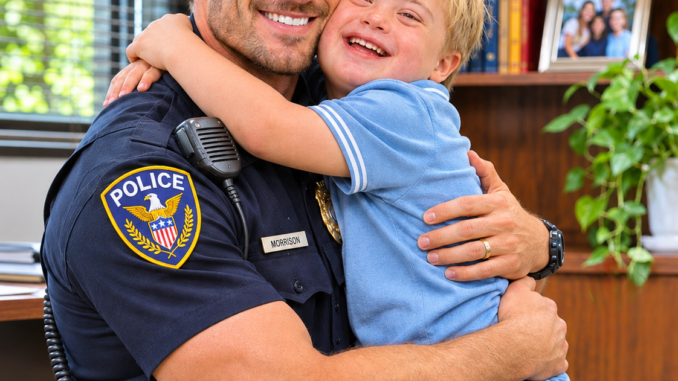
Principal Harris’s secretary led us into his office. Ethan was sitting beside the window, holding his blue backpack against his chest. The moment he saw me, he hurried across the room.
“Mommy!”
I knelt and held him close. His cheeks were damp.
“Sweetheart, did somebody hurt you?”
He shook his head, then leaned toward my ear.
“Mommy, please don’t make me leave school.”
I pulled back to look at him. “Leave? Why would we make you leave?”
He glanced at the two uniformed officers standing near the principal’s desk. His fingers tightened around my sweater.
One officer stepped forward and introduced herself as Officer Miller, the school resource officer. She explained that a second officer had arrived after staff requested assistance during a commotion in the cafeteria. Neither child had been accused of a crime; the officers had remained while the school sorted out what had happened.
Michael’s expression hardened. “Then what happened?”
Principal Harris asked us to sit. “Several students were involved in an incident at lunch. We have cafeteria footage, and we’ve spoken with children who witnessed it.”
He turned his computer toward us.
On the silent security recording, Ethan sat with his lunchbox open. Three boys stood around the table. One held a phone pointed toward my son. At first Ethan was smiling and gesturing enthusiastically. Then the boys began laughing. One exaggerated the movements of his mouth while another leaned close with the phone.
I watched Ethan’s smile disappear.
He lowered his head toward his sandwich, but the phone stayed in front of him.
A smaller figure entered the picture: Oliver. He placed himself beside Ethan and faced the other boys. One child put a hand on Oliver’s shoulder; Oliver moved away, and a chair scraped sideways as the boys crowded one another. A cafeteria worker arrived, and the video ended.
“Ethan told us they kept asking him to say he wanted to be a scientist,” Principal Harris said. “The students confirmed that they recorded him and imitated the way he spoke.”
My son had said, “I’m going to be a famous scientist!” The boys had asked him to repeat it, louder, again and again. What began as excitement had become something he wanted to escape.
I looked down at the small hands holding the straps of his backpack.
“Ethan,” I asked gently, “was today the first time they did that?”
His answer was so quiet I almost missed it.
“No. They started Wednesday.”
Wednesday—the day he had come home glowing because other children had invited him to their table.
And suddenly, I understood that the smile I had celebrated might have been hiding something very different.
Part 2: What He Was Afraid to Tell Us
“Why didn’t you tell us, honey?” I asked, and immediately wished I had chosen gentler words.
Ethan looked at the floor. “Because I like school.”
“We know you do.”
“You said if school was too hard, I could come home.”
There it was: a sentence I remembered saying, now carrying a meaning I had never intended.
The night before his first day, Ethan had struggled to fall asleep. He wanted school more than anything, but he was nervous about new people and unfamiliar rules. I sat on the edge of his bed and said that if school ever felt too difficult, he could tell us and we would figure out another way for him to learn.
I thought I was offering him reassurance. He had heard a warning: if school was hard, he could lose it.
“If I’m sad,” he whispered now, “you might say school is too hard.”
My eyes burned. I held both his hands.
“Oh, Ethan. Thank you for telling me. Someone being unkind to you doesn’t mean you don’t belong here. It means the adults need to help make things right.”
“Even if I cry?”
“Even then. And I’m sorry my words made you afraid to tell us.”
Michael came to sit beside us. “Buddy, you can tell us the best thing about your day and the worst thing. You don’t have to protect our feelings.”
Ethan thought about that for a long moment. Then he nodded once.
I asked what had happened before Friday. The story came slowly, with pauses to gather his thoughts. On Wednesday, three boys asked him to join their lunch table. Ethan assumed the invitation meant friendship, so he brought Oliver, who had been sitting with him since Tuesday.
The boys asked Ethan what he wanted to be when he grew up. He proudly said he wanted to be a famous scientist. They laughed. At first he laughed too. When they imitated his speech, he became confused, but he hoped they would be nicer the next day.
On Thursday, one boy brought a phone. They asked him to repeat words and made exaggerated faces when he spoke. Oliver told them to stop. Ethan did not know whether to be angry or keep smiling.
“Why did you go back to the table today?” Michael asked.
Ethan seemed surprised by the question.
“Because they let me sit there.”
I looked at Michael. We had practiced tying shoes, asking for help, following directions, and telling a teacher when he needed a break. But we had never fully explained that being allowed to join a group was not the same as being treated kindly by it.
To Ethan, the invitation itself still mattered. Those children had made room for him, and he was afraid that saying they were being unkind would close the door again.
“Who was sitting with you before those boys invited you?” I asked.
“Oliver.”
“Did you know him before Monday?”
“No. He was new.”
Ethan explained that Oliver had spent their first classroom activity sitting alone. Ethan noticed the dinosaur printed on his pencil case and asked whether he liked dinosaurs. They spent recess arguing cheerfully about whether a triceratops could beat a T. rex. On Tuesday, Ethan invited Oliver to lunch.
“He looked sad,” Ethan said simply. “I thought we could talk about dinosaurs.”
“Were those other boys nice to Oliver?” I asked.
Ethan shook his head. “Not really.”
“Did you want Oliver to leave the table?”
“No. I wanted everybody to be friends.”
I touched the strap of his backpack. I had arrived fearing that he had failed at something we had encouraged him to try. Instead, I was beginning to see how hard he had worked to make the week feel successful for everyone around him.
Principal Harris returned from speaking with the lunchroom supervisor. He looked troubled.
“I need to tell you something we’ve just confirmed,” he said. “Oliver tried to report the recording yesterday.”
Michael straightened. “He told an adult?”
“Yes. He told a lunch supervisor that the boys were filming Ethan and making fun of him.”
“What did the supervisor do?” I asked.
“She spoke to the children. They said they were only joking. She told them to stop and returned them to lunch. There was no written report or follow-up.”
I sat very still.
A six-year-old had recognized the problem. He had found an adult and asked for help. The adult had intervened briefly, but the filming happened again the next day.
Michael stood. “So someone knew before today, and no one called us?”
Principal Harris did not defend the decision. “That report should have been documented and followed up. It wasn’t. I’m sorry.”
There was another piece of the story he needed us to hear. When the chair scraped and the cafeteria grew noisy, a staff member initially assumed Oliver had started a confrontation. He and Ethan were both brought to the office while the situation was reviewed. Oliver insisted that the adults listen to Ethan before deciding who was responsible.
“He kept saying Ethan hadn’t done anything wrong,” the principal told us.
Ethan lifted his head. “Oliver said friends don’t leave.”
I had come to school believing two police officers might be the most alarming part of the day. But the real revelation was that a little boy had asked for help twice—and that the first warning had been easy for the adults to overlook.
Part 3: The Choice We Had to Make
“We need more than an apology,” I told Principal Harris. “I want to know what changes tomorrow, and who will make sure they happen.”
My voice sounded steadier than I felt.
I could understand that children sometimes make hurtful choices before they understand the consequences. I could not accept a system that depended on another first grader to recognize, report, and stop the behavior all by himself.
Principal Harris wrote our concerns down. He said the school would contact the families involved, follow its student conduct procedures, address the unauthorized phone recording, and supervise lunch more closely. He would also meet with Ethan’s teacher and special education coordinator to review the support plan that had been promised before the school year began.
“Will the children who teased him be encouraged to understand what they did?” I asked.
“Yes,” he said. “There will be appropriate consequences and guidance. We won’t ask Ethan to excuse their behavior or make him responsible for teaching them.”
It mattered to me that Ethan not be made into a lesson for everyone else. He was a child who wanted to eat lunch, learn about planets, and make friends. His dignity was not a classroom demonstration.
Officer Miller, who had listened quietly, crouched so she was closer to his height.
“Ethan, you aren’t in trouble. And Oliver isn’t either. The school is handling this. You can ask a grown-up for help whenever something feels wrong.”
Ethan looked at her badge. “Even if it’s just words?”
“Even if it’s just words.”
“Oliver can too?”
“Absolutely.”
Principal Harris asked whether we wanted to take Ethan home for the rest of the afternoon. I could already imagine getting him into the car, bringing him to our quiet kitchen, and giving him his favorite lunch. It would be easy to promise myself that he never needed to face this kind of situation again.
Michael looked at me, waiting.
Then I remembered what Ethan had said when he first reached for me: Please don’t make me leave school.
I turned to him.
“What do you want to do, sweetheart? You can come home with us today, or you can return to class. We’ll help either way.”
His response was immediate. “Go back.”
“Are you sure?” Michael asked.
“We have science today.”
For the first time since the phone call, I laughed. It was the small, surprised laugh of someone remembering that an awful morning was not the whole of her child’s life.
Before we agreed, we asked for a teacher to meet him at the classroom door and check in with him after lunch the following week. We arranged a written follow-up meeting, a simple signal Ethan could use if he needed a quiet conversation, and one named staff member he could approach without having to explain the entire situation repeatedly.
When we left the principal’s office, I walked with him to the classroom hallway. He paused by a display of student drawings.
“Mom?”
“Yes?”
“Can I still be a scientist?”
“Of course you can.”
He looked uncertain. “Even if I talk differently?”
Michael knelt beside him. “The way you speak doesn’t make your questions any less important. Scientists ask questions, make mistakes, learn things, and keep trying. You already do that.”
Ethan studied his father’s face, then nodded. “Okay. I’m going to science class.”
He turned down the hallway with his blue backpack bouncing behind him. I wanted to follow him all the way to his desk, but I stayed where I was. Loving him sometimes meant moving closer. That afternoon, it meant trusting his answer while making sure the adults did their part.
At home that evening, Michael could barely touch his dinner.
“What if Oliver hadn’t been there?” he asked.
“I don’t know,” I said. “That’s why we can’t let the school treat this like one bad lunch period.”
We discussed whether we had rushed Ethan into first grade. For years, homeschooling had given us familiar routines and close support. But it had also been Ethan who repeatedly asked for classmates, a school library, and a friend of his own.
“Maybe we thought being careful meant keeping him away from every difficult thing,” Michael said.
“Maybe,” I replied. “But being included shouldn’t mean he has to endure unkindness. We need both: a chance to grow and adults who will act.”
The next morning we practiced what he could say if anyone made fun of him again.
“That’s not funny,” Ethan tried.
“Good,” Michael said. “What if they don’t stop?”
“I tell my teacher.”
“And if you’re upset?” I asked.
“I still tell you.”
It sounded simple. Yet when he picked up his backpack for Monday, his face held a question I couldn’t answer with another promise. Would the adults at Brookfield really do what they had said?
Part 4: The Friend We Almost Misunderstood
On Monday afternoon, my phone rang again, and my stomach tightened before I answered.
This time it was Ethan’s classroom teacher, Ms. Collins.
“I wanted you to hear this from me,” she said. “Ethan had a good day. He joined the reading discussion, and when another student spoke over him, he asked for time to finish.”
“What did the class do?”
“They waited. Oliver quietly reminded one child that Ethan wasn’t done talking. And Ethan finished his thought.”
After hanging up, I sat down at the kitchen table and let myself cry. Nothing had become perfect overnight. The children involved in the filming were receiving guidance and appropriate consequences, and we knew rebuilding trust would take time. But Ethan was beginning to find his voice in a room full of people.
The school followed up in writing. The principal confirmed that the original report had been reviewed with the lunch staff, the phone recording was no longer being circulated at school, and teachers would document future concerns. We met with the special education coordinator to establish concrete ways for Ethan to request help during busy, noisy periods of the day.
We also made changes at home. At dinner we began asking, “What made you happy today?” and “Was there anything that bothered you?” We asked both questions without treating the second as a reason for panic.
Some days Ethan told us that math was frustrating. Sometimes he complained that Oliver took too long choosing a game at recess. Other days he talked only about planets. Learning to tell us something unpleasant was a skill he practiced in ordinary moments, not just emergencies.
One Saturday, Michael picked up a plastic dinosaur from Ethan’s collection without asking.
Ethan put his hands on his hips. “Excuse me, Daddy. You have to ask first.”
Michael returned it immediately. “You’re right. I’m sorry.”
Ethan smiled in approval. “Good job, Daddy.”
We laughed together, but I tucked the moment away. He was learning not only how to make friends but also how to set boundaries with them.
Two weeks after the cafeteria incident, a message arrived from a mother named Rachel Bennett. She introduced herself as Oliver’s mom and invited Ethan over for a Saturday playdate.
Ethan read the invitation beside me, sounding out the words with enormous concentration. When he understood, he nearly knocked over his cereal.
“Oliver wants me at his house?”
“He does.”
“Can I go?”
We arranged a time, and that Saturday I drove Ethan to a house with a bright red front door. Oliver opened it before I could ring the bell.
“Ethan! The dinosaur game’s ready!”
The boys vanished into the living room, already debating whose dinosaur was strongest.
Rachel offered me coffee. At first we talked about ordinary first-grade matters: lunchboxes, school forms, and the extraordinary number of glue sticks the children seemed to use. Then she set her mug down.
“I’ve wanted to thank you,” she said.
“For what? Oliver was the one who helped Ethan.”
Rachel looked toward the living room. “We moved here after my divorce. Oliver missed his old neighborhood terribly. He didn’t know anyone at Brookfield, and the first morning he told me he wished he could go back to his old school.”
I remembered Ethan’s story about the dinosaur pencil case.
“On Monday,” Rachel continued, “he came home and said a boy had talked to him about dinosaurs. On Tuesday, he said that same boy asked him to sit together at lunch. It was the first time I’d seen him excited about school since we moved.”
I could hear the children in the next room, using cushions as mountains and cardboard as a volcano.
“Ethan never told me Oliver was lonely,” I said.
“He probably didn’t know what it meant to Oliver. That’s the thing. Your son didn’t make a speech about kindness. He just noticed somebody sitting by himself.”
For days I had thought of Oliver as the brave child who rescued Ethan. He had been brave. But the friendship had begun with Ethan offering a lonely new classmate a place to belong.
The two boys had helped one another before either family understood how much it mattered.
As I collected Ethan later, he appeared wearing a paper crown decorated with green dinosaurs.
“Oliver says my T. rex is better!” he announced.
“I said your T. rex drawing,” Oliver corrected. “My triceratops is still the best.”
They collapsed into giggles.
A few weeks later, Brookfield announced its annual science exhibition. Ethan wanted Oliver as his partner, and they chose the solar system. When I heard where the projects would be displayed, I froze for a moment.
The exhibition would be held in the cafeteria—the very place where Ethan had once lowered his eyes because other children laughed at the way he spoke.
Part 5: The Scientist With the Blue Backpack
The night before the science exhibition, Ethan asked me to listen to his presentation for the fourth time.
“This is Mercury,” he began, pointing to a paper planet taped to the cardboard display. “It’s the closest planet to the sun.”
Oliver, who had come over after school to finish the project, rotated their model so the next planet faced the audience.
They had spent the week measuring circles, arguing about colors, and making a surprising amount of mess with glue. At one point, Ethan placed Jupiter after Saturn. Oliver noticed, and Ethan studied the picture carefully before fixing it.
“Thank you,” Ethan said.
“That’s what partners do,” Oliver replied.
It was such an ordinary exchange that neither boy knew I was listening from the kitchen. I smiled and returned to making dinner.
On exhibition morning, Ethan came downstairs wearing a blue button-down shirt. His backpack was already packed, and his Junior Scientist badge was clipped to the front pocket.
“Do I look like a scientist?” he asked.
“You look ready,” Michael said.
“Scientists wear glasses sometimes.”
“Some do,” I answered.
Ethan considered that. “Maybe when I’m older.”
I adjusted his collar, resisting the urge to offer twenty more instructions. He knew his subject. He had practiced. Most importantly, he wanted to be there.
At Brookfield, the cafeteria had been transformed. Tables were covered with paper volcanoes, seedlings in transparent cups, weather charts, and handmade planets. Families moved slowly between exhibits while children practiced explaining their work.
Ethan and Oliver stood behind a cardboard sign marked OUR SOLAR SYSTEM. Their badges matched.
“Welcome to our solar system!” Oliver said when we approached.
Ethan began describing the planets. He showed us Mercury, Venus, Earth, and Mars. Oliver pointed out the asteroid belt. They disagreed briefly about which planet had the most beautiful rings, then remembered they were supposed to be presenting instead of arguing.
I laughed, and Ethan laughed with me.
A group of parents arrived. Ethan started again, this time speaking more slowly. Halfway through, he reached a word he had practiced but still found difficult. His mouth tightened, and he glanced at the people waiting.
I felt that old urge to jump in and finish for him.
Then I heard his own voice.
“I need a second,” he said.
Oliver waited. So did the adults. Ethan took a breath, tried the word again, and continued.
Nothing dramatic happened. No one gasped. No one gave him a standing ovation. The parents simply listened to a young scientist explaining something he loved.
That was what made the moment extraordinary to me.
Ms. Collins stopped at the table and smiled. “These two have worked hard. Ethan read three books about the planets for this project.”
“Three!” Ethan confirmed proudly.
“And he insisted Oliver get to explain his favorite part,” she added.
“Because we’re a team,” Oliver said.
Across the room, I noticed Principal Harris speaking with another family. When he saw us, he gave a small nod. We had continued meeting with the school, and I knew he understood that one successful exhibition did not erase what had happened. We still expected consistent supervision, real follow-through, and a classroom where the children learned to respect one another.
There had been imperfect days. Once, Ethan came home upset because a classmate laughed when he lost his place reading. This time he told Ms. Collins before lunch, and he told us at dinner. The situation was addressed without making Ethan feel he had to hide it. Another afternoon, he and Oliver argued about a game, took a break, and apologized without adult prompting.
We were discovering that belonging was not a prize you won once and kept forever. It was something a community had to practice, every day.
After the exhibition, I found Ethan at the kitchen table, carefully removing his Junior Scientist badge from his shirt.
“Can you put this somewhere safe?” he asked.
I set it beside his school photograph. “Of course.”
He watched me for a moment. “Do you think I’ll make more friends someday?”
“I think you will.”
“But Oliver’s my best friend.”
“I know.”
“He waits when I need more time.”
I sat beside him. “And what do you do when he needs help?”
“I wait too. Or I ask him what’s wrong.”
He seemed satisfied with that answer. Then he rested his head against my shoulder.
“I like school,” he said. “Even when some days are hard.”
This time, I did not rush to assure him that every day would be wonderful. “I’m glad you tell me about both kinds of days.”
A week later, while we searched for a missing lunchbox, Ethan stopped at the front door.
“Mom? If somebody’s mean again, I’ll tell you.”
“Please do.”
“And you won’t make me leave?”
I knelt to meet his eyes. “We’ll listen to you. We’ll work out what you need, together. You get a say.”
He smiled. “Okay.”
Then he lifted his blue backpack himself. The little scientist badge was clipped back onto its pocket, rising and falling as he walked toward the car.
I remembered that Friday in the principal’s office—how tightly he had held that same bag, how frightened he had been that telling the truth would cost him the world he had just begun to love.
I could not promise to protect him from every unkind word or difficult day. But I could promise to listen, to act when adults needed to act, and to recognize the difference between protecting his childhood and shrinking it.
At the car, Ethan turned and called, “Mom! Hurry! I don’t want to miss science!”
And as I followed him, I understood something I had almost missed: the boy I had feared might never find a place at school had already helped someone else find his.
Disclaimer: This story is a work of fiction inspired by real-life themes. Names, characters, places and events are fictionalized, and any resemblance to real persons is purely coincidental. It does not represent any person or organization and does not encourage inappropriate behavior. Images are for illustration purposes only.