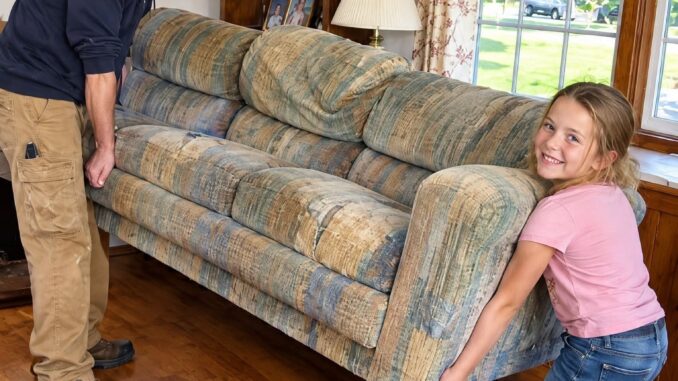
For two decades, I had urged my husband, Arthur, to get rid of our worn-out brown sofa.
The fabric had lost its color, the cushions were misshapen, and the center sagged so much that anyone seated there would gradually slide towards the person next to them.
One armrest had undergone multiple repairs, and the springs emitted a disagreeable sound whenever someone moved.
Yet, Arthur consistently declined to replace it.
Whenever I voiced my concerns, he would smile, pat the cushion beside him, and say, “But this sofa brings us closer together.”
I often rolled my eyes.
After forty-two years of marriage, I understood that changing his mind was unlikely.
Then Arthur unexpectedly passed away from a heart attack.
The piece of furniture I had longed to replace turned into the one item I couldn’t bear to part with.
Six months later, I finally sold it.
The next morning, the young father who purchased it returned to my door with a package.
My name was inscribed on the front in Arthur’s handwriting.
What I discovered inside unveiled a part of our family’s history that my husband had kept hidden for many years.
The Sofa Arthur Wouldn't Replace
Our sofa had been a fixture in our home for as long as I could remember.
We had acquired it when our family was still small.
Throughout the years, it had endured birthday celebrations, holiday get-togethers, spilled drinks, and countless evenings spent watching TV.
Our daughter, Kate, had taken her first steps near it.
Arthur and I had shared many quiet evenings together after long days.
However, over time, the sofa began to show its age.
The brown fabric faded.
The cushions became lopsided.
The armrests required constant maintenance.
Rising from the center necessitated significantly more effort than sitting down.
I frequently suggested purchasing something more comfortable.
Arthur always had a reason to keep it.
Sometimes he insisted it still had years of use ahead.
Other times he joked that modern furniture wasn’t made as sturdily.
But his favorite explanation never varied.
“This sofa keeps us close.”
I thought he was merely being sentimental.
I hadn’t realized how much significance that old piece of furniture held for him.
Adjusting to Life Without Arthur
Arthur’s death altered everything in our home.
After forty-two years of marriage, I was used to hearing his footsteps in the hallway, his laughter from the living room, and his familiar voice calling from the kitchen.
Without him, the house felt oddly silent.
Even simple routines became challenging.
I would reach for a second coffee cup only to remember that I only needed one.
At times, I turned towards his chair to share something, momentarily forgetting that he wasn’t there.
At night, the bedroom felt particularly vacant.
For months, I couldn’t bring myself to sleep there.
Instead, I rested on the old sofa, wrapped in Arthur’s favorite blanket.
The cushions were not comfortable, but the familiar setting provided a sense of solace.
I could almost envision him sitting next to me.
The sofa had become one of my strongest ties to our shared life.
My Daughter Urged Me to Make a Change
About six months after Arthur’s death, our daughter Kate came to visit.
She noticed that I was still sleeping in the living room.
One afternoon, she sat beside me and gently suggested that I think about making a few changes around the house.
“Mom, you don’t have to keep everything just as Dad left it,” she said.
I understood her intent.
She wasn’t asking me to forget him.
She merely wanted me to feel at ease in my own home once more.
We discussed rearranging the furniture and creating a space that reflected the next chapter of my life.
Eventually, I agreed to sell the sofa.
I took several photos and listed it online for forty dollars.
Before finalizing the advertisement, I hesitated.
Three times, I nearly deleted it.
But I reminded myself that memories are not confined to the items we hold onto.
I finally posted the listing.
A Young Father Came to Purchase the Sofa
The next afternoon, a young man named Eli arrived with a friend and his little daughter.
His daughter’s name was Mila.
She was joyful and inquisitive, and she immediately climbed onto the old cushions.
“Daddy, look!” she exclaimed. “We can both sit here!”
Eli chuckled.
He explained that he had recently moved into a small apartment following his divorce.
He was trying to make the place cozy for Mila during her visits.
Until then, they had been sitting on the floor to watch cartoons together.
Something about his explanation resonated with me.
I glanced at Mila, who was happily bouncing on the sofa.
Then I thought about all the evenings Arthur and I had spent sitting in that very spot.
When Eli handed me forty dollars, I returned half.
“Keep the rest,” I told him. “Buy something nice for your daughter.”
He expressed his gratitude warmly.
A few minutes later, he and his friend carried the sofa out through the front door.
I stood in the hallway, watching them leave.
Part of me wanted to ask them to bring it back.
But I understood it was time.
My First Night Back in the Bedroom
That evening, the living room appeared unfamiliar.
The vacant space where the sofa had been felt much larger than I anticipated.
I moved a small chair closer to the window and folded Arthur’s blanket carefully.
For a while, I simply stood there.
Then I went upstairs.
For the first time in six months, I slept in my own bedroom.
It wasn’t easy.
I missed Arthur just as much as I had the night before.
But I sensed that I had taken a small step toward adjusting to life without him.
The next morning, I was preparing breakfast when someone knocked at the door.
It was Eli.
He looked concerned.
In his hands was a carefully wrapped package.
An Unexpected Discovery Beneath the Cushions
“Is something wrong with the sofa?” I inquired.
Eli shook his head.
“No, it’s fine. But I found something I think belongs to you.”
He explained that Mila had dropped a pencil between the cushions while playing.
When he turned the sofa over to retrieve it, he noticed something unusual.
Part of the fabric underneath had been hand-stitched.
The stitches appeared different from the original upholstery.
Upon closer inspection, he discovered it concealed a small compartment.
Inside was a package wrapped in old tape.
My name was written on the front.
Eli handed it to me.
“I didn’t want to keep something that might be significant to your family,” he said.
I stared at the handwriting.
It was Arthur’s.
I would have recognized it anywhere.
I thanked Eli and invited him inside.
We sat at the kitchen table while I carefully unwrapped it.
A Collection of Letters From the Past
Inside the package were several envelopes and a handwritten letter.
The paper had slightly yellowed with age.
Some envelopes appeared to have been opened and read numerous times.
I unfolded the first page.
At the top was a date.
My heart sank.
April 14 was the birthday of our first daughter, Rose.
She had been born in 1986 and had passed away shortly after.
Though many years had passed, I had never forgotten her.
Arthur and I seldom discussed those early days because the memories were so painful.
I continued reading.
The initial lines explained that Arthur had been carrying a secret connected to Rose’s final hours.
I set the letter down.
For a moment, I wasn’t sure I could continue.
Then I took a breath and resumed reading.
The Difficult Decision Arthur Had Faced
Arthur’s letter described the days surrounding Rose’s birth.
Our daughter had been born with a serious heart condition.
The doctors had informed us that her chances of survival were extremely limited.
At the same time, I had developed a severe infection after childbirth.
I was receiving treatment and was unconscious for part of the time when Rose’s condition worsened.
Arthur had been left to confront an extraordinarily challenging situation.
According to his letter, a medical specialist approached him about a possible tissue donation.
Another newborn, a little boy, needed a heart valve.
The specialist explained that Rose might be able to help.
Arthur wrote that he had spent a long time sitting beside our daughter, holding her and trying to comprehend what to do.
He realized that her condition was not expected to improve.
He also knew that another family was hoping for a chance to save their child.
Eventually, he agreed to the proposed donation.
The medical events in this fictional account are part of the story and should not be taken as a description of standard transplant procedures.
The Promise He Had Been Afraid to Break
As I read further, I recalled something from those difficult days.
Before my condition worsened, I had asked Arthur to promise that no procedures would be performed on Rose after her passing.
I had been frightened, exhausted, and overwhelmed.
Arthur had reassured me.
But his letter revealed that he had already agreed to the donation.
He wrote that he had been terrified of causing me more pain.
When I later inquired whether my wishes had been honored, he told me they had.
For decades, I believed him.
Now, sitting at my kitchen table, I learned that he had concealed the truth.
I felt a mixture of emotions.
Sadness.
Confusion.
Anger.
And an overwhelming urge to ask him why he had never confided in me.
But Arthur was no longer there to respond.
All I had were the words he had left behind.
The Boy Whose Life Was Connected to Rose
The next envelope contained a photograph of a baby boy.
His name was Daniel.
A letter from his mother accompanied the picture.
She expressed gratitude to the family whose daughter’s donation had enabled her son to receive treatment.
The letter described Daniel’s recovery and the relief his parents felt as he began to grow stronger.
I sat quietly, holding the photograph.
For years, I had thought of Rose’s life only in terms of the time we had lost with her.
Now I was reading about another child whose future had been impacted by her donation.
I opened the next envelope.
It contained another photograph.
Daniel was a toddler, smiling beside a birthday cake.
The next showed him starting school.
As I continued reading, I realized that Arthur had been receiving updates about Daniel for years.
A Childhood Preserved in Letters
The envelopes formed a remarkable collection of family memories.
Daniel’s mother had written about his first steps.
She described his early school years and his excitement about learning to play baseball.
There were photographs from birthdays, school events, and family celebrations.
Some letters were brief.
Others included several pages.
Arthur had kept every one.
When Daniel was twelve, he required another medical procedure because the valve he had received as a baby could no longer meet his needs as he grew.
His family wrote that the earlier treatment had given him valuable time to reach the next stage of care.
Later letters described Daniel graduating from school and deciding to pursue a career in nursing.
He eventually became a neonatal nurse.
His work involved caring for newborn babies, including some with serious medical conditions.
I read those details slowly.
The child in the first photograph had matured into an adult who dedicated his professional life to assisting other families.
A Name That Brought Back Memories
One of the later envelopes contained a photograph of Daniel holding a newborn daughter.
On the back, someone had written her name.
Rose.
Daniel had named his little girl in memory of the baby whose donation had helped him.
I covered my mouth with my hand.
For decades, I had envisioned all the experiences our daughter would never have.
Her first birthday.
Her first day of school.
Her graduation.
The possibility of a family of her own.
Nothing could replace those moments.
But seeing another little girl bearing her name was profoundly moving.
It showed me that Rose’s memory had remained significant to a family I had never met.
I continued reading.
And then I discovered that Arthur had known far more about Daniel than I realized.
Arthur Had Met Daniel in Person
The final envelopes revealed that Arthur had eventually contacted Daniel directly.
They had arranged to meet at a local restaurant.
At first, I couldn’t believe it.
Arthur had met the boy whose life was linked to our daughter.
He had sat across from him, spoken with him, and learned about the person he had become.
According to the letters, their first meeting had been emotional.
Daniel had wanted to thank Arthur personally.
Arthur had brought the only photograph we had of Rose.
They had discussed her and the circumstances that had united their families.
Over time, the two men continued meeting.
Daniel learned about Arthur’s life, our marriage, and our surviving daughter, Kate.
Arthur learned about Daniel’s career and family.
I realized that my husband had maintained a meaningful relationship that I knew nothing about.
The Letter Arthur Never Had the Courage to Give Me
The final handwritten letter was from Arthur.
He had penned it shortly before his death.
He explained that he had intended to tell me everything on Rose’s birthday.
But each year, as the date approached, he struggled to find the words.
He feared that discovering the truth would reopen the pain I had carried for so long.
He also feared that I would never forgive him.
In the letter, Arthur apologized for making such an important decision without my input and for hiding it afterward.
He acknowledged that I had deserved to know.
Then he explained why he had resisted replacing the old sofa.
The hidden compartment had become the place where he kept Rose’s story.
Every letter and photograph represented another year of a life connected to hers.
Whenever he sat on the sofa, he knew those memories were close by.
He hadn’t kept it because it was comfortable.
He had preserved it because it contained something he couldn’t bring himself to share.
Trying to Understand the Man I Had Loved
After Eli departed, I remained at the kitchen table for hours.
The letters were spread out before me.
I read Arthur’s words multiple times.
Part of me felt betrayed.
We had shared forty-two years of marriage.
We had raised a daughter, supported each other through difficult times, and built a life together.
Yet he had concealed something so significant from me.
I wished he had trusted me enough to disclose the truth.
At the same time, I thought about the young father he had been when Rose was born.
He had been scared.
His newborn daughter was critically ill.
His wife was receiving treatment in another room.
And he had been asked to make a decision with consequences he couldn’t fully anticipate.
I could empathize with his fear without pretending that the dishonesty hadn’t hurt me.
Both feelings coexisted.
Telling Kate About Her Father’s Letters
A few days later, I invited Kate over.
I showed her the package and explained what I had uncovered.
She listened attentively as I recounted Rose’s donation, Daniel’s letters, and Arthur’s meetings with him.
When I finished, she sat quietly.
Then she reached across the table and held my hand.
“Mom, I can see why you’re upset,” she said.
I nodded.
“He should have told me.”
“Yes,” she agreed. “But I think he was also carrying a lot of fear.”
We talked for an extended period.
Kate didn’t attempt to convince me that Arthur had handled everything perfectly.
She simply reminded me that people sometimes make complex decisions under overwhelming circumstances.
Understanding those circumstances didn’t erase the pain.
But it helped me start to view the story from another angle.
Eventually, Kate asked if I wanted to contact Daniel.
I looked at the final envelope.
A phone number was written inside.
After several days of contemplation, I decided to call.
The Phone Call I Had Never Expected to Make
My hands shook as I dialed the number.
A man answered.
“Hello?”
I took a deep breath.
“My name is Frances. I believe you knew my husband, Arthur.”
There was a pause.
Then his voice softened.
“Are you Rose’s mother?”
“Yes,” I whispered.
For a moment, neither of us spoke.
Daniel explained that Arthur had told him about me during their meetings.
He had always hoped we might have the chance to meet.
We spoke cautiously at first.
I inquired about his family and his work.
He asked how I had been coping since Arthur’s passing.
Eventually, we agreed to meet at the restaurant where he and Arthur had often conversed.
I ended the call feeling anxious.
I wasn’t sure what I would say when I saw him.
But I knew I wanted to understand the life described in those letters.
Meeting Daniel and His Daughter
Daniel arrived at the restaurant with his young daughter.
She was a cheerful little girl with a bright smile.
He introduced her as Rose.
Hearing the name spoken aloud brought tears to my eyes.
Daniel greeted me warmly.
For a moment, we stood quietly before embracing.
Then we sat down and began conversing.
He shared stories about his childhood, his family, and his decision to become a nurse.
He explained that his experiences as a patient had influenced his desire to care for newborns with serious medical needs.
He also spoke about Arthur.
Apparently, my husband had shared countless stories about our life together.
He remembered how Arthur described our first meeting.
He knew about Kate.
He even knew about the small disagreements Arthur and I had over the old sofa.
I laughed through my tears.
It was strange to hear my husband’s familiar tales from someone I had just met.
A Drawing From Little Rose
During lunch, Daniel’s daughter reached into her bag.
She pulled out a drawing.
It depicted a woman holding hands with a little girl.
Above the figures, she had written:
“Grandma Fran and Baby Rose.”
I looked at Daniel in surprise.
He smiled.
“She’s grown up hearing about the little girl who helped me,” he explained.
His daughter carefully handed me the drawing.
“I made it for you,” she said.
I thanked her and placed it gently beside my plate.
It was a simple picture.
But it symbolized a connection between two families that had begun decades earlier.
For the first time, I felt I could talk about Rose without being overwhelmed solely by sadness.
Her memory had become part of another family’s narrative.
Visiting Rose’s Grave Together
A few days later, Daniel asked if he could accompany me to the cemetery.
Arthur had been buried beside Rose.
We brought flowers.
Daniel stood quietly in front of her headstone.
Then he knelt and introduced himself.
He spoke softly about his life, his work, and his family.
His daughter placed a small bouquet near the grave.
I watched them for a while.
Then I turned towards Arthur’s headstone.
I told him that I was still hurt by what he had hidden.
I wished he had given me the opportunity to understand the truth while we were together.
But I also told him that I had met Daniel.
I had witnessed the life that had emerged from the decision Arthur made during those challenging days.
And although my feelings remained complex, I was beginning to comprehend why he had carried the letters for so long.
Standing there with Daniel and his daughter, I felt less alone in remembering Rose.
Remembering Rose on Her Fortieth Birthday
On what would have been Rose’s fortieth birthday, we organized a small gathering at Arthur’s favorite restaurant.
Kate came with her family.
Daniel brought his wife and daughter.
I also invited Eli and Mila, whose discovery had brought the letters back into my life.
We exchanged stories and photographs.
Daniel spoke about his work caring for newborns and the families he had encountered throughout his career.
He explained how the donation mentioned in Arthur’s letters had given him time to grow and eventually receive further treatment.
Then he raised his coffee cup.
He thanked Rose and remembered Arthur.
Everyone joined him.
It wasn’t a commemoration of the loss our family had endured.
It was a way to honor Rose while recognizing the meaningful connections that had developed since.
For the first time in many years, her birthday felt like a day when I could share both memories and hope.
A Gift From Daniel
Before we departed the restaurant, Daniel handed me a small box.
Inside was his old nursing stethoscope.
He explained that he had used it throughout much of his career.
It had accompanied him while caring for newborn babies and supporting families through difficult times.
“I wanted you to have something that symbolizes the work I’ve been able to do,” he said.
I held the stethoscope carefully.
Then Daniel offered to let me listen to his heartbeat.
I placed the earpieces in my ears.
The rhythm was steady.
Daniel reminded me that the original donated valve had eventually been replaced.
But according to the story preserved in the letters, the earlier treatment had helped him survive long enough to receive the care he later needed.
I thanked him for sharing that moment with me.
It didn’t change the fact that I had lost my daughter.
Nothing could.
But it helped me understand another facet of the history Arthur had kept hidden.
Visiting the Old Sofa One More Time
Later that afternoon, I visited Eli and Mila.
Their apartment had become a cozy little home.
There were family photographs on the walls and vibrant drawings near the kitchen.
And in the living room stood Arthur’s old brown sofa.
It looked just as I remembered.
The faded fabric.
The repaired armrest.
The familiar sagging cushions.
Mila invited me to sit beside her.
As soon as I settled into the seat, the middle dipped and gently pulled us closer together.
I laughed.
Arthur would have loved that.
Eli explained that he had repaired the fabric underneath the sofa after discovering the letters.
But he had left a small pocket beneath one of the cushions.
Mila proudly showed me another drawing.
It depicted three people sitting together on the sofa.
Underneath, she had written:
“This couch makes you sit closer.”
Then she tucked the picture into the pocket.
I watched her with a smile.
Understanding Why Arthur Loved That Sofa
For years, I had believed Arthur kept the sofa because he disliked change.
I thought he was being obstinate.
I never imagined that the old furniture held a collection of letters connecting our daughter to another family’s life.
I also hadn’t comprehended how deeply Arthur had cherished the memory of Rose.
He had kept those letters close because they helped him remember her.
His decision to conceal them had caused pain.
I couldn’t overlook that.
But the letters also revealed how much he had thought about our daughter over the years.
And now the sofa had found another purpose.
It was providing a young father and his daughter a comfortable space to spend time together.
The same sagging cushions that had drawn Arthur and me closer were now doing the same for Eli and Mila.
Somehow, that felt right.
Learning That Love and Forgiveness Can Be Complicated
I didn’t forgive Arthur’s secrecy all at once.
There were still moments when I wished I could sit beside him and ask difficult questions.
I wanted to know why he hadn’t trusted me.
I wanted to express how much it hurt to uncover the truth after he was gone.
But I also remembered the man who had shared forty-two years with me.
The husband who made me laugh.
The father who adored Kate.
The person who had quietly preserved memories of Rose while trying to shield me from more sorrow.
I came to realize that loving someone doesn’t mean believing every decision they made was correct.
People can act out of love and still make mistakes.
Forgiveness can take time.
And understanding someone’s motivations doesn’t erase the consequences of their choices.
For me, the letters marked the beginning of that journey.
Final Thoughts: The Stories We Leave Behind
I sold Arthur’s old sofa because I thought it was time for a change.
I believed I was letting go of a worn-out piece of furniture.
Instead, the sale led me to a collection of letters that unveiled a part of our family’s history I had never known.
Through those letters, I learned about Daniel, his family, and the life he had built.
I discovered that Arthur had maintained a connection with him for years.
And I began to understand why my husband had been so hesitant to part with the sofa.
The experience didn’t erase the sadness of losing Rose or Arthur.
It didn’t make the years of secrecy easy to accept.
But it provided me with a new way to remember them.
Rose’s story was no longer preserved solely in our family photographs and memories.
It was also honored by Daniel and his daughter, who carried her name.
And Arthur’s old sofa had become part of a new family’s daily life.
Sometimes, the objects we hesitate to let go of hold memories we haven’t fully grasped.
I had spent twenty years wishing Arthur would replace that sofa.
In the end, it helped me uncover a narrative about grief, difficult choices, family connections, and the potential for understanding after loss.