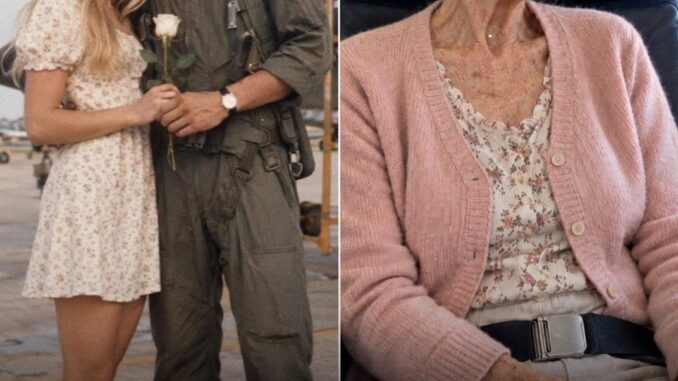
For 55 years, I thought the man I loved had vanished in Vietnam. Each year, I traveled to his memorial with a white rose, honoring the promise I made to him when I was 21. But on my most recent flight, the captain unexpectedly announced my name over the intercom and shared something that made my heart stop.
I was just twenty-one when Thomas went missing over Vietnam. Now, at seventy-six, I believed the worst thing he ever did was die without a farewell.
I told him engineers were terrible partners.
We met in college when I was eighteen. He suggested we share a cup of coffee. He had fifty cents; I had twenty.
“That’s not half,” I remarked.
“I’m an engineering student. I can make the math work.”
I was studying literature. He insisted novels were naive, filled with characters who could resolve their issues through honest conversation.
I told him engineers made awful boyfriends.
He proved me wrong for three years.
Everyone anticipated we would marry after graduation. We thought so too.
Thomas remembered everything. My exams, my mother’s birthday, how I detested raisins in cookies. When my father lost his job, Thomas discreetly delivered groceries, claiming his aunt had overbought.
His aunt lived in another state.
Everyone expected us to marry after graduation. We expected it too.
In our second year together, Thomas completed college, enlisted in the military, and began pilot training. We maintained our relationship through letters and the moments we could share.
“I’ll get you a proper engagement ring when I return.”
“I’ll get you a proper engagement ring when I return,” he promised.
“Will you propose properly too? You’ve asked me awkwardly about six times.”
“Practice makes perfect.”
The night before his deployment, we sat on my parents’ porch until the lights inside turned off.
He pressed his forehead against mine.
Six months later, Thomas’s mother called and asked me to come over.
“Don’t let me become a sad story you tell when you’re older.”
“Then come back.”
“I will.”
Six months later, Thomas’s mother called and asked me to come over. Two officers were in her living room.
His aircraft had gone missing during a mission. They had no confirmed crash site and no body. His status was missing in action.
When American prisoners began returning that year, I searched every list.
I inquired if he could be a prisoner.
“We can’t rule that out,” one officer replied.
For years, those words kept me hopeful.
Thomas’s parents relocated out of state the following year. We exchanged a few letters, but by 1973, we had lost contact.
When American prisoners began returning that year, I checked every list published in our local newspaper. Thomas’s name was not among those I saw.
A few men asked me out. Some were kind enough that I wished I could feel love for them.
Eventually, I could no longer endure another disappointment. I stopped searching.
I completed my education. I taught English. I traveled when possible and became the aunt who brought silly birthday gifts.
A few men asked me out. Some were kind enough that I wished I could love them.
Ruth, my sister, once said, “You can miss Thomas and still have a life.”
“I have a life.”
I grew frustrated with her, even though she hadn’t been unkind.
“I know. I just wish you’d let someone share it.”
I grew frustrated with her, even though she hadn’t been unkind.
Eventually, she stopped asking.
I wasn’t unhappy every day. I cherished my students, enjoyed my family, and built a life I was proud of. But whenever I saw a plane overhead, I blew it a kiss and pressed my palm to my heart.
A few days before this year’s visit, Ruth’s granddaughter, Natalie, offered to accompany me.
Each year on Thomas’s birthday, I traveled to a memorial honoring those still unaccounted for from the war. I brought a single white rose and an old photograph of us outside the college library.
I told him about my year.
Sometimes I scolded him.
“You promised, remember?”
Of course, he never responded.
I wish now that I had allowed her to join me.
“I’m perfectly capable of traveling alone,” I said.
“I know. I’m offering companionship, not oversight.”
I almost accepted. Then I told her I preferred solitude.
I wish now that I had allowed her to join me.
When I entered the small airport’s arrivals hall, I saw a man standing near the only exit, holding a photograph.
The flight was uneventful. The woman next to me spent most of it sharing pictures of her son’s wedding preparations. By the time we landed, I had seen eleven images of table settings.
Ordinary things. A normal morning.
But when I stepped into the small airport’s arrivals hall, I noticed a man standing near the only exit, holding a photograph.
I recognized it instantly.
A copy of the same photograph I carried in my purse.
Thomas and I, standing outside our college library.
A copy of the same photograph I carried in my purse.
I halted my steps.
The man looked up from the picture. He appeared to be in his thirties, with dark eyes and a crooked smile that made my stomach tighten.
“Ms. Eleanor?”
“Where did you get that?” I inquired.
“Who is your grandfather?”
He glanced at the photograph.
“My grandfather gave it to me.”
“Who is your grandfather?”
“His name is Thomas.”
I gripped the handle of my suitcase.
“Thomas was my fiancé.”
“I’m Daniel. His grandson.”
“I know.”
“Then who are you?”
“I’m Daniel. His grandson.”
I shook my head.
“That’s impossible.”
Daniel took a breath.
I asked where Thomas had been found, how long he’d been missing, whether he’d been imprisoned.
“He’s alive, Ms. Eleanor. And he asked me to bring you to him.”
For a moment, I couldn’t comprehend the words.
“Alive?”
Daniel nodded.
“I don’t know. He told us you lost contact after the war.”
Daniel explained slowly. Thomas had survived an aircraft malfunction, been captured, and held as a prisoner until his release in 1973 with other American servicemen.
“Then why wasn’t I informed?”
Daniel hesitated.
“I don’t know. He told us you lost contact after the war.”
“Lost contact?”
“Granddad kept your college picture. He remembered your town.”
“That’s what he said.”
I stared at Daniel.
“How did you find me?”
“Granddad kept your college picture. He remembered your town. I found a school newsletter with your retirement interview, then an article about your memorial visits.”
“The article mentioned the memorial and said you visited every year on his birthday.”
“How did you know I’d be here today?”
“The article mentioned the memorial and said you visited every year on his birthday. This is the nearest airport, and there’s only one arrivals exit. I wasn’t sure which flight you’d take, so I arrived early.”
“And you recognized me?”
“There was a recent picture of you in the retirement interview.”
“Does your grandfather know you’re here?”
I glanced at the photograph again.
Thomas had kept it all these years.
“Does your grandfather know you’re here?”
“Yes. He asked me to bring you to him.”
I waited for more.
I thought about all the years I’d longed for someone to tell me Thomas was coming home.
Daniel lowered his gaze.
“He’s very ill.”
Now a stranger was telling me he’d been home for decades.
“Did Thomas send you because he was too scared to face me himself?” I asked.
“He said you’d be happy to see him. That you’d both lost so much time.”
Daniel shifted uncomfortably.
“He said you’d be happy to see him. That you’d both lost so much time.”
“Did he inquire whether I’d married? Whether I had children?”
“No. He mostly wanted to know if you still visited the memorial.”
I looked past him at the people embracing their loved ones near the exit.
I called Ruth from the airport.
“I need to call my sister.”
I called Ruth from the airport.
“Thomas is alive,” I said.
She fell silent.
Then, very quietly, “Eleanor, are you safe?”
Ruth asked me to return home. I said I needed answers first.
I laughed. It was a dreadful sound.
“I don’t know.”
Ruth asked me to return home. I said I needed answers first.
Before leaving, I requested Daniel’s full name, phone number, and the address where he was taking me. I sent everything to Ruth.
Daniel drove me to a house forty minutes away. During the drive, he informed me that Thomas had married a nurse named Margaret. They had two children, including Daniel’s mother. Margaret passed away three years ago.
“Did he ever mention me to your mother?”
I gazed at the road.
“Did he remember me?”
“Yes.”
“Did he ever mention me to your mother?”
“Not until recently.”
I turned toward the window.
Thomas was sitting by the window, a blanket over his knees.
Daniel seemed to realize that I didn’t want to hear anything else about his grandfather.
The house had flowers along the walkway and a wooden sign that read GRANDPA’S PLACE.
Thomas was sitting by the window, a blanket over his knees.
He was eighty, with thin white hair and trembling hands. But I recognized his eyes.
“Eleanor,” he said.
None of those imagined moments included another woman’s family photographs on the walls.
I had envisioned hearing my name in his voice a thousand times.
He reached out to me.
I remained standing.
“Tell me when you came home.”
He glanced at Daniel.
“You’ve been home for over fifty years.”
“Could you give us a moment?”
“No,” I replied. “He brought me here. He can hear the answer.”
Thomas swallowed.
“1973.”
I calculated the years in an instant.
“Did you try to reach me?”
“You’ve been home for over fifty years.”
“I have.”
“Did you try to reach me?”
His face tightened.
“At first, I intended to.”
After his release, he spent months recovering in a military hospital.
I waited.
He explained in fragmented pieces. After his release, he spent months recovering in a military hospital. Margaret was a nurse there. She remained after her shifts and listened when he couldn’t sleep.
“She understood what I had endured,” he said.
“Did you tell her about me?”
“Yes.”
“So you chose not to return.”
“And?”
He looked at a photograph on the mantel.
“She became pregnant, and I proposed.”
I sat down to steady my legs.
“So you chose not to return.”
“Were you unable to use a phone?”
“It wasn’t that straightforward.”
“Did anyone prevent you from writing?”
“No.”
“Were you unable to use a phone?”
“Eleanor, please.”
“Answer me.”
“Then it would have been simple to send one letter.”
“No.”
“Then it would have been simple to send one letter.”
Thomas wiped his eyes.
“I thought you’d despise me.”
“I might have, but at least I wouldn’t have spent my life waiting for someone who had no intention of coming home.”
“So you let me keep mourning for 50 years.”
He said he had written letters he never sent. He believed I must have eventually married someone else. The longer he waited, the more challenging it became.
“I couldn’t bear to ruin the life I had built,” he confessed.
I looked at him.
“So you let me keep mourning for 50 years.”
“Your parents knew you had come home. They knew where I lived. Why didn’t they tell me?”
He began to cry.
But there was still something I didn’t comprehend.
Thomas stared at his hands.
“They were notified when I was released. You weren’t listed as my next of kin.”
“That doesn’t explain why they never contacted me.”
“I told them I had written to you.”
He looked away.
“I told them I had written to you.”
“And?”
“That you knew I was alive. That you’d told me not to reach out to you again.”
I stared at him.
“They believed me. They thought they were honoring your wishes.”
“You told them that?”
He nodded.
“They believed me. They thought they were honoring your wishes.”
“You lied to them too.”
He didn’t deny it.
“You told us she was an old sweetheart who lost contact.”
Daniel stood near the door, pale.
“You told us she was an old sweetheart who lost contact,” he said.
Thomas whispered, “I didn’t know she was still waiting.”
“Daniel told me you asked whether I still visited the memorial,” I said. “You knew I hadn’t forgotten you.”
Thomas lowered his gaze.
Rebecca saw me and smiled.
A car pulled into the driveway. Daniel’s mother, Rebecca, and his uncle, Peter, entered carrying groceries. Thomas had apparently invited them for dinner.
Rebecca saw me and smiled.
“You must be Eleanor. Dad told us his first love was coming. Isn’t this wonderful?”
Thomas reached for my hand.
Then I remembered every birthday I had spent talking to an empty memorial.
“I hoped we could have some time together,” he said. “Whatever time I have left. Maybe we can finally have our second chance.”
For one fleeting second, I remembered the boy sharing his coffee.
Then I remembered every birthday I had spent talking to an empty memorial.
“No.”
Thomas blinked.
“He knew I believed he was still missing, and he never told me otherwise.”
“Eleanor, please.”
Rebecca looked confused.
“Dad said you two were separated by the war.”
“We were,” I said. “Until he came home.”
“What do you mean?” she asked.
Peter set down the grocery bags.
“Your father returned in 1973. He knew I believed he was still missing, and he never told me otherwise.”
Peter set down the grocery bags.
“Dad, is that true?”
Thomas whispered, “I was ashamed.”
Rebecca stared at him.
“I loved Margaret. I love all of you. I was trying to do right by my family.”
“You let her believe you were dead?”
“I assumed she’d moved on.”
“She didn’t,” Daniel said.
Thomas looked around at their faces.
“I loved Margaret. I love all of you. I was trying to do right by my family.”
“I’m sorry. I thought he’d told me the whole story.”
“And I wasn’t family,” I said.
He flinched.
“You were everything to me once.”
“Once,” I echoed.
Daniel walked me outside. At the car, he paused and faced me.
“I’m sorry. I thought he’d told me the whole story.”
“I should have asked more questions.”
“You believed him.”
“I should have asked more questions.”
“Now you know to.”
I requested that he take me to the memorial.
He drove without turning on the radio.
At the memorial, I stood before the stone honoring those who had never returned home.
I took it from my purse and examined our youthful faces.
I placed my white rose at its base.
For the first time, I didn’t lay down our photograph.
I took it from my purse and examined our youthful faces.
“I did love you,” I whispered. “I won’t apologize for that.”
Daniel waited several steps away.
I slipped the photograph back into my purse.
When Ruth picked me up, she asked what I wanted to do next.
On the flight home, I saw another plane through the window. My hand instinctively moved toward my heart.
Then I lowered it.
When Ruth picked me up, she asked what I wanted to do next.
“Have dinner with you,” I replied.
“Then we’ll go to the beach.”
“Anything else?”
“Yes. I think I’d like to see the ocean.”
She smiled.
“Then we’ll go to the beach.”