Nine Days
My Aunt Ione rang me on a Tuesday afternoon in January, the day following the blizzard that finally subsided. I was in the bus garage at the Norway Lake school district, lying flat on my back on a creeper beneath Bus 14 with a drop light attached to the frame, attempting to determine why its air brakes kept losing pressure overnight. My phone vibrated in the pocket of my coveralls, and upon seeing her name on the screen, I quickly rolled out from under the bus and bumped my head on the bumper.
Aunt Ione doesn’t typically call during the day. She belongs to a generation that views long-distance calls as costly and believes phone conversations are reserved for emergencies, Christmas, and funerals. She has never fully accepted that I am merely six miles away. So, when her name appeared on a Tuesday at two in the afternoon, my stomach sank before I even picked up.
“Jessa,” she said. Her voice was serene, as it always is, the calm of a woman who spent thirty-eight years as a nurse at the hospital in Willmar. “I don’t want you to worry. But I was wondering if you might have some time to come by this week.”
“Are you okay? Is it your heart?”
“My heart’s fine,” she replied. “It’s my medication I’m concerned about. The post office is holding my mail. I called them this morning. They said the carrier can’t access my box, so they’ve been keeping it at the counter in Sunburg. My heart medication is in there, from the mail-order pharmacy.” She paused. “I have until Thursday.”
I sat up on the creeper with my back against the bus tire. Aunt Ione takes a medication called Eliquis for her heart, and another for her blood pressure, which she receives in a three-month supply through the mail from the Medicare pharmacy her insurance uses. She is the most organized person I have ever known. She orders her refills two weeks in advance, every time, and keeps a small calendar on her refrigerator where she marks off each day’s pills with a pencil.
“How long has it been since you received mail, Aunt Ione?”
She was silent on the line, and I could hear her counting softly as she always does, carefully, touching each day on that refrigerator calendar.
“Nine days,” she said.
Nine days. I closed my eyes. The first storm had swept through the Friday before last, leaving a foot of heavy snow that turned to ice on top, and then the blizzard struck Sunday night and raged for two consecutive days. Twenty-two inches atop what was already there, with wind gusts reaching fifty and the drifts on the township road towering as high as a pickup cab. The plows had been working on County Road 14 since Monday night, but the township road where Aunt Ione lives had only been cleared that morning.
“Is the road clear now?” I inquired.
“The road’s clear,” she said. “It’s my driveway that isn’t. Or at least the end of it. The carrier can’t get to the box.” She paused again. “It’s Hollis’s snow, Jessa. Just like always. Only this time it’s taller than I am.”
Chapter Two: The Berm
My Aunt Ione never married. She is my father’s older sister, eighty-three years old, and she has lived alone in the red farmhouse at the end of Brandvold Road for most of her life. Our family farmed that land for a century until my grandfather sold the fields to the neighbors in the eighties, but he retained the house and the five acres surrounding it and gave them to Ione, as she was the one who returned home from nursing school to care for him and Grandma in their old age. She has been there ever since, with her garden, bird feeders, gray cat named Thor, and her red mailbox at the end of a gravel drive leading to the township road.
Her driveway sits right next to Hollis Brandvold’s lane. The two run parallel to each other out to the road, maybe fifty feet apart, separated by a strip of grass and a row of lilacs. The Brandvolds have farmed the land across the lilacs since the 1880s, and the road itself is named after them. Hollis is now forty-four and took over the farm when his father passed away two springs ago.
After every storm, Hollis angled his blade to the right. He plows his own lane with a large blade on the front of an old John Deere, a quarter-mile from his yard to the road, and when he reaches the end, he swings the tractor around and pushes everything he has cleared off to the right side. To the right is the end of Aunt Ione’s driveway. Each scoop lands there, right in front of her mailbox, and by morning it is packed solid as a curb, a ridge of plowed snow and ice that freezes overnight and won’t budge for anything short of a jackhammer.
Last winter, there were nine storms. Each one left a new ridge at the end of Aunt Ione’s drive, a little taller than the last. She is eighty-three years old and five foot one, and every time she went out with a shovel, chipping her way through it so she could get her car out and the carrier could reach her box. Sometimes it would take her two hours. Twice, I drove out after work and did it for her in the dark with a pick and a scoop shovel while she stood on her porch with a flashlight, cautioning me to be careful with my back.
I asked Hollis twice, politely. The first time was in December of last year, after the third storm, when I happened to see him at the Cenex in Sunburg filling his pickup. I approached and said hello, asking if he could perhaps angle his blade the other way when he reached the end of his lane, toward the field on the left, since the snow was piling up across Aunt Ione’s drive. He listened courteously, a large quiet man in a seed cap and a canvas chore coat, and then he shrugged.
“Snow’s got to go somewhere, Jessa,” he replied. “That’s how Dad always pushed it.”
The second time was in February, after the sixth storm. I drove over to his place on a Saturday and knocked on his door. He emerged on the step in his socks, looking tired and disheveled, and I asked him again. He said he’d try to remember. He didn’t. The next storm, the ridge returned, a little taller.
His late father, Arvid, had pushed snow that way for forty years. That was the part I couldn’t comprehend. In forty years, I never once heard Aunt Ione complain about the end of her driveway. I never saw a ridge there when I was growing up, never had to shovel it out, never heard her mention it. It was only after Arvid passed away and Hollis took over the tractor that the berm appeared. I didn’t think Hollis had ever looked back to see where his snow landed.
I could have called the township. There’s a state law in Minnesota against pushing snow onto a public road, and the township board would have sent Hollis a letter. But his snow wasn’t exactly on the road. It was at the end of my aunt’s private drive, which posed a different kind of issue, one to be settled with a lawyer and a lot of hard feelings. A feud between the two families on Brandvold Road would take months to resolve. It would not get Aunt Ione her heart pills by Thursday.
Chapter Three: Dad’s Loader
I repair school buses for a living. I’ve been the head mechanic for the Norway Lake district for eleven years, ensuring that fourteen buses run through Minnesota winters that would incapacitate a lesser machine. I understand diesel engines, air brakes, and hydraulics, and I know how cold affects all of them.
What I don’t possess is anything capable of moving twenty-two inches of packed snow. I have a pickup with a plow on it, but a pickup plow won’t touch a frozen berm. I needed something with real weight, power, and a bucket. I needed my dad’s loader.
My dad is seventy and has a new knee. Dr. Halvorson in Willmar replaced his left one in December, three weeks before Christmas, and he was still using a cane and doing his exercises every morning at the kitchen table, lifting his leg with a strap. He was supposed to avoid ladders and cold weather for another month. He couldn’t climb onto his old yellow loader yet, and he despised it.
I drove to Dad’s place after work on Tuesday and found him in his recliner with his leg elevated on a pillow, watching the weather on Channel 11 out of Minneapolis. I told him about Aunt Ione’s pills and the post office and the nine days. He listened silently, his jaw tightening the entire time, and when I reached the part about the ridge being taller than she was, he set the remote down on the arm of his chair with great care.
“That Brandvold boy,” he remarked. “His dad never did that. Not once in forty years.”
“I know, Dad.”
He looked down at his knee, propped up on the pillow, and I could see him wanting to get up and handle it himself. Then he let out a long breath and pointed toward the back door.
“Key’s on the nail,” he said. “In the shop, by the door. Plug the block heater in tonight, or it won’t start in the morning. Supposed to be ten below.”
“Thank you.”
“And Jessa.” He met my gaze. “Wear your good gloves. The leather ones with the liners. That seat’s wide open, and at ten below, you’ll feel every mile.”
I went to the shop and found the key hanging on its nail where it has hung my entire life, on a ring with a small brass tag that reads JD in Dad’s handwriting. I ran an extension cord to the loader and plugged in the block heater to keep the engine warm overnight. Then I stood in the cold shop for a moment with my hand resting on the large yellow tire, thinking about Aunt Ione battling that ridge alone with her shovel.
Chapter Four: Ten Below
At dawn on Wednesday, it was ten below. There wasn’t a cloud in sight, just a bright, clear blue sky as it appears after a blizzard passes, and the snow blanketed everything like a fresh white sheet with long blue shadows stretching across it. The air was so frigid it hurt to breathe. Every sound traveled for a mile.
I pulled my gray knit cap down over my ponytail and zipped my green work coat all the way up to my chin. I wore two pairs of wool socks inside my insulated boots, Dad’s leather gloves with liners, and a scarf my mother knitted wrapped twice around my face. I still felt the cold the moment I stepped out of my pickup in Dad’s yard.
The loader started on the third try. The first attempt it groaned and turned over slowly without catching. The second it coughed once and stalled. The third time it roared to life, releasing a cloud of black smoke from the stack, then settled into a rough, steady rumble, and I sat there on the cold seat allowing it to warm up while my breath froze on my scarf.
It has an open cab, meaning no cab at all, just a seat, a steering wheel, and the levers, with nothing between you and the elements. At ten below, driving down a township road at fifteen miles an hour, the wind cuts through everything you’re wearing. By the time I reached the two miles from Dad’s place to Brandvold Road, I couldn’t feel my nose, and my eyes were watering so much that the tears froze on my eyelashes.
I went to Aunt Ione’s first.
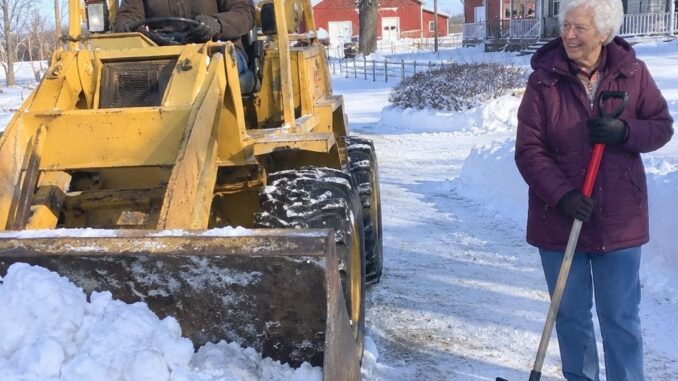
She was already out by her mailbox when I rounded the curve, standing at the end of her driveway in her long navy wool coat, the one she has worn to church every Sunday since 1979. She had a white knit hat pulled over her white hair and a pair of old leather mittens on, holding a shovel in her hands. She was chipping away at the ridge.
It was taller than she was. I could see that from the road. Hollis’s blade had pushed it into a solid wall of ice and packed snow, maybe five feet high, running all the way across the end of her drive and around her red mailbox, so the box stuck up out of the top of it like a flag on a mountain. And my eighty-three-year-old aunt was standing in front of it with a square-nosed shovel, chipping away little pieces of ice, one at a time.
I pulled the loader up beside her and shut the throttle down to hear better. She turned around and looked up at me, her cheeks flushed from the cold, and her eyes were watering as well.
“Jessa,” she said. “I was going to manage it myself.”
“I know you were, Aunt Ione.”
“I’ve been out here since seven. I’ve made about this much progress.” She showed me a small notch she’d chipped into the top of the ridge, maybe six inches deep. “I just thought, if I could reach the box, the carrier could deliver my pills tomorrow.”
“Step back,” I instructed. “Over by the lilacs.”
She stepped back. I lowered the bucket and drove into that ridge, and the loader shuddered upon hitting the packed ice, but it broke. The first bite took the top off. The second opened a notch down to the gravel. I backed up and approached from the side, and the third bite cleared most of the wall in front of her mailbox, and the fourth pushed the last of it off into the ditch on the left side, toward the field.
I broke that ridge open in four bites. It took about three minutes.
When it was finished, I turned off the loader and sat there in the sudden silence. Aunt Ione walked out to her mailbox, carefully stepping over the broken chunks of ice, and stopped in front of it. She reached up and placed her mittened hand on top of the red box. She just left it there, resting on top, as if placing her hand on the shoulder of an old friend.
“I’ve been looking at this box for nine days,” she said quietly. “From my kitchen window.”
I didn’t respond. My throat felt too tight.
Chapter Five: Eleven Walls
Then I gazed down the road.
Brandvold Road stretches a mile and a half from County Road 14 to where it dead-ends at Norway Lake, and there are eleven houses on it, including Aunt Ione’s and Hollis’s. From the loader’s seat, elevated in the cold, I could see the entire length of it in the bright morning sun. The township plow had come through that morning and opened the road itself, one lane wide with high walls of snow on either side.
And at the end of every single driveway, there was a wall.
The township plow had created the same situation for everyone that Hollis had done to Aunt Ione. When a road plow comes through after a blizzard, it pushes everything off to the side, and everything off to the side lands right across the end of everyone’s driveway. Every house on Brandvold Road had a packed ridge of snow and ice across the end of its drive, some of them four feet tall. Eleven houses. Eleven walls of snow.
I sat there on the loader for a long time observing it.
If I only did Aunt Ione’s, it would create a feud. That’s how it would appear. Everyone on the road would see that Leroy Thorvaldson’s daughter fired up his loader and cleared her aunt’s drive while leaving the Brandvold berm sitting there for the world to see, and it would be one family against another. People would take sides. Conversations would happen at church and at the Cenex. Hollis would hear about it, and the next storm, he’d shove the snow right back where it was out of sheer stubbornness, and it would continue for years.
But if I cleared the entire road, it would simply be neighbors helping each other after a storm.
So I kept going.
The next house down was Gus Lindquist’s, a small white house at the curve where the road bends toward the lake. Gus is seventy-nine, a widower since last spring. His wife, Ruth, passed away from cancer in April, and since then he mostly remains inside, watching the Twins on TV and the Weather Channel. His ridge was three feet high across his drive, and his old Buick was buried to the door handles in his yard. I broke the ridge in three bites and cleared a path up to his garage, and when I came back down to the road, he was standing on his front step in a bathrobe and a stocking cap, holding a coffee cup in both hands, staring at me.
“Thank you, Jessa,” he called. His voice sounded hoarse. “I didn’t know how I was going to get to church on Sunday.”
Past Gus was a young family in a new house, a gray split-level built three years ago. Tess Anderson is twenty-eight, a nurse’s aide at the care center in Sunburg, and she has twin boys who are four. Her husband drives truck and was somewhere in Montana. She was out in her drive with a snow shovel and both boys in snowsuits, trying to dig out her minivan, and when I approached, she put down the shovel and burst into tears.
“I have a shift at two,” she said when I halted the loader. “If I don’t make it, they’ll cut my hours. I’ve been out here since six.”
I cleared her driveway, her parking pad, and a path to the front door, while the twin boys stood in the snowbank by the mailbox, waving at me with both arms and shouting “Tractor!” each time I passed.
Chapter Six: Merle’s Eggs
People began to appear on the shoulders in their boots.
I didn’t notice it at first. I was focused on the loader, maneuvering the levers with my frozen hands, backing up, turning, and lowering the bucket. But around the fourth house, I looked up and saw people standing at the ends of their driveways in the cold, clad in their chore coats, Sorel boots, and stocking caps, watching. Some were shoveling their own front walks. Others were simply standing there.
Someone handed me coffee. At the fifth house, the Halvorsens’, Judy Halvorsen came out to the road in her husband’s barn coat carrying a thermos and handed it up to me without a word. It was so hot it burned my lips, and I drank half of it while sitting on the loader seat, steam rising off the cup into the frigid air. When I attempted to return the thermos, she shook her head and insisted I keep it.
Merle Anderson resides at the sixth house, a small farmhouse with a red barn and a chicken coop in the back. He’s eighty-eight, no relation to Tess, a retired dairy farmer who still keeps two dozen laying hens because he claims he wouldn’t know what to do with himself in the morning without them. He couldn’t reach his chickens. The drift between his back door and the coop was five feet deep, and he’d been tossing feed out his kitchen window into the snow for two days, hoping for the best.
I cleared his driveway, then took the loader around back and carved a path from his door to the coop. Merle stood on his back step in a buffalo plaid hunting coat leaning on a broom, watching me, and when I finished, he carefully descended the steps and walked out to the loader. He reached up and placed something on the step beside my boot. It was a cardboard egg carton, a dozen brown eggs, still warm.
“From the girls,” he said. “They’ve been laying the whole storm. Couldn’t get them to anyone.”
At the seventh place, I cleared Sonja Hagen’s dairy. Sonja manages sixty cows with her son, and the milk truck from the co-op in Litchfield was due at ten o’clock. Her son had cleared the yard with their skid steer, but the end of their lane was buried, and if that milk truck couldn’t make it in, they’d have to dump two days of milk. I cleared the lane and the turnaround in twenty minutes, and when I came back out to the road at nine-fifty, the big silver milk tanker was just coming around the curve. The driver honked twice and waved as he passed by me.
By the ninth driveway, they were waving from every porch.
I didn’t wave back much. My hands were occupied on the levers, and my fingers were so cold inside Dad’s gloves I could barely feel them, and my throat was tight in a way that had nothing to do with the cold. I kept my head down and continued working.
At the tenth house, the Petersons’, someone approached the loader on foot. It was Darlene Sundquist, the rural mail carrier, dressed in her Postal Service parka with the eagle patch on the shoulder. Her car was parked on the road behind me with its flashers on, a little Jeep with the steering wheel on the right side.
“I heard what you’re doing,” she shouted over the engine. “Your aunt called the post office. She told them to send me out.” She held up a large white plastic tub full of mail. “Nine days’ worth, for this entire road. I’ve been following you house to house.”
I glanced back down the road behind me. Sure enough, at every mailbox I’d cleared, the little red flag was down, and the door was shut. Darlene had been right behind me the entire time, filling them.
“Did my aunt receive her pills?” I asked.
Darlene smiled. “First stop,” she replied. “She was standing right there waiting for me with her hand on the box.”
Chapter Seven: The Last Lane
Ten driveways by twenty past eleven.
That left one.
I sat on the loader at the end of the Peterson drive with the engine idling and looked back up the road toward Aunt Ione’s. From that vantage point, I could see Hollis Brandvold’s lane running north from the road through his snowy fields, a quarter mile to his yard and his big white farmhouse and his red barns. His lane was still drifted shut. The blizzard had piled it four and five feet deep in places, and the township plow had blocked the end of it with a ridge as tall as the one I’d broken at Aunt Ione’s.
Hollis works nights. He drives a forklift on the night shift at the turkey processing plant in Willmar, from eleven at night to seven in the morning, and he farms his land in between. I knew he must have gone in to work Tuesday night somehow, perhaps with a friend who had a four-by-four, and gotten a ride back that morning. His pickup was buried in his yard. He’d be asleep now, I figured, with his curtains drawn, recuperating from a ten-hour shift.
I could have stopped right there. Ten out of eleven. Nobody on that road would have blamed me. Some might have said it served him right.
I cleared it anyway.
I drove the loader to the end of his lane and broke through the township ridge in four bites, just as I had at Aunt Ione’s. Then I began up the lane toward his yard. A quarter mile of drifted snow, packed hard by two days of wind. It took me twenty minutes, bucket after bucket, pushing forward, backing up, and pushing forward again.
And with every single scoop, I pushed left into the field. Every bucketful of snow I removed from Hollis Brandvold’s lane, I carried to the left side and dumped it in his field, away from the lilacs and away from Aunt Ione’s drive. A quarter mile of it.
When I reached his yard, I cleared a turnaround in front of his garage so he could get his pickup out. Then I backed all the way down the lane to the road.
Then I scraped the last of his old berm off Aunt Ione’s drive. There was still a little remaining along the edge of her driveway, the lower layers of last winter’s ridges and this winter’s, packed down and frozen into the gravel, a hard gray crust maybe eight inches thick. I lowered the edge of the bucket and scraped it, carefully, back and forth, the way Dad taught me to scrape a yard so you don’t disturb the gravel underneath.
I scraped it down to bare gravel. Brown and gray and dry in the cold sun, with the snow pushed back neatly on both sides. You could see precisely where Aunt Ione’s driveway ended and Hollis’s lane began, with the strip of grass and the lilacs in between, clear and clean for the first time in two winters.
I turned off the loader at 11:52.
Chapter Eight: The Door
The entire road fell silent.
You don’t realize how loud a loader is until you shut it off. That big old diesel had been roaring in my ears for five hours, and when I turned the key, the quiet descended like a blanket. I could hear the wind moving across the snow in the fields. I could hear a cow lowing over at Sonja’s dairy and Merle’s chickens clucking a quarter mile away. I could hear my own heartbeat.
I sat there on the cold seat at the end of Aunt Ione’s drive and looked down the road.
Every single neighbor was outside. I’m not sure when it happened. Sometime in the last hour, while I was clearing Hollis’s lane, they had all come out of their homes and walked to the ends of their driveways, the ones I’d cleared that morning. Gus in his bathrobe and stocking cap. Tess with her twin boys in their snowsuits. Judy Halvorsen. Merle with his broom. Sonja and her son from the dairy. The Petersons. Darlene the mail carrier was still there too, leaning on the hood of her Jeep with a cup of coffee.
Aunt Ione emerged from her house and walked down her clear gravel drive to stand beside the loader. She had her shovel. She leaned on it next to me, in her navy wool coat, and looked down the road with the rest of us.
That’s when Hollis’s front door swung open.
Across the lilacs and a quarter mile up his newly cleared lane, the front door of the large white Brandvold farmhouse opened. Hollis stepped out onto his front step. He was dressed in jeans and a gray T-shirt with no coat at all, his hair sticking up on one side from sleep. He must have heard the loader. Or perhaps he’d heard the silence when it ceased.
He looked at his lane first. A quarter mile of it, cleared and smooth all the way to the road, with the snow pushed off to the left into his field.
Then he gazed at the end of it, at Aunt Ione’s driveway beside his, scraped down to bare gravel where his ridge had been. Where his ridge had been for two winters.
Then he looked down the road at every neighbor he had, standing in the sun, looking back at him.
Nobody spoke.
He stood on his front step in his T-shirt at ten below zero for what felt like an eternity. I couldn’t see his face from that distance, only his silhouette, a large man standing very still in a doorway. Then he went back inside, and I thought maybe that was the end of it. Perhaps he’d just close the door and return to bed.
He reemerged a minute later in his canvas chore coat and unlaced boots. He descended his steps. And he began walking toward us down his lane, slowly, with his hands at his sides.
Chapter Nine: What Arvid Did
It took him five minutes to walk the quarter mile. Nobody on the road moved. Nobody returned indoors. We all simply stood there and watched him approach, a large man walking slowly down a cleared lane between two walls of snow, his breath steaming before him.
He halted at the end of his lane, right beside the strip of lilacs. Aunt Ione’s bare gravel was on his left. The loader was there, with me on it, and Aunt Ione standing beside it with her shovel. He regarded the gravel for a long time. Then he looked at me.
“You cleared my lane,” he said. His voice was rough from sleep.
“I did everybody’s,” I replied.
“You pushed it left.” He looked back up the lane, at the snow neatly piled in his field. “Into my field.”
“Snow’s got to go somewhere, Hollis.”
He flinched. I hadn’t intended for it to sting, but I watched it land. He looked down at the gravel again, at the end of Aunt Ione’s drive where his ridge had been, and I noticed an unexpected expression cross his face. It wasn’t anger. It was something closer to confusion, like a man trying to recall something he had forgotten.
Then he turned his gaze to Aunt Ione.
“I didn’t look,” he said quietly. “I’m sorry, Ione. I just never looked. I come home after a night shift at seven in the morning, and I’m so exhausted I can’t see straight. I just get on the tractor and clear the lane the way Dad always did. I never once turned around to see where it landed.” He shook his head. “Jessa asked me. Twice. And I just assumed it was how it had always been done. Dad pushed it that way for forty years, and you never said a word to him.”
Aunt Ione leaned on her shovel and regarded him for a long time. Initially, she didn’t say anything. Then she removed one hand from the shovel and placed it on his arm, her voice gentle when she spoke.
“Hollis,” she said. “Your father never left a ridge on my driveway. Not once in forty years.”
Hollis frowned. “He pushed it the same way I do. To the right. I watched him do it my whole life.”
“He did,” Aunt Ione affirmed. “He pushed it to the right. And then every single time, after he finished his lane, he turned that tractor around and came back and cleared the end of my drive. Every storm. For forty years.”
The road was utterly silent.
“He’d clear his own lane,” Aunt Ione continued, “and push it to the right, because that was the way the wind blew and the way his father pushed it, and the left side drifted worse. Then he’d come back and scoop my ridge out and push it across the road into the ditch. Afterward, he’d park his tractor by my lilacs and come in my back door for a cup of coffee at my kitchen table.” She paused. “Every storm, Hollis. Every single one. Since 1983.”
Hollis stared at her. “I never knew that.”
“I know you didn’t,” she said. “You were in school. Then you were off working. Then you returned home, and he was aging, and you probably thought he was just checking on cattle.” She almost smiled. “He was checking on me.”
Chapter Ten: The Cup on the Hook
After that, she invited us into her kitchen. Not the entire road, just Hollis and me. The neighbors drifted back to their homes one by one, Gus and Tess and Merle and the rest, and Darlene drove off in her Jeep to finish her route. Aunt Ione instructed me to bring Merle’s eggs inside before they froze, and she put on a pot of coffee, seating Hollis at her kitchen table in the chair by the window.
He sat there, surveying her kitchen as if he had never seen it before. He probably hadn’t. In forty-four years of living fifty feet away, I doubt Hollis Brandvold had ever once stepped inside Aunt Ione’s house.
There was a row of hooks by her back door, the kind for hanging coats. On the last hook, next to her own navy coat and barn jacket, hung a coffee cup. A large white enamel mug, chipped around the rim, with a faded green John Deere logo on the side.
Aunt Ione took it off the hook. She washed it in the sink and dried it carefully with a dish towel, then filled it with coffee and set it down in front of Hollis.
“That was his cup,” she said. “He kept it here. He said my coffee was better than yours.” She sat down across from him. “It’s been on that hook since the January before he died. The last storm before his stroke.”
Hollis wrapped both hands around the cup but didn’t drink. He merely held it.
“How long?” he finally asked. “You and him. How long?”
Aunt Ione was silent for a long time. She gazed out her kitchen window, past the lilacs, toward the Brandvold farmhouse a quarter mile up the lane.
“We were sweethearts in high school,” she replied. “1959. He gave me a class ring. I still have it in my jewelry box.” She smiled slightly. “I went to Minneapolis for nursing school at Swedish Hospital, and he wrote to me every week for two years. Then his father had a heart attack, and Arvid had to take over the farm at nineteen. There was a girl from church whose family owned the land across the road.” She shook her head. “His mother wanted the two farms united. And I was in Minneapolis. And Arvid was nineteen and terrified, with an entire farm on his shoulders.”
“He married my mother,” Hollis said quietly.
“He married your mother,” Aunt Ione stated. “Marit. She was a good woman, Hollis. I want you to understand that. I never once spoke ill of her, and neither did he. They had a good marriage. They had you.” She folded her hands on the table. “I returned home in 1964 to care for my parents, and I lived here fifty feet from them for thirty years, and I was grateful for them. Truly.”
“And the driveway?”
“That began in the winter of 1983,” she said. “My father passed away that November, and I was in this house alone for the first time. The first major storm, Arvid cleared his lane, and I came out the next morning to find a four-foot ridge across my drive. I stood out there with a shovel crying, having just buried my father, and I couldn’t get my car out to go to work.” She inhaled deeply. “And Arvid saw me from his yard. He returned with the tractor and cleared it. Then he came in for coffee. And he never left a ridge again.”
“Did my mother know?”
“Your mother knew,” Aunt Ione replied. “Marit understood. She would sometimes send pie over with him. She knew it was just coffee and a clear driveway between two old friends. She passed away in 2012, God rest her.” She paused. “After that, he’d stay a little longer. That’s all. An hour, maybe, on a storm morning. We’d chat about the weather, the Twins, and the price of corn.”
Hollis set the cup down on the table and buried his face in his hands.
Chapter Eleven: Forty Years
He remained at Aunt Ione’s kitchen table for a long time without speaking. I stood at the counter by the coffee pot and didn’t move. Thor the gray cat entered from the living room and jumped onto the empty chair beside him, watching him with yellow eyes.
“I didn’t know,” Hollis finally said, through his fingers. “Forty years. I observed him pushing that lane every winter. I rode on the tractor with him when I was little. And I never once saw him return.”
“He didn’t want you to,” Aunt Ione remarked. “He was a private man, your father. He didn’t want anyone making something of it.”
Hollis removed his hands from his face. His eyes were red. “When he had his stroke,” he said slowly, “and he was in the hospital in Willmar, in those final days, he kept trying to tell me something. He couldn’t communicate properly. He kept saying ‘the drive, the drive.’ I thought he was referring to the tractor. I told him I’d keep it running.” He shook his head. “I assured him not to worry; I’d continue clearing the lane just like he did.”
Aunt Ione reached across the table and placed her hand on top of his.
“He meant mine,” she said softly. “I expect he meant mine.”
Hollis broke down then. He laid his head on Aunt Ione’s kitchen table, right beside his father’s chipped coffee cup, and he cried in a way that men out here rarely do, with his whole body. Aunt Ione kept her hand on his and said nothing. She simply let him be.
I turned around and looked out the window over the sink at the bare gravel at the end of her drive, at the lilacs and the clean lane leading up to the Brandvold place, and I had to wipe my own eyes with the back of Dad’s leather glove.
When Hollis finally sat up, he wiped his face on the sleeve of his chore coat and picked up the coffee cup, drinking from it slowly. Then he looked at me standing by the sink.
“Jessa,” he said. “I owe you for the fuel. And your time. And your dad’s loader.” He swallowed. “And for asking me twice, nicely, and me not listening.”
“You don’t owe me anything,” I replied.
“I owe this entire road,” he stated. He gazed out the window at the cleared driveways. “Every one of them witnessed you do it. They all saw what I did to Ione’s drive for two winters.” He shook his head. “My dad would have been ashamed of me.”
“Your dad didn’t know you didn’t know,” Aunt Ione reassured him. “He’d have forgiven you. He forgave himself for much worse.”
Hollis was quiet for a while. Then he reached into the pocket of his chore coat and took out his wallet, and I thought he was going to attempt to pay me, and I began to shake my head. But he didn’t pull out money. Instead, he retrieved a small folded piece of paper, soft and creased from being carried for a long time, and unfolded it on the table.
It was a list, written in pencil in an old man’s shaky handwriting. Names and addresses. Every house on Brandvold Road.
“I found this in Dad’s tractor,” Hollis said. “In the toolbox, after he died. I never knew what it was. I just kept it.” He smoothed it flat. “Ione’s name is at the top. Then Gus and Ruth. Then Merle. Then the Hagens.” He looked up at us. “He didn’t just do yours, did he, Ione?”
Aunt Ione examined the list for a long time.
“No,” she replied. “He did whoever needed it. After a significant storm, he’d go down the road and help anyone who couldn’t manage on their own. Mostly the elderly. Ruth Lindquist when she became ill. Merle after his hip.” She smiled. “Mine was just the first. And the one he stopped for coffee.”
Chapter Twelve: The Next Storm
The next major storm arrived three weeks later, on a Sunday night in February. Fourteen inches, with wind. It wasn’t as severe as the blizzard, but it was enough to close the schools on Monday, which meant I didn’t have to go to the bus garage. I woke up at five-thirty and looked out my window at the snow falling sideways in the yard light, and I thought about Aunt Ione.
I dressed and drove to Dad’s place to retrieve the loader. Dad was already up, sitting at the kitchen table with his coffee and his strap, performing his knee exercises. He had received the go-ahead from Dr. Halvorson the week before to start climbing again, carefully.
“You’re heading out to Ione’s?” he asked.
“I was planning to.”
He regarded me over his coffee cup. “You might want to call her first,” he suggested.
I didn’t understand. I called her anyway, from Dad’s kitchen. She answered on the second ring, wide awake, and when I mentioned I was coming with the loader, she laughed.
“Don’t bother, honey,” she said. “My drive’s clear. Come have coffee if you’d like.”
I drove out regardless. It was just getting light when I rounded the curve onto Brandvold Road, and the snow had ceased, and the fields were white and blue in the dawn. And at the end of every single driveway on that road, the ridge was absent.
Gus’s drive was clear. Tess’s drive was clear, and her minivan was already gone to work. Merle’s was clear, with a path cut back to his chicken coop. Sonja’s lane was open for the milk truck. All the way down the road, eleven driveways, every one of them scraped down to gravel with the snow pushed off neatly to the side.
And at the end of Hollis’s lane, his old green John Deere was parked beside the lilacs, its blade down and its engine ticking as it cooled.
I pulled my pickup in at the end of Aunt Ione’s drive. Clear. Scraped to gravel. Not a ridge in sight. I walked up to her back door and knocked, and she called for me to come in, and I opened the door.
Hollis was seated at her kitchen table in his chore coat, in the chair by the window, with his father’s chipped white John Deere cup in his hands. Aunt Ione was across from him in her bathrobe, with her own cup and a plate of the egg bake she makes with Merle’s eggs. Thor was asleep on the third chair.
Hollis looked up when I entered. He appeared tired, as a man does after a night shift and a morning on a tractor in the snow. But he was smiling.
“I got off at seven,” he stated. “Cleared my lane to the left. Then I came down and did yours, Ione’s. Then I thought I might as well keep going.” He held up the folded pencil list from his father’s toolbox. “Did the whole road. Took me two hours.”
“He did it the way your grandfather taught me,” Aunt Ione remarked to me. “Down to gravel, and the snow off to the side where it won’t drift back.”
“I asked Dad’s friend Merle how he used to do it,” Hollis said. “He told me. Then he gave me a dozen eggs.”
Aunt Ione got up and poured me a cup of coffee, setting it down at the empty place, and I sat down across from Hollis at her kitchen table, in the warmth, with the snow outside the window glowing gold in the morning sun. For a while, we didn’t say anything. We just sipped our coffee and listened to the furnace hum and Thor snore on his chair.
Then Hollis set his cup down on the table, looked across at Aunt Ione, and said something I’ll remember for the rest of my life.
“Ione,” he said. “Every storm. As long as I’ve got a tractor.” He glanced at the chipped white cup in front of him. “And then I’ll come in for coffee. If that’s all right.”
Aunt Ione gazed at him for a long moment, her eyes glistening, and she smiled in a way I hadn’t seen in years.
“That’s all right, Hollis,” she replied. “That’s always been all right.”
When he departed that morning, he didn’t take his father’s cup with him. He washed it at her sink and dried it with her dish towel, then walked over to the row of hooks by her back door and hung it back up on the last hook, next to her navy coat, where it had hung for forty years. Then he stepped outside, and I watched through the kitchen window as he climbed onto his old green tractor beside the lilacs and drove slowly back up his clear lane toward home.
Aunt Ione stood at the window beside me and watched him go as well. When he was out of sight, she turned around and looked at the cup on its hook for a long time.
“His father’s hands,” she said softly, almost to herself. “Exactly his father’s hands.”
Then she sat back down at her table, finished her coffee, and reached for her pencil to check off one more day on the refrigerator calendar, the way she does every morning, carefully, touching each box. Outside, the little red flag on her mailbox stood upright in the cold sun, waiting for Darlene to come down a clear road.