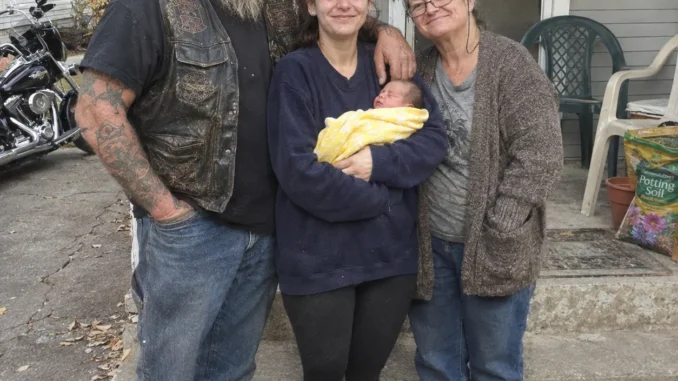
A biker noticed me in tears after my husband tossed me and our 3-day-old baby into the rain because I refused to terminate her.
I wasn’t crying due to the rain. I was crying because she hadn’t made a sound in forty minutes and I was uncertain if that was typical.
The biker switched off his engine and paused for a moment. He was a large man with a gray beard, water dripping from the brim of his hat. Then he approached slowly, as if nearing a frightened dog.
He didn’t inquire if I was okay. He didn’t ask where my husband was. He glanced at the bundle beneath my shirt and asked, “When did she last eat?”
I resented him for that question. Because the truth was I didn’t know. I had been so preoccupied with being thrown out that I had lost track, and this stranger recognized it with one glance.
I told him to leave us be. He didn’t. He removed his vest, wrapped it around both of us, and mentioned that his truck was two blocks away and his wife was a nurse.
I said I didn’t accept rides with unfamiliar men. He replied, “Ma’am, you’re sitting in a gutter with a newborn. I’m the least dangerous thing out here tonight.”
So I agreed to go. His wife met us at the door with towels already in her arms, as if she had done this before. She took my daughter, unwrapped her, and fell silent.
Then she looked at her husband over my head and said, “Ray. Go get the car. Her lips are blue.”
I don’t recall the drive to the hospital. I remember Ray’s wife, named Jean, sitting in the back with me and cradling my daughter against her bare chest under her own sweater. She told me her skin was the warmest thing in the vehicle and that was what the baby needed at that moment. She spoke about it as casually as if discussing the weather. I remember asking if my daughter was going to die and Jean hesitated before answering. “She’s cold and she’s…
I don’t recall the drive to the hospital. I remember Ray’s wife, whose name was Jean, sitting in the back with me and holding my daughter against her bare chest under her own sweater. She told me her skin was the warmest thing in the car and that was what the baby needed right now. She said it like she was telling me the weather.
I remember asking if my daughter was going to die and Jean didn’t respond immediately.
“She’s cold and she’s hungry,” she finally said. “Babies this young can’t regulate their own heat. That’s all it is. We caught it in time.”
I inquired how she knew. She informed me she had worked in labor and delivery for twenty-six years, and then she said something I’ve reflected on every day since.
“You didn’t do this to her. You kept her safe from the worst of it with your own body for two hours. Most people wouldn’t have known to do that.”
I hadn’t known to do that. I had merely been holding her.
At the hospital, they took her from me quickly. A nurse in purple scrubs carried her through a set of doors and I tried to follow, but someone’s hand landed on my shoulder and held me back. It was Ray’s hand. He didn’t say anything. He simply stood there with his hand resting on me until my knees stopped threatening to buckle.
Jean returned twenty minutes later and said they had her under a warmer and were administering sugar water through a tiny tube in her nose. Her temperature had been 94.1 when they received her. Normal is around 98.
“Another hour,” Jean said, then paused.
I urged her to finish her thought. She shook her head and said she didn’t deal in another hours, only in actual outcomes. What actually happened was that my daughter was going to be okay.
Her name is Lila. I hadn’t spoken it aloud to anyone but her yet. I said it to Jean and she wrote it on the whiteboard in the small room they gave us, and beneath it, she wrote MOM: and then looked at me.
“Hannah,” I replied.
She noted it down. Then she sat in the chair beside me and said, “Okay, Hannah. Tell me what happened tonight. All of it.”
I met Cole when I was twenty-one and he was twenty-six. He managed a tire shop owned by his uncle and had a way of making decisions that felt like relief back then. Where to eat. What to watch. When to move in together. I grew up in a home where decisions were nonexistent and everything just sort of happened to us, so a man who made decisions felt like safety.
We wed at the courthouse. His mother didn’t attend. She held opinions about me that she never voiced directly, and Cole would return from visiting her with those opinions lingering in his mouth for a day or two before he finally expressed them.
I discovered I was pregnant in February. I’d been vomiting for a week and thought it was the flu until a coworker asked me if I’d taken a test.
Cole’s face displayed something I had never seen when I told him. It didn’t fall. It closed. Like a shop door at the end of the day.
He said we couldn’t afford it. He mentioned his mother was ill and he would have to assist her more. He stated he had never wanted children, which surprised me since he had never mentioned it, and I had never asked, which was my own foolish fault.
Then he offered to pay for me to take care of it and insisted we’d never discuss it again.
I refused.
I didn’t say it out of some grand belief. I won’t pretend I was braver than I was. I said no because the moment I saw the two lines, I had already begun to communicate with her in my mind, and I couldn’t find a way to stop.
He asked me again at eight weeks. At ten. At twelve, he made the appointment himself and informed me the morning of, as if it were a dentist visit. I didn’t go. He came home and found me on the couch, and said, very quietly, that he would never forgive me for this.
I believed him about as much as one believes anyone who claims never. Which is to say I thought he would eventually get over it.
He didn’t hit me. I want to clarify that, because people often ask as if it’s the only thing that matters. He simply stopped. Stopped talking to me except to relay information. Stopped sleeping in the bed. Stopped attending appointments, which he had never initiated.
I convinced myself it would change once she was born. I had this entire vision in my mind of him holding her and that closed door on his face reopening.
He didn’t come to the hospital. He picked us up on day three because the nurses needed someone to confirm I had a ride, and he signed, then drove us home in silence, and carried the car seat inside, placing it on the kitchen floor like groceries.
Then he went to the front door and opened it. The rain had just begun.
“I told you,” he said. “I told you what I’d do. If you want her, keep her somewhere else.”
I thought he was joking for about four seconds. Then I noticed my duffel bag already sitting on the porch, getting soaked.
“Cole, she’s three days old.”
“That’s not my problem. You made her my problem and I told you I wouldn’t carry it.”
I asked where we were supposed to go. He said that was also not his problem. I asked for my car keys and he said the car was in his name. I requested my phone charger and he said I had fifteen percent left, which was enough to call whoever I needed.
I had no one to call. My mother had passed away two years ago. I hadn’t spoken to my father in a decade. The friends I had before Cole had gradually faded away, one by one, in a way I hadn’t noticed happening.
I stood on the porch with Lila and the diaper bag and my duffel, and he closed the door. I heard the deadbolt click.
I walked because I didn’t know what else to do. I had some notion of a shelter downtown but didn’t know its location and my phone died at nine percent, not fifteen, because the cold drained the battery. By the time I reached the Dollar General, I had been walking for an hour and a half and could no longer feel my hands.
That’s when I noticed she had gone silent.
Jean didn’t say anything for a while after I finished. She reached over and removed the hospital bracelet from my wrist, the one from Lila’s birth that I had never taken off, and placed it on the table as if it were evidence.
“Did he know it was raining?” she asked.
“He pointed at it.”
She nodded once, stood up, and went out into the hall. I could hear her speaking softly to someone. When she returned, Ray was with her and he had two coffees and a vending machine honey bun, which he placed in front of me without a word.
“Eat that,” Jean said. “You’re feeding her. You can’t produce milk out of nothing.”
I hadn’t considered that either. The list of things I hadn’t thought about was becoming extensive enough to drown in.
Ray and Jean resided in a brick house with a wheelchair ramp that Ray had constructed for Jean’s mother before she passed away. They had a spare room with a bed that had belonged to Jean’s mother, and a bassinet in the garage that had been used by a grandchild who was now eleven.
I know all this because that’s where Lila and I went when the hospital discharged her two days later.
I attempted to refuse. I said it was too much, that they didn’t know me, that I’d manage somehow. Ray listened to my entire speech and then said, “Where?”
I didn’t have an answer.
“Then it’s settled,” he replied. “You’ll figure something out from a warm room with a locked door. That’s the only kind of place a person can figure anything out from.”
So I slept in a deceased woman’s bed and my daughter slept in a bassinet that smelled like cedar, and for the first week, I woke every forty minutes to ensure she was breathing, and each time I checked, she was.
I learned a lot about Ray during those weeks, mostly from Jean, because Ray himself didn’t talk much.
He had been with the same club for thirty-one years. He had completed two tours before that, back when he was young enough to believe it was a good idea. He had three grown children, one of whom hadn’t spoken to him in six years and he wouldn’t disclose why.
Most Saturday mornings, he would go out with eight or nine other men his age, and they would return by noon to sit in Jean’s kitchen eating her eggs and arguing about football. They all referred to me as ma’am the first week, then Hannah the second, and by the third, they brought things. A car seat someone’s daughter no longer needed. A box of newborn clothes still in the dry cleaner’s plastic. A used phone with a prepaid card already loaded.
One night, I asked Jean why they were doing this. Not Ray and her. The rest of them. Men who had met me twice.
She was washing dishes and didn’t turn around.
“Ray had a sister,” she said. “Younger. Her husband put her out one night in January back in ‘89 with their boy. She didn’t have anywhere to go either.”
I waited.
“The boy survived,” Jean said. “She didn’t. The cold got her first. Ray was the one who found them.”
She rinsed a plate and placed it in the rack.
“That’s why he asks about the baby first. He learned it the hard way. You check on the little one first, because the little one can’t communicate.”
Cole called the prepaid phone on day nineteen. I’m not sure how he got the number. I believe his mother knew someone at the hospital.
He wanted to know where his car seat was. That was his opening line. Not where I was, not how she was. The car seat was his, he had paid for it, and he wanted it back.
I told him he could have it. I said I’d leave it on the porch since he liked the porch so much for leaving things.
He fell silent. Then he said he had been thinking, and maybe he had been hasty, and perhaps we could talk.
I glanced at Lila asleep on my chest. She had gained a pound and a half. Her lips were the color they were supposed to be.
“When did she last eat?” I asked him.
“What?”
“Your daughter. When did she last eat? Do you know?”
He didn’t respond.
“A stranger knew to ask me that,” I said. “A man I’d never met saw us for one second in the dark and knew that was the question. You carried her into the house and set her on the floor.”
I hung up. My hands were shaking so badly I dropped the phone, and Ray, who had been reading the paper across the room and not listening as he usually didn’t, picked it up and placed it next to me without a word.
I wish I could tell you Cole faced some dramatic consequence, but life doesn’t operate that way and you already know it.
What transpired was quieter. Jean knew a woman who practiced family law and did it affordably for people who came through the hospital like I did. There were documents. There was a hearing where Cole appeared in a tie and told the judge he had been under a lot of stress with his mother. The judge, a woman in her sixties, asked him to confirm the date he had asked me to leave and the weather that night, and he confirmed both, and she made a note and didn’t look at him again.
He receives supervised visitation he never uses. He pays what the state mandates. He’s not a villain in a movie. He’s simply a man who made a decision and never looked back, just as he decided everything, and I was the one who had mistaken that for strength.
I’m writing this from a kitchen table in an apartment that belongs to me. Two bedrooms. The lease is in my name and nobody else’s. I work at a dentist’s office answering phones, and Lila attends a daycare run by the daughter of one of Ray’s Saturday morning friends, who gives me a rate I know she doesn’t offer to anyone else.
Lila is now fourteen months old. She walks. She says “Ray” and it’s the only name she utters, which Jean pretends to be hurt about.
Last Sunday, I was at the grocery store and noticed a girl in the parking lot, perhaps nineteen, sitting on the curb by the cart return with a baby in one of those carriers on her chest. She wasn’t crying. She was just sitting there in the heat staring into space, and the baby wasn’t moving much, and I recognized that expression because I had worn it.
I didn’t ask if she was okay. I didn’t ask where the father was.
I approached slowly and crouched down so I wasn’t towering over her, and I asked when the baby last ate.
She looked up at me as if I had slapped her. Then her face crumbled, and she admitted she didn’t know.
I reassured her that it was fine. I introduced myself as Hannah and mentioned I knew someone who could help, and I meant Jean, but I also meant myself.
She resented me for the question. I could see it.
That’s how I knew it was the right one.