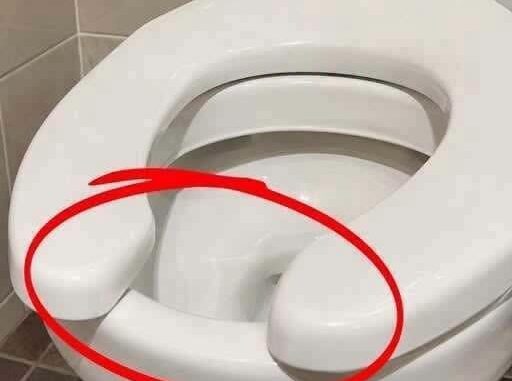
If you have ever utilized a public restroom in an airport, shopping center, or office building, you may have observed an unusual characteristic: unlike the solid, circular rings found in home bathrooms, commercial toilet seats almost always feature an open, U-shaped front. To a casual observer, the absent section might appear to be a manufacturing oversight or an unfinished plastic shell. However, this open-front design is far from an error; it is a purposeful aspect of sanitary engineering—a straightforward solution developed from years of public health standards, ergonomics, and high-volume facility management.
Hygiene First: Reducing Contact in Shared Spaces
The main reason behind the split-front toilet seat is rooted in a basic principle of public sanitation: minimizing direct physical contact with communal surfaces.
In heavily frequented restrooms visited by numerous strangers each day, the front edge of a toilet seat is statistically the most susceptible area for splashback and accidental contamination. By eliminating that section of plastic, designers significantly decrease the surface area that comes into contact with bodily fluids.
For users, the advantages are immediate and practical:
Wiping Clearance: The open gap provides an unobstructed area, enabling users to wipe hygienically after using the toilet without their hands or paper touching the seat itself.
Splash Protection: During use, the missing front section reduces the likelihood of urine splashing directly onto the rim, keeping the seating area drier and cleaner for the next user.
Gender-Neutral Utility: The opening caters to varied anatomical needs, offering additional physical clearance that prevents accidental contact with the fixture.
Regulatory Standards and the Plumbing Code
This design is not only a favored choice among facility managers—in many areas, it is explicitly mandated by law.
Since the mid-20th century, major plumbing codes throughout North America and Europe—including the American National Standards Institute (ANSI) and the International Association of Plumbing and Mechanical Officials (IAPMO)—have required open-front seats in public and commercial buildings.
These regulatory guidelines were established with public health in mind, ensuring that commercial properties meet strict sanitary standards that protect consumers from preventable cross-contamination.
Maintenance Efficiency and Durability
In addition to personal hygiene, the U-shaped seat presents significant economic and operational benefits for property managers overseeing large facilities.
Cleaning a standard solid seat necessitates staff to thoroughly scrub every inch of the perimeter, including hard-to-reach front curves where dirt easily accumulates. The open-front design simplifies routine sanitization, enabling maintenance workers to wipe down fixtures more quickly and effectively during tight cleaning schedules.
Moreover, commercial seats are designed for longevity:
Material Savings: Producing a split seat requires slightly less plastic per unit—a cost reduction that adds up significantly when outfitting a skyscraper, university campus, or stadium with hundreds of stalls.
Structural Resilience: Without a front bridge, the flexible arms of a U-shaped seat are less likely to crack under uneven weight distribution compared to rigid, closed rings.
Vandalism Resistance: Sturdier hinges and high-impact polymers ensure the seats can endure heavy, continuous daily use without needing frequent, costly replacements.
Why Don’t We Use Them at Home?
If the open-front design excels in hygiene and durability, why hasn’t it made its way into residential interior design?
The answer lies in the fundamentally different priorities of private versus public spaces. Residential bathrooms are accessed by a small, predictable group of individuals where personal hygiene habits are understood, and surface contamination is easily managed.
For homeowners, aesthetics, comfort, and cover lids take precedence over extreme sanitation protocols. A solid, round seat with a matching lid offers a warmer, more polished appearance that integrates seamlessly into home decor—and prevents items from accidentally falling into the bowl.
The Genius of Hidden Design
Every day, we engage with countless everyday objects whose subtle design choices go completely unnoticed.
The simple U-shaped toilet seat is a masterclass in functional design—an unassuming, cost-effective adjustment that quietly safeguards public health, keeps commercial facilities operating smoothly, and makes shared spaces a bit cleaner for all.
So the next time you enter a public stall, rest assured that the gap in the seat isn’t a missing piece—it’s a purposeful, thoughtful element of engineering functioning exactly as intended.