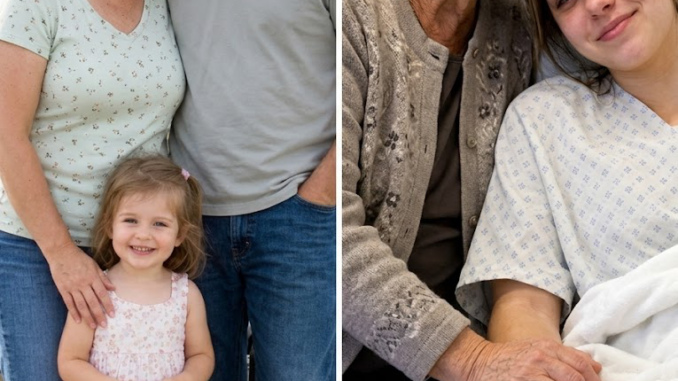
My son, Micah, was twenty-six when he passed away. He left behind a wife, a two-year-old daughter, and an entire future ahead of him.
The young man who struck him was seventeen. He had taken his parents' vehicle without consent, panicked at a junction, and caused the accident.
During the hearing, he could hardly meet my gaze. His mother wept throughout. I was furious enough to despise him. But when the judge asked if I wished to speak, I surprised everyone.
“I lost my son,” I stated. “I don’t want another mother to suffer the same loss. Please show him compassion.”
The boy finally looked up. He was in tears.
For years, I questioned whether I had made the right choice. Micah’s daughter, Hazel, grew up with only pictures and tales about her father. Then, eighteen years later, my phone rang in the middle of the night.
Hazel had developed intense abdominal pain in her college dorm. She could barely stand when she called me, so I contacted emergency services and provided them with her address.
By the time I reached the hospital, doctors were preparing her for emergency surgery.
I sat in the waiting area for nearly three hours, praying as I had the night Micah died.
Finally, the doors swung open.
A surgeon in blue scrubs approached me.
He halted upon seeing my expression.
I gazed at him, trying to comprehend why he seemed familiar.
Then I noticed his name badge.
Dr. Silas Keene.
My legs almost gave way.
It was him.
The seventeen-year-old boy from the courtroom. Now, he was a man.
“Your granddaughter is going to be fine,” he said.
I covered my mouth and began to cry.
But he didn’t walk away.
He looked at me for a long moment.
“There’s something your son said to me that night,” he murmured, “that I need to share with you.”
I grasped the back of a chair.
For eighteen years, I had held a mental image of that boy. He had been thin and terrified, sitting beside his parents with his hands clasped so tightly that his knuckles had turned pale.
The man before me had gray starting to show at his temples. His demeanor was serious, and he appeared as though he hadn’t rested much.
“You’re Silas?” I whispered.
He nodded.
“I didn’t recognize who Hazel was when she came in. I only realized your name afterward when I checked her emergency contacts.”
I stared at him.
“You performed surgery on my granddaughter?”
“Yes, ma’am. Her appendix had burst. We were able to address the infection, and she’s stable now. She’ll require antibiotics and several days of observation, but we expect her to recover.”
I should have felt relieved.
Part of me did. Another part was still grappling with how the boy responsible for my son’s death had become the doctor who saved his daughter.
Silas glanced toward the waiting area.
“Mrs. Whitaker, I know this is hard. I can arrange for another doctor to take over Hazel’s care.”
I barely heard him.
“What did Micah say?”
Silas took a deep breath.
“I’ve wanted to tell you for a long time. I just never knew if I had the right.”
“Please,” I urged. “Tell me.”
He looked down at the surgical cap in his hands.
“I got out of the car right after the accident. I was terrified. Your son was conscious, and I kept telling him I was sorry.”
Tears began to well up again.
Silas continued cautiously.
“He asked if I’d called for an ambulance. I told him I had. Then I started crying because I thought I’d killed him.”
His voice wavered.
“Your son looked at me and said, ‘I know you didn’t intend for this to happen. Please don’t let it ruin the rest of your life.'”
I covered my mouth.
For a moment, the hospital around me seemed to fade away.
“He said that?”
Silas nodded.
“I remember it because I couldn’t understand why he was trying to comfort me when he was the one who was injured.”
He wiped his eyes.
“I’ve thought about those words nearly every day.”
I sank into the nearest chair.
Micah had always been that way.
When he was twelve, he came home with a broken wrist after another boy pushed him off a swing. Instead of letting me call the boy’s parents, he begged me to leave it be because the boy had already apologized.
But knowing my son’s nature didn’t make hearing those words any easier.
“Why didn’t you tell me at the hearing?” I asked.
Silas looked remorseful.
“I thought you’d think I was trying to comfort myself. And after you asked the judge to show me mercy, I didn’t want to make things worse for your family.”
He paused.
“I went to counseling for years afterward. Eventually, I decided to pursue medicine. I wanted to do something meaningful with the life I still had.”
I looked at the hospital badge hanging from his scrubs.
“Does that make what happened easier for you?”
“No,” he replied. “I still remember what I did. Becoming a doctor doesn’t change that.”
I believed him.
But I wasn’t certain what I was supposed to do with what he had shared.
“Thank you for helping Hazel,” I finally said.
He nodded and stepped back, leaving me alone with eighteen years of memories.
When Micah died, Hazel was too young to grasp why her father had stopped coming home.
For months, she’d dash toward the front door whenever she heard a car pull into the driveway.
His wife, Laurel, was only twenty-four.
I recalled finding her asleep on the couch one afternoon, still clutching Micah’s old work jacket. Hazel was curled beside her with a picture book open on her lap.
I had tried to assist in any way I could.
I made dinners, took Hazel to daycare, and stayed with them whenever Laurel needed to work late.
However, after the hearing, something shifted between us.
Laurel couldn’t comprehend why I had asked the judge to be lenient with the teenager who caused the accident.
“Your son is gone, Etta,” she told me afterward. “And you stood there asking them to be kind to the person who took him away.”
I attempted to explain that Silas was still a child.
She looked at me with tears streaming down her face.
“So was my daughter when she lost her daddy.”
I hadn’t known how to respond.
Over the years, we managed birthdays, holidays, and family dinners. We both cherished Hazel, and neither of us wanted her caught in the middle.
But there were moments when the old disagreement resurfaced.
Whenever Laurel spoke with anger about the accident, I’d remind her that holding onto anger wouldn’t bring Micah back.
Sometimes I even said Micah wouldn’t want her to spend her life being bitter.
She always fell silent when I said that.
I used to think she was starting to agree with me.
Sitting in the hospital that night, I wondered if she’d simply stopped trying to explain herself.
Hazel woke up shortly after sunrise.
She was pale, with an IV connected to her arm, but she managed a weary smile when she saw me.
“Grandma, please tell me they didn’t remove anything vital.”
I laughed through my tears.
“Just your appendix, sweetheart.”
“Good. Because I have an exam next week.”
“You’re not worrying about exams right now.”
She rolled her eyes, then noticed my expression.
“Grandma, why have you been crying?”
I sat beside her bed.
“Because I was scared. And because something occurred that I never anticipated.”
Hazel listened as I explained who her surgeon was.
At first, she appeared confused.
Then her face shifted.
“Wait. The doctor who operated on me?”
I nodded.
“The same person who caused Dad’s accident?”
“Yes.”
She fixated on the blanket covering her legs.
“Does Mom know?”
“Not yet. She’s flying home from her conference. I called her before your surgery.”
Hazel reached for my hand.
“Grandma, what did Dad say to him?”
I recounted Silas’s words.
She listened without interruption.
For a long time, neither of us spoke.
Then she whispered, “That sounds like something Dad would say.”
I looked at her.
“You think so?”
“You’ve always told me he was kind. Mom says he couldn’t stay angry with anyone.”
Her eyes filled with tears.
“I wish I remembered him.”
I leaned forward and kissed her forehead.
“I wish you did too, sweetheart.”
Laurel arrived at the hospital that afternoon, still in her travel clothes.
She dropped her suitcase beside Hazel’s bed and embraced her daughter carefully, trying not to hurt her stitches.
“Oh, honey. You scared me half to death.”
“I’m okay, Mom.”
Laurel examined her face, asked about her pain, and checked the medications listed on the bedside chart.
Only after she was satisfied did Hazel tell her about Silas.
I watched Laurel’s expression change.
“What did you say?”
Hazel explained again.
Laurel turned toward me.
“You knew?”
“I recognized him after the surgery.”
“And you spoke with him?”
“He told me something about Micah.”
I recounted what Silas had said at the accident scene.
Laurel listened with her arms crossed.
When I finished, she shook her head.
“Of course he said that.”
I frowned.
“What do you mean?”
“Of course he returns eighteen years later with a story about Micah forgiving him.”
“Laurel, he wasn’t asking for forgiveness.”
“Wasn’t he?”
Her voice rose.
“He gets to become a doctor. He gets to have a career, a family, and a future. Micah never got any of that.”
Hazel looked uneasy.
“Mom, he saved my life.”
Laurel turned to her.
“And I’m thankful you’re alive. You have no idea how grateful.”
She took Hazel’s hand.
“But that doesn’t mean I have to thank him personally. And it doesn’t mean I have to forgive what happened to your father.”
I wanted to tell her that Micah himself had seemingly forgiven Silas.
The words were already forming when Laurel looked at me.
“Please don’t,” she said.
“Don’t what?”
“Tell me what Micah would have wanted.”
I fell silent.
Laurel’s eyes filled.
“You’ve been doing that for eighteen years, Etta. Every time I get upset, you remind me that Micah was kind. Every time I mention the accident, you tell me he wouldn’t want me to be angry.”
I stared at her.
“I was trying to help you.”
“I know you were.”
Her voice broke.
“But you made me feel like I was wrong for missing my husband the way I did.”
Hazel began to cry softly.
Laurel sat beside her.
“Sweetheart, I’m sorry. I didn’t mean to upset you.”
Hazel wiped her cheeks.
“I just don’t want us fighting because of Dad.”
Laurel kissed her daughter’s hand.
“Neither do I.”
Later that afternoon, Laurel requested to speak with Silas.
He returned with another physician, explaining that his colleague would oversee Hazel’s recovery from that point forward.
Laurel stood when he entered.
“You’re Silas Keene?”
“Yes, ma’am.”
“I’m Micah’s wife.”
Silas lowered his head.
“I’m very sorry for what happened to your husband.”
Laurel held herself rigidly.
“You told my mother-in-law that Micah forgave you.”
“I shared what I remember him saying.”
“Did you think that would make us feel better?”
“No. I wanted her to know what happened before the ambulance arrived. But I understand if hearing it was painful.”
Laurel gazed at him for a long moment.
“You were seventeen when you caused that accident. I know you didn’t wake up that morning intending to hurt anyone.”
Silas nodded.
“But I was twenty-four when I buried my husband. My daughter spent years asking why every other child had a father and she didn’t.”
Her voice quivered.
“There were nights when I wanted to call you and tell you exactly what our lives had become.”
Silas’s eyes welled up.
“You would have had every right.”
“I don’t know if I’ll ever forgive you.”
“I understand.”
Laurel glanced toward Hazel’s bed.
“But I’m glad you knew how to help my daughter.”
Silas swallowed.
“She’s a remarkable young woman. I’m glad she’s healing.”
He didn’t ask for anything else.
After a quiet farewell, he left with his colleague.
Laurel sat down, drained.
I moved my chair closer.
“Laurel, I’m sorry.”
She looked at me.
“For what?”
“For making you feel like you had to forgive him because I chose to ask for mercy.”
She stared at her hands.
“I thought if we could stop being angry, we might be able to live with what happened,” I admitted. “I didn’t realize how often I was asking you to hide what you felt.”
Laurel wiped her cheeks.
“I know you lost your son. I never forgot that.”
“And I know you lost your husband. I should have remembered that we were allowed to grieve in different ways.”
For the first time that day, she reached for my hand.
She didn’t say she forgave me, and I didn’t ask her to.
We remained beside Hazel until visiting hours concluded.
Hazel returned home four days later.
Laurel took time off work to care for her, and I came over most afternoons to assist with meals.
One evening, while Hazel rested on the couch, Laurel brought out a box of old photographs.
She handed her daughter a picture of Micah holding her as a baby.
“Your father was terrified the first time he had to give you a bath,” she said, smiling.
Hazel laughed.
“Why?”
“He thought he’d drop you. He made me stand beside him the entire time.”
I recalled that afternoon.
“And he used three towels because he was convinced you’d get cold.”
Laurel chuckled softly.
“He did. I’d forgotten about that.”
We spent the next hour looking through photographs.
Hazel asked questions about her father, and this time, Laurel and I answered them together.
We talked about his terrible singing, his habit of leaving coffee mugs in the garage, and how he once drove forty minutes to buy Laurel the lemon cake she craved while she was pregnant.
For once, nobody mentioned the accident.
Before I left, Hazel asked if we could compile an album of her father’s pictures.
“I’d like to know more about him,” she said. “Not just how he died.”
Laurel promised we’d start that weekend.
At the door, she helped me into my coat.
“Etta?”
I turned.
“I’ve been thinking about what you said at the hospital.”
I waited.
“I’m still angry about what happened to Micah. I probably always will be.”
“I understand.”
“But I don’t want that anger to keep coming between us.”
I reached for her hand.
“Neither do I, honey.”
She embraced me, something she hadn’t done in a very long time.
On the drive home, I reflected on Silas and the conversation I’d never anticipated having with him.
I didn’t know if Micah’s words had given him the courage to change his life. Perhaps he’d have become a doctor regardless. I couldn’t know how much of that night he recalled precisely, either.
But I knew my granddaughter was alive, and the man I’d once asked the judge to spare had helped save her.
When I got home, I took Micah’s photograph from the mantel and sat with it for a while.
In the picture, he was twenty-three, standing in our backyard with a silly birthday hat on his head.
I remembered how he’d complained about the hat but refused to take it off because Hazel, still a baby, laughed every time she saw him wearing it.
I’d spent so many years focusing on the day he died that I’d nearly forgotten how much there was to cherish about the years he lived.
That Saturday, I went to Laurel’s house with three albums and a shoebox full of photographs.
Hazel was waiting at the kitchen table with colored pens and a stack of blank pages.
Laurel had made coffee.
She pulled out a chair beside hers.
“Come sit down, Etta,” she said. “We’ve got a lot of pictures to go through.”
I sat beside them, and together we began with the photographs from the year Micah was born.