Twenty-six years ago, I lost my only son, Colin, to a sudden illness. He was just twenty-two, and his passing left me grappling with how my life could transform so drastically in just a few days.
Colin had always been a vibrant, healthy young man. He had a passion for photography and could spend hours roaming around town capturing images of things most people wouldn’t even notice.
He took pictures of everything from birds perched on power lines to old homes with flaking paint.
Whenever I asked him why he needed so many photos, he would smile.
“Because one day, Mom, you’ll be thankful I took them.”
I never realized how painful those words would become.
When Colin fell ill, I took time off work to care for him. I was employed as a cashier at a department store, and my manager had already cautioned me about missing too many shifts.
But my son required me.
I remained beside his hospital bed until the very end.
A few weeks following his funeral, I went back to work, hoping that keeping busy would ease the days.
Instead, my manager summoned me to his office.
“I’m sorry, Leanne, but we’ve had to replace you. We can’t keep your position open any longer.”
I remember staring at him, barely comprehending what he was saying.
I had dedicated twelve years to that job, and now I was being let go for taking care of my dying son.
I gathered my things and walked out without a word.
That afternoon, I made my way home in tears.
I had only ten dollars left in my wallet, and I was uncertain how I would manage to pay my rent.
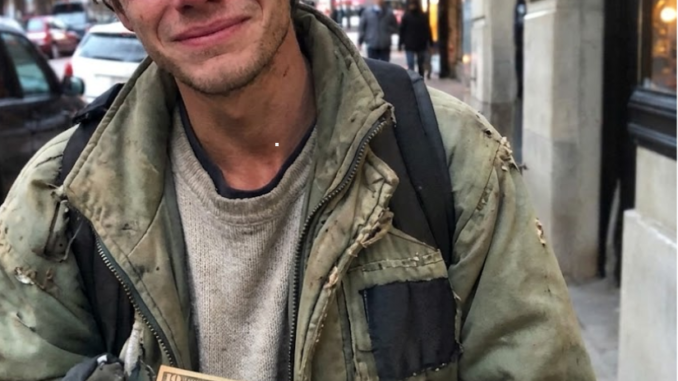
As I passed a bus stop, I spotted a young man seated on the sidewalk.
He appeared worn out and couldn’t have been much older than Colin.
Initially, I continued walking.
Then something about his jacket caught my eye.
It was an old denim jacket with a tiny red sailboat stitched above the front pocket.
I halted so abruptly that someone walking behind me nearly collided with me.
I recognized that sailboat.
I had sewn it myself when Colin was thirteen, using a piece of red fabric to mend a tear he had made while climbing a fence.
Colin had laughed when he saw my handiwork.
“Mom, now everyone will think I’m a sailor.”
A month before he fell ill, he had donated the jacket to our church’s thrift store.
And now a stranger was wearing it.
“Excuse me,” I said, approaching the young man. “Where did you find that jacket?”
He looked startled.
“At the church thrift store, ma’am. They gave me some clothes.”
I reached towards the little sailboat.
“My son used to wear this.”
The young man immediately began removing it.
“I’m sorry. I didn’t realize it belonged to someone. You can have it back.”
I shook my head.
“No, dear. Keep it. He wanted someone to have it.”
He hesitated, then slowly put it back on.
I don’t know why I chose to sit beside him that afternoon.
Perhaps I was weary from crying alone. Perhaps seeing Colin’s jacket made me feel connected to my son once more.
Whatever the reason, I found myself sharing with a complete stranger the darkest weeks of my life.
The young man listened quietly.
When I finally finished speaking, he wiped his eyes.
“I’m sorry about your son,” he said.
I thanked him and stood up.
Then I opened my wallet and took out my last ten-dollar bill.
“Here. Please get yourself something to eat.”
He stared at the money.
“Ma’am, you just told me you lost your job.”
“I’ll find another one.”
“But you need this.”
I placed the bill in his hand.
“And you need dinner.”
He glanced down for a moment before responding.
“My name’s Brent.”
“Leanne.”
He found an old receipt in his pocket and carefully wrote my name on the back.
“I won’t forget you, Leanne. Someday, I’ll find you and repay you.”
I smiled.
“Just take care of yourself, Brent.”
Then I headed home.
I thought about him occasionally during the challenging months that followed, wondering if he had found a safe place to sleep.
But I never encountered him again.
Eventually, I found another job. Several years later, I married a kind man named Frank, and we had a daughter, Maeve.
I cherished my family dearly, although I never stopped missing Colin.
Every September, on the anniversary of his death, I would pull out his photographs and spend an afternoon reminiscing about him.
That was my plan for this year.
Instead, someone knocked on my door.
The man outside wore an expensive gray suit and carried a large cardboard box.
Folded on top was an old denim jacket.
My breath caught when I saw the red sailboat above the pocket.
“Mrs. Leanne Carter?” the man inquired.
“Yes?”
“My name is Mr. Keller. I’m an attorney representing Brent Lawson.”
I stared at him.
“Brent? The young man who wore this jacket?”
He nodded.
“He’s spent several years trying to find you. He wanted me to deliver this personally.”
“Where is he?”
“He’s doing well, ma’am, but he wasn’t sure you’d want to see him after finding out what’s inside.”
I frowned.
“What do you mean?”
Mr. Keller carefully placed the box in my arms.
“Brent asked me to inform you that he made sure you received what you deserved.”
His words made me uneasy.
Before I could ask another question, he handed me his business card.
“Please call me after you’ve looked through everything.”
I took the box into the living room.
Frank was in the kitchen preparing dinner, but I told him I needed a few moments alone.
Inside the box were Colin’s jacket, a sealed envelope, and a small USB drive.
There was no money.
No lavish gift.
I opened the envelope first.
The letter was several pages long, penned in neat handwriting.
It started:
Dear Leanne,
You may not remember much about me, but I’ve never forgotten the afternoon you sat beside me on the sidewalk. I’ve wanted to thank you for years, but there’s something I need to confess first.
I sat down.
Brent explained that when we met, he was nineteen and living on the streets.
He had fallen in with a group of older young men who stole to survive.
Sometimes they took food from stores. Other times, they stole anything they believed they could sell.
Then I reached a paragraph that made my stomach churn.
Shortly before we met, two of the men I’d been staying with heard about a young man who had died. Someone told them his family had placed an expensive digital camera beside him during the funeral viewing.
I stopped reading.
Colin’s camera.
I had bought it for his twenty-first birthday after saving for months.
He carried it everywhere.
When we prepared his funeral, I placed the camera beside him because I couldn’t bear the thought of leaving behind something he had loved so dearly.
My hands began to tremble as I continued.
Brent admitted that he had helped the men enter the funeral home’s viewing room.
They had taken the camera while the room was unattended.
I covered my mouth.
For a moment, I couldn’t breathe.
Those young men had stolen from my son’s funeral, and one of them had been sitting beside me when I gave away my last ten dollars.
I wanted to tear the letter apart.
But there were several pages remaining.
After you walked away, I couldn’t stop thinking about what you’d said. I realized I was wearing your son’s jacket while helping the others sell something taken from his funeral.
I was ashamed, Leanne. I knew what we’d done was wrong, but I was too scared to go back.
He explained that before the camera was sold, he had secretly removed its memory card.
He had kept it all these years.
I can’t undo what happened. I should have returned it immediately, but I was frightened and ashamed. I hope you can forgive me for waiting so long.
I sat there staring at the letter.
I was furious with Brent for what he had done.
But I also desperately wanted to know what was on that memory card.
I picked up the USB drive.
Frank found me in the study twenty minutes later, sitting in front of our computer.
“Leanne? Is everything okay?”
I showed him the letter.
He read it quietly, then sat beside me.
“Do you want me to open the files?”
I nodded.
The USB contained a folder filled with old photographs.
The first picture showed Colin standing in front of a mirror, making a silly face.
I began to cry immediately.
I had almost forgotten how much he loved to make people laugh.
Frank gently squeezed my shoulder.
We went through the photographs together.
There were images of our old kitchen, the backyard after a snowstorm, and Colin’s friends gathered around a picnic table.
One photograph showed me asleep on the couch with a book resting on my stomach.
I laughed through my tears.
“That boy really did photograph everything.”
Then we came across a picture I had never seen before.
Colin was standing beside a young woman outside a small restaurant.
She had long brown hair and was smiling at him.
I leaned in closer.
“Who’s that?”
Frank shook his head.
“I don’t know.”
The next photograph displayed the same woman sitting on a park bench wearing Colin’s jacket.
Then there were images of them holding hands, laughing together, and cooking dinner in a small apartment.
My heart ached.
My son had been in love.
And he had never told me.
I wondered why he had kept the relationship private, but I knew Colin had been spending more time in a neighboring town during his final year.
Perhaps he had planned to introduce her to me eventually.
I clicked on the next photograph.
Then I stopped.
The young woman was standing in front of a window, smiling as Colin held her from behind.
Her stomach was noticeably rounded.
She was pregnant.
I stared at the screen.
“Frank, look at this.”
He leaned in closer.
“Oh, Leanne.”
The next photograph showed Colin kneeling beside her, his hands gently resting against her stomach.
Then came an ultrasound picture.
I checked the date.
It had been taken several months before Colin died.
I looked at Frank.
“Do you think…?”
He didn’t respond immediately.
“We need to find out who she is.”
I continued scrolling.
There were more photographs of the couple preparing a small nursery.
Colin was assembling a crib in one picture, looking thoroughly bewildered by the instructions.
In another, he was holding a tiny pair of baby shoes.
I began to cry so hard that Frank had to close the folder.
My son had been preparing to become a father.
Had the baby survived?
Was there a child somewhere who might be Colin’s?
For the first time in twenty-six years, I had a question about my son’s life that someone might still be able to answer.
The following morning, I went through every photograph again.
I enlarged the images and examined anything that might help identify the woman.
Eventually, I spotted an envelope on a kitchen counter in one image.
Most of the address was hidden, but I could make out a name.
Serena Walsh.
I wrote it down.
The ultrasound photograph also displayed part of a clinic’s name.
I called the clinic, but the receptionist explained that she couldn’t disclose patient information.
I understood, although I felt incredibly disappointed.
For several days, Frank assisted me in searching old newspapers and public records.
We found numerous people with the same name.
Then I discovered an archived birth announcement in a small-town newspaper.
A woman named Serena Walsh had welcomed a baby boy in the spring of 2001.
The child’s name was Jesse Colin Walsh.
I stared at the screen for what felt like an eternity.
Colin.
She had given her son my son’s name.
I didn’t know whether to cry or laugh.
We continued searching until we found a current profile belonging to a woman named Serena Brooks.
She looked older, but I recognized her immediately.
It was the same woman from Colin’s photographs.
I sent her a message.
Hello, Serena. My name is Leanne Carter. I’m Colin Carter’s mother. I recently found some photographs of you and my son from 2000. If you’re willing, I’d appreciate the opportunity to speak with you.
I waited anxiously.
Her reply came that evening.
I don’t know why you’re reaching out to me after all this time. Your son knew I was pregnant, and he walked away from us.
I read the message three times.
Then I responded.
Please, Serena. I think there’s something you need to know.
After several more messages, she agreed to meet me.
Serena was waiting at a small café when I arrived.
She looked exactly like the woman in the photographs, although there were faint lines around her eyes now.
She didn’t smile.
“You’re really Colin’s mother?”
I nodded.
“Thank you for agreeing to see me.”
She folded her arms.
“I almost didn’t come.”
“I understand.”
“Do you? Because I spent months waiting for your son to call me.”
My heart ached.
Serena explained that she had met Colin while he was taking photographs for a local community project.
They had begun dating and eventually discovered they were expecting a baby.
Colin had been thrilled.
They had chosen a crib, discussed names, and started looking for a larger apartment.
Then, one day, he stopped answering her calls.
“He was supposed to come visit me that weekend,” Serena said. “He never showed up.”
I could barely speak.
“I called his number for weeks. Eventually, it was disconnected.”
She looked away.
“I thought he’d gotten scared and decided he didn’t want to be a father.”
“Serena…”
“I was twenty-three, pregnant, and completely alone. I waited until the baby was born, hoping he’d return.”
Tears filled her eyes.
“But he never did.”
I reached for her hand, but she pulled away.
“Please don’t tell me he had some good reason. I spent years trying to explain his disappearance to our son.”
I swallowed.
“Colin didn’t leave you.”
She let out a bitter laugh.
“Then what would you call it?”
I took a photograph from my purse.
It showed Colin smiling beside me shortly before he became ill.
Then I placed a copy of his funeral program on the table.
“Colin died in September 2000.”
Serena stared at the paper.
For several seconds, she didn’t move.
Then she shook her head.
“No.”
“I’m so sorry.”
“No, that can’t be right.”
“He became very sick. Everything happened so quickly.”
Her hands began to tremble.
“You’re telling me he was dead all that time?”
I nodded.
Serena covered her mouth.
Tears streamed down her cheeks.
“Oh, my God.”
I sat beside her while she cried.
She shared how she had spent years resenting Colin, believing he had abandoned her and their child.
She had even told Jesse that his father had chosen not to be part of their lives.
“I thought he didn’t want us,” she whispered.
“He loved you,” I said. “I saw the photographs. He was preparing a home for your baby.”
Serena cried harder.
“I didn’t know.”
“Neither did I.”
We sat together for a long time, exchanging memories of a young man we had both loved.
Eventually, Serena took out her phone.
“There’s someone I think you should see.”
She showed me a photograph of a young man standing beside her.
He had dark hair, a familiar smile, and the same little crease beside his eyes that Colin had whenever he laughed.
“That’s Jesse,” she said. “He’s twenty-five.”
I touched the screen with trembling fingers.
“He looks so much like his father.”
Serena nodded.
“He does.”
Then she asked if I would like to meet him.
I couldn’t respond because I was crying too hard.
Jesse came to our house the following Sunday.
Serena had explained everything to him, and he’d spent several days looking through the photographs I had sent her.
When I opened the door, he stood there holding a small bouquet of flowers.
“Mrs. Carter?”
I smiled through my tears.
“Please call me Grandma Leanne, if you’re comfortable with that.”
He laughed nervously.
“I think I’d like that.”
We sat in the living room for hours.
I showed him Colin’s childhood photographs, his school certificates, and the collection of pictures he had taken around our neighborhood.
Jesse asked dozens of questions.
“What was he like when he was little?”
“Did he play sports?”
“Was he funny?”
I answered every question I could.
When I told him about the sailboat I had sewn onto Colin’s jacket, he smiled.
“Mom said Dad wore that jacket all the time.”
I went to the closet and brought it out.
Jesse held it carefully, examining the faded denim and crooked red sailboat.
“Can I try it on?”
“Of course.”
It fit him perfectly.
For a moment, I had to look away.
Frank quietly placed a hand on my shoulder.
Later that evening, after everyone had gone home, I called Mr. Keller.
I told him I had found Serena and Jesse.
Then I requested to speak with Brent.
Brent came to visit the following week.
He was in his mid-forties now, neatly dressed and noticeably anxious.
He explained that he had left the streets shortly after our meeting, found work, and eventually started a small construction business.
He had married and had two children.
For years, he had kept Colin’s memory card in a drawer, too ashamed to explain how he had obtained it.
When he finally decided to return it, locating me had been challenging because I had remarried and changed my surname.
“I’m sorry it took so long,” he said.
I looked at him.
“You should’ve told me what happened twenty-six years ago.”
“I know.”
“You have no idea how angry I was when I read your letter.”
He lowered his gaze.
“I understand.”
I was silent for a moment.
“Do you know what was on those photographs?”
He shook his head.
“I never looked through them. I thought they belonged to your family.”
I told him about Serena and Jesse.
Brent stared at me.
“Your son had a child?”
I nodded.
“And that child grew up believing his father had abandoned him.”
Brent covered his face.
“I’m so sorry.”
I reached across the table.
“I can’t pretend what you did was right. But I’m grateful you finally brought those photographs home.”
He looked up, his eyes glistening.
“Thank you, Leanne.”
We spoke for another hour.
Before leaving, Brent asked if there was anything he could do for me.
I smiled.
“You’ve already returned something I never knew I’d lost.”
A few months later, Jesse began visiting regularly.
Sometimes he brought Serena. Other times, he’d come alone and sit with Frank and me while we looked through Colin’s photographs.
He had also grown close to Maeve, who was thrilled to discover she had a nephew older than herself.
One afternoon, Jesse arrived carrying a new photo album.
Inside were copies of Colin’s old pictures, followed by photographs of Jesse growing up.
He had arranged them side by side so I could see the similarities.
There was Colin at twelve, smiling with his bicycle.
Beside it was Jesse at the same age, standing proudly with his first bike.
I laughed.
“They even stand the same way.”
Jesse smiled.
“Mom says I got his terrible sense of humor, too.”
“Then she’s probably right.”
We spent the afternoon filling the remaining pages together.
When Jesse left, I placed the album beside Colin’s photograph on the mantel.
For twenty-six years, I had believed there was nothing left for me to uncover about my son’s life.
Now I had an entire family I never knew existed.
And whenever Jesse came through our front door, smiling that familiar smile, I couldn’t help but remember the young man who had once promised that someday I would be grateful he took so many photographs.