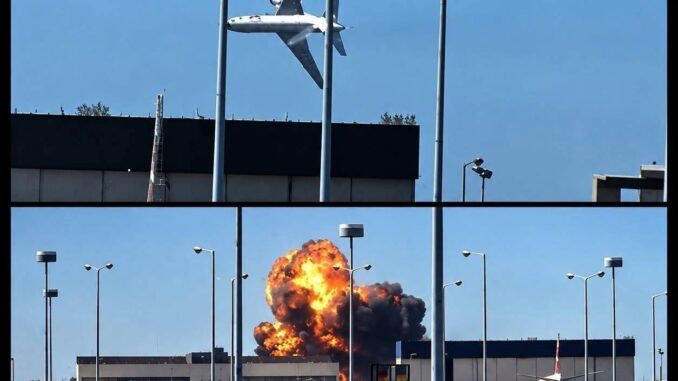
The aircraft was picking up speed on the runway at Chicago O’Hare International Airport, carrying passengers who expected a standard flight. For those aboard, May 25, 1979, started like many other travel days: luggage was stored, seats occupied, and the familiar sounds of an aircraft getting ready for departure echoed in the cabin. Outside, the plane accelerated, nearing the moment it would leave the ground.
However, mere seconds after takeoff, a disastrous mechanical failure transformed the flight into one of the most tragic incidents in aviation history.
American Airlines Flight 191, a McDonnell Douglas DC-10 bound for Los Angeles, lost its left engine assembly during takeoff. The engine and its mounting structure broke away from the aircraft, damaging vital systems and causing an abrupt, dangerous change in the airplane's aerodynamic behavior. Although the plane took off, it could not maintain safety. It rolled, dropped, and crashed shortly after departing the runway.
All 271 people aboard perished, along with two individuals on the ground, resulting in a total of 273 fatalities. The tragedy shocked the public, devastated families, and sparked urgent inquiries about aircraft maintenance, engineering, airline protocols, and how potentially hazardous mechanical problems were identified and handled.
The story of Flight 191 is more than just a series of unfortunate events. It serves as a case study of how a maintenance failure can lead to a disaster in the air, why a seemingly minor alteration in an aircraft’s behavior can have repercussions far beyond what passengers can notice, and how investigators piece together incidents that unfold in seconds.
The official investigation uncovered a critical chain of mechanical and operational failures. Understanding this chain clarifies why the aircraft could not recover and why the disaster became a pivotal moment in discussions about commercial aviation safety.
To comprehend what happened, it is essential to return to the runway at O’Hare, follow the aircraft through its final moments, and investigate the maintenance choices and engineering specifics that investigators identified as crucial to the tragedy.
**The Flight That Began Like Any Other**
American Airlines Flight 191 was a scheduled passenger service traveling from Chicago O’Hare International Airport to Los Angeles International Airport on May 25, 1979. The aircraft was a McDonnell Douglas DC-10-10, a wide-body jet powered by three engines: two located beneath the wings and a third situated at the rear of the fuselage close to the tail.
The DC-10 was designed to transport large numbers of passengers over extended distances. Its spacious cabin, three-engine layout, and long-range capabilities made it a notable aircraft in the progression of commercial air travel during the 1970s.
On that late May afternoon, passengers boarded Flight 191 expecting to journey across the United States. The crew prepared the aircraft for takeoff, and the routine checks and procedures associated with a scheduled flight were completed. Nothing about the passengers’ customary preparations could have hinted at the series of events that were about to unfold.
The departure runway was long enough for the aircraft to accelerate and achieve the necessary speed for takeoff. As the engines generated thrust, the DC-10 moved down the runway, gathering the energy needed to become airborne.
For pilots, the takeoff phase is one of the most demanding aspects of a flight. The aircraft must speed up, respond to control inputs, and transition from ground movement to flight within a carefully managed sequence. Pilots monitor engine performance, airspeed, and the aircraft’s reactions while adhering to established departure procedures.
A serious malfunction during this phase presents a particularly formidable challenge. The aircraft may be traveling too fast for a simple stop, yet it may not have enough altitude for the crew to diagnose an unfamiliar issue and recover.
That was the situation Flight 191 faced.
As the aircraft accelerated and lifted off from the runway, the left engine assembly detached from the wing. This failure was not just the loss of an engine’s thrust; the departing assembly damaged other components, including systems necessary to maintain the aircraft’s expected behavior after takeoff.
The plane continued into the air, but the damage significantly changed the scenario. The pilots dealt with an aircraft that no longer responded as expected, at a moment when altitude and time were critically limited.
What followed became the focus of the National Transportation Safety Board’s investigation.
**The Seconds After Liftoff: Why the Aircraft Could Not Recover**
The sequence that followed the engine separation was incredibly brief. According to the investigation, Flight 191 climbed to about 325 feet above ground before beginning a steep roll to the left. The aircraft continued to roll until its wings passed beyond the vertical position, and its nose dropped below the horizon.
For an aircraft just above the airport, this left almost no time to diagnose the issue, understand its effects, and react.
The engine assembly did not simply fall away without affecting other systems. Its separation damaged systems in the left wing area, including hydraulic lines and electrical components. These failures changed the aircraft's behavior and eliminated important warning indications that pilots would typically rely on to identify an unsafe condition.
To grasp the significance, it is helpful to examine two parts of an airplane that passengers seldom consider: leading-edge slats and stall-warning systems.
**What Are Leading-Edge Slats?**
Leading-edge slats are movable aerodynamic surfaces attached to the front edge of a wing. They assist the wing in generating lift at lower speeds, particularly during takeoff and landing.
When deployed correctly, slats modify the airflow around the wing, allowing it to continue producing lift at angles and speeds that would otherwise heighten the risk of a stall. Their position is carefully controlled because the aircraft’s performance depends on the wing's configuration.
On Flight 191, the separation of the left engine and its pylon damaged hydraulic lines and control-related components. The investigation revealed that the outboard leading-edge slats on the left wing unexpectedly retracted.
The right wing did not experience the same change, creating an aerodynamic imbalance: the two wings were no longer generating lift under equivalent conditions.
This difference became critical as the aircraft climbed and its airspeed decreased. The left wing, with its slats retracted, reached a stall condition while the other wing continued to produce comparatively more lift. The resulting imbalance caused the aircraft to roll sharply to the left.
**Why the Loss of Warning Systems Mattered**
The engine separation also disrupted electrical power to systems linked with the left engine. Among the affected equipment were the captain’s flight-director instrument, stall-warning equipment, and the slat-disagreement warning system.
These were not minor issues. Warning systems are designed to provide crews with information that may be difficult or impossible to observe directly from the cockpit. Pilots cannot look through the cabin windows and inspect the full position of the wings while simultaneously controlling the aircraft.
In this instance, the pilots did not receive the expected indications of the dangerous slat configuration and impending stall. The situation was further complicated because the event initially resembled an engine failure during takeoff—an emergency that flight crews are trained to handle.
The crew had to react based on the information available to them, while the aircraft’s behavior was being influenced by damage they could not fully perceive. The official investigation concluded that the loss of the warning systems left the crew with insufficient opportunity to recognize and avert the developing stall.
This point is crucial to understand before evaluating the actions taken in the cockpit. Investigators assessed the crew’s response in light of the information available, the procedures in place at the time, and the extremely limited time between the mechanical failure and impact.
The tragedy of Flight 191 was not merely that an engine detached. It was that the separation triggered several interlinked failures simultaneously, leaving the aircraft in a configuration that was extraordinarily difficult to recover from at such low altitude.
**The Maintenance Work Before the Flight**
One of the most significant findings in the investigation concerned the work performed on the aircraft prior to the accident. The left engine and its pylon—the structural assembly connecting the engine to the wing—had been removed and reinstalled during maintenance.
This work was associated with service actions involving the DC-10’s engine pylon attachment area. The aircraft’s maintenance history became central to comprehending why the assembly separated during takeoff.
An engine pylon must support immense loads. It secures the engine in place while the aircraft experiences vibration, thrust, aerodynamic forces, and changes in loading throughout flight. The attachment structure is engineered to withstand those forces, but it relies on its components remaining within specified tolerances and free from damaging cracks or deformation.
Removing and reinstalling such a heavy assembly requires precise handling. If the engine and pylon are moved in a manner that places unintended loads on attachment points, parts that appear intact can sustain structural damage.
Investigators discovered that the pylon had been damaged due to improper maintenance procedures. This critical structure had been weakened, ultimately leading to its failure under the forces experienced during takeoff.
**Why the Removal Method Became So Important**
The investigation scrutinized how the engine and pylon were handled during the maintenance process. The aircraft manufacturer’s procedures stipulated that the engine and pylon should be removed separately; however, the maintenance operation involved removing and reinstalling them together.
The method used to handle the combined assembly involved a forklift. The investigation identified issues with using that equipment to perform the precise movements needed to align the heavy structure with the wing attachment points.
The clearances between the pylon and wing structure were tight. A small unintended movement could cause contact where none was intended, potentially creating damage that might not be immediately apparent.
The issue was not simply whether the engine could be lifted or moved, but whether the operation could be performed without applying damaging forces on the attachment structure.
The investigation determined that damage incurred during the maintenance process weakened the pylon structure. Under the loads of takeoff, the damaged structure failed, allowing the engine and pylon assembly to detach from the aircraft.
This finding was particularly significant because maintenance is intended to ensure airworthiness. A task carried out to keep an aircraft safe should not introduce a hidden structural defect that remains undetected until the aircraft is under the stress of flight.
**Why a Small Crack Can Have Enormous Consequences**
Large aircraft structures are engineered with carefully calculated load paths. Forces are transferred through components and attachment points to ensure the aircraft can withstand the stresses of normal operation.
A crack in a critical structural component can reduce its ability to carry those loads. If the crack expands or the remaining material becomes too weak, the component may fail when subjected to sufficient force.
The pylon failure on Flight 191 exemplified how damage that began during maintenance could remain concealed until a critical moment. The assembly had been reinstalled, and the aircraft subsequently entered service. The defect did not manifest during a standard ground inspection in a way that prevented the flight from departing.
However, during takeoff, the engine and pylon were subjected to significant forces. The weakened structure could no longer endure them.
The lesson is not that every crack leads to catastrophe. Aviation maintenance includes inspection standards, engineering assessments, and procedures designed to identify defects before they become hazardous. The takeaway is that a small defect in the wrong location, combined with inadequate handling procedures and a failure to detect the damage, can lead to consequences far beyond the size of the original flaw.
This is why the investigation extended beyond the final mechanical failure. Investigators also examined how maintenance practices were approved, communicated, monitored, and corrected.
**The Investigation: Reconstructing a Disaster That Lasted Seconds**
After the crash, investigators faced a task that required more than merely examining the aircraft’s final position. They needed to reconstruct what transpired during takeoff, identify which systems failed, determine why the engine separated, and establish whether the crew had any realistic chance to prevent the impact.
The National Transportation Safety Board (NTSB) led the investigation. Its work included examining the wreckage, reviewing flight and maintenance records, analyzing recorded flight data and cockpit communications, interviewing witnesses, and studying the aircraft’s design and operating procedures.
The scene provided important clues. The engine and pylon assembly had separated near the runway, while most of the aircraft wreckage was located near the crash site. Investigators could examine the detached assembly and the damaged attachment structure rather than relying solely on fragments from the impact area.
The investigation also had to determine the order in which failures occurred. An aircraft crash can produce evidence of various kinds of damage: some caused before impact, some created when the aircraft strikes the ground, and others resulting from the post-crash fire. Distinguishing these categories is essential to identifying the original failure.
**Evidence From the Aircraft and Its Systems**
The physical evidence indicated that the engine and pylon had separated during takeoff rotation. Investigators examined the pylon structure and identified damage and cracking that had compromised its strength.
They also analyzed the aircraft’s hydraulic and electrical systems. The separation severed hydraulic lines and interrupted electrical power to equipment associated with the left engine. These failures explained why the left-wing slats retracted and why certain warning systems did not provide the indications the crew would typically expect.
The flight data recorder provided another crucial source of evidence. By examining the recorded parameters, investigators could reconstruct the aircraft’s speed, altitude, attitude, and movement during its brief flight.
The cockpit voice recorder and additional evidence helped establish what the crew experienced and when key events occurred. Investigators compared the available information with witness observations and physical evidence to develop a consistent sequence.
The work was not merely about identifying a single broken part. It was about understanding the chain of events that linked the maintenance operation to the aircraft’s loss of control.
**Why Investigators Look Beyond the Final Failure**
When a major component separates from an aircraft, it may seem that the cause is clear. However, identifying the immediate failure is only the beginning.
Investigators must explore why the component failed, whether the failure could have been detected, whether maintenance procedures were adequate, and whether other design or operational factors allowed the failure to escalate into a catastrophe.
In the case of Flight 191, the engine separation triggered additional failures that made the aircraft difficult to control. The loss of warning systems diminished the crew’s ability to recognize the escalating danger. Existing takeoff procedures also had to be scrutinized in light of the aircraft’s altered configuration.
The NTSB’s final report identified several contributing factors beyond the immediate maintenance-induced damage. These included vulnerabilities in the pylon attachment design, weaknesses in the leading-edge slat system, deficiencies in regulatory oversight and reporting, failures in communication among the operator, manufacturer, and Federal Aviation Administration, and the limited tolerance of the prescribed operating procedures for the unusual emergency.
This broader approach is a hallmark of serious aviation investigations. It does not merely assign blame to one individual or one component; it examines the system in which the failure occurred.
**What the Pilots Faced in the Cockpit**
The pilots of Flight 191 were faced with a situation that was both sudden and misleading. The aircraft had commenced a normal takeoff, then encountered a major failure as it transitioned into flight.
From the cockpit, the crew could not directly observe the complete separation of the left engine and pylon or the resulting damage to the wing systems. They had to interpret the aircraft’s behavior and the indications available to them.
A conventional engine failure during takeoff is a serious but recognized emergency. Pilots are trained to maintain control, follow appropriate speed and configuration procedures, and climb away using the remaining engines when circumstances allow.
Flight 191 initially presented a problem that resembled such an event. The crew’s response must be viewed in that context, rather than through knowledge that became available only after the investigation.
The difficulty arose because this was not an ordinary engine failure. The engine’s departure had damaged other systems and caused the left-wing slats to retract. The resulting aerodynamic imbalance meant that the aircraft’s stall characteristics had changed. A speed that might ordinarily have been acceptable under the applicable engine-out procedure was no longer sufficient for the damaged wing configuration.
Simultaneously, the loss of relevant warning systems deprived the crew of information that might have helped them recognize the unusual condition. The aircraft was climbing, but its performance was deteriorating.
This combination left very little chance for recovery. The aircraft reached only a few hundred feet above the ground before rolling sharply and descending.
**Why the Crew’s Limited Time Matters**
In hindsight, the sequence can be described in a clear order: the pylon failed, the engine separated, hydraulic and electrical systems were damaged, the slats retracted, the aircraft stalled asymmetrically, and the aircraft rolled out of control.
However, the pilots did not have the benefit of that reconstructed explanation at the moment. They had only seconds to respond to the evolving situation.
Aviation safety analysis must differentiate between information available to investigators afterward and information accessible to a flight crew during an emergency. This distinction is crucial when evaluating decisions.
The official findings highlighted that the failure of the warning systems and the unusual aerodynamic condition left the crew with inadequate opportunity to recognize and prevent the stall. Thus, the disaster cannot be understood simply as a case of pilots failing to respond correctly to an obvious problem.
It was a systemic failure that developed too quickly, with too little warning, during a phase of flight where the margin for error was extremely narrow.
**The Human Cost: 273 Lives Lost**
Behind the engineering details and investigative findings were hundreds of individuals whose lives ended in the disaster. Flight 191 carried 271 passengers and crew members, all of whom perished. Two additional individuals on the ground also lost their lives, bringing the total fatalities to 273.
The crash occurred in an open field near the airport, with wreckage scattering into a nearby trailer park. The aircraft was destroyed by impact and fire. Two additional individuals on the ground were injured, and nearby property, including vehicles and a mobile home, suffered damage or destruction.
For families awaiting loved ones, the news brought a sudden and devastating loss. A scheduled flight meant to connect Chicago and Los Angeles became the final journey for everyone aboard.
Disasters of this magnitude are often summarized through numbers: the number of passengers, seconds elapsed, altitude reached, or total fatalities. While these figures are necessary for understanding the event, they cannot fully capture the human consequences.
Every passenger and crew member had a personal history, relationships, responsibilities, and plans that ended that afternoon. The individuals on the ground who died or were injured were also caught in an unexpected tragedy.
The families left behind faced profound grief while investigators worked to determine how the accident occurred. Their need for answers was one reason the investigation mattered beyond its technical findings. Understanding the cause could not reverse the loss, but it could help prevent similar failures from claiming other lives.
**The Aftermath: Why the DC-10 Came Under Intense Scrutiny**
Flight 191 had an immediate and lasting impact on public confidence in the DC-10. The aircraft type had already faced scrutiny over earlier safety concerns, and the Chicago crash intensified questions about its design, maintenance requirements, and certification.
Following the accident, the Federal Aviation Administration took action affecting DC-10 operations. The aircraft’s airworthiness and the condition of its engine-pylon attachment structures became subjects of urgent review. Inspections of other aircraft uncovered additional cracked pylon attachment structures, indicating that the issue was not confined to Flight 191.
This discovery was critical. If similar damage existed on other aircraft, the safety response needed to extend beyond a single tail number or airline. Inspecting the broader fleet could help identify aircraft with comparable vulnerabilities before they encountered similar failures.
The investigation also raised questions about how maintenance instructions were written and followed. A procedure requiring heavy components to be removed separately may exist for a reason: the process can minimize the chance of applying damaging forces to sensitive attachment points.
When maintenance methods deviate from approved procedures, the consequences may not be immediately visible. The aircraft may return to service and operate normally until the damaged component encounters a load that causes it to fail.
This underscores the necessity for safety procedures to be both technically sound and consistently adhered to. It also highlights the importance of organizations having systems that promote the reporting of issues, the investigation of near misses, and the dissemination of lessons learned across the industry.
The DC-10’s history following Flight 191 was shaped by further inspections, regulatory actions, technical changes, and ongoing scrutiny. The crash became a defining example of how a maintenance error can expose weaknesses in the broader system of aircraft design, oversight, and operation.
**How Flight 191 Changed the Way Aviation Safety Is Understood**
The significance of Flight 191 extends beyond the loss of a single aircraft. Its investigation illustrated how a catastrophic accident can arise from the interaction of multiple failures rather than one isolated defect.
The weakened pylon structure was central to the accident, but the engine separation alone does not fully account for the loss of control. The separation also damaged hydraulic lines and electrical systems. Those failures led to the unexpected retraction of the left-wing slats and removed critical warnings. The aircraft then encountered an aerodynamic condition that the crew had little time or information to recognize.
Each link in this chain mattered.
If the pylon structure had not been damaged, the engine might not have separated. If the damage had been detected during maintenance, the aircraft could have been grounded for repairs. If the slats had remained in the intended configuration, the aerodynamic imbalance may not have developed in the same manner. If the warning systems had remained functional, the crew might have received more information about the dangerous condition.
These are not claims that any single change would have certainly saved the flight. They illustrate the layers of protection that aviation safety seeks to establish. A robust system does not rely on every component, procedure, and person being perfect every time. It aims to prevent one mistake or failure from cascading into disaster.
**Maintenance Is a Safety-Critical Operation**
Aircraft maintenance is sometimes perceived as a task conducted on the ground, separate from the act of flying. Flight 191 demonstrated why that distinction is misleading.
A maintenance action can alter the condition of a structure that will later endure immense forces in flight. A small crack or deformation may not affect the aircraft during a brief ground check, yet it can become critical during takeoff or another high-load phase.
For this reason, maintenance procedures specify not only what work must be completed but also how components should be supported, removed, installed, inspected, and tested. Tools and lifting equipment must be appropriate for the task, and technicians need clear instructions for handling complex assemblies.
The accident also highlighted the importance of reporting and investigating damage that may not appear immediately catastrophic. A damaged attachment point should not be dismissed as a minor issue simply because the component can still be installed or the aircraft can still operate.
**Communication and Oversight Matter**
The NTSB identified deficiencies in the surveillance and reporting systems used by the Federal Aviation Administration, as well as shortcomings in practices and communication among the airline, manufacturer, and regulator. These failures contributed to the inability to identify and prevent improper maintenance procedures and to effectively share information about previous damage incidents.
Safety information holds value only when it reaches the individuals who need it. If one organization uncovers a recurring structural problem but the information is not investigated or communicated adequately, other aircraft may remain exposed to a similar risk.
Modern aviation safety therefore relies on more than engineering strength. It also depends on documentation, quality assurance, regulatory oversight, a culture of reporting, and the willingness to act on evidence before an accident occurs.
**The Legacy of American Airlines Flight 191**
More than four decades after the crash, Flight 191 remains one of the most significant accidents in commercial aviation history. It is remembered for the scale of the loss, the dramatic engine separation during takeoff, and the detailed investigation that ensued.
The disaster also serves as an important teaching case for pilots, engineers, maintenance technicians, regulators, and aviation safety specialists. It illustrates how an aircraft can lose control when structural damage triggers multiple failures simultaneously, and why an emergency must be understood in the context of the information available to the crew.
Its legacy is not that flying is inherently unsafe. Instead, it underscores the need for ongoing vigilance in aviation safety. Commercial flight depends on a network of interconnected systems: aircraft design, inspection, maintenance, training, operating procedures, and regulatory oversight. Each layer plays a role in preventing failures and mitigating their consequences.
When an accident reveals a weakness, the industry must examine that weakness honestly and implement changes where necessary. This process is one way painful lessons can contribute to safer operations in the future.
**Remembering the People Behind the Investigation**
It is easy to become absorbed in the technical explanation of Flight 191: the cracked pylon flange, the engine separation, the hydraulic damage, the slats, and the stall. These details are essential to understanding the accident, but they do not encapsulate the entire story.
The aircraft was carrying individuals who expected to arrive in Los Angeles. They had families, friends, colleagues, and plans for the days ahead. The crew had accepted the responsibility of operating a complex aircraft and ensuring the safety of their passengers. People living near the airport were going about their lives when the aircraft crashed nearby.
The investigation clarified how the accident occurred, but no technical report can fully quantify the grief experienced by those who lost loved ones. Memorials and the continued remembrance of the victims help keep those human lives at the center of the story.
The crash also serves as a reminder to distinguish documented evidence from speculation. Over time, major disasters can attract simplified explanations, rumors, or dramatic retellings that obscure the sequence established by investigators. Flight 191 is a powerful example of why the official findings matter: the catastrophe was not merely an unexplained failure seconds after takeoff. It involved a traceable sequence of maintenance-induced structural damage, system failures, aerodynamic changes, and limited opportunity for recovery.
Understanding those facts honors the victims more than sensationalizing the final moments.
**Final Thoughts: A Catastrophe That Began Before Takeoff**
American Airlines Flight 191 departed Chicago O’Hare on May 25, 1979, for what should have been a routine flight to Los Angeles. Seconds after becoming airborne, its left engine and pylon assembly separated from the aircraft. The separation damaged systems that helped control and monitor the wing, leading to an asymmetric stall and an uncontrollable roll at low altitude.
The crash claimed the lives of all 271 individuals on board and two people on the ground. The subsequent investigation traced the initiating failure to maintenance-induced damage that weakened the engine-pylon attachment structure. It also identified deficiencies in design vulnerability, oversight, communication, and the ability of existing procedures to accommodate the unusual emergency.
The tragedy illustrates that an aviation disaster may begin long before passengers board the aircraft. The critical event can be a hidden defect introduced during maintenance, a problem that goes undetected, or a warning system that fails to provide the necessary information at the decisive moment.
Flight 191 remains a reminder of the importance of adhering to approved maintenance procedures, inspecting critical structures, sharing safety information, and treating every identified defect with seriousness. These safeguards are crucial because the consequences of failure can be enormous.
Above all, the story should be remembered not only for the dramatic loss of an aircraft but also for the 273 lives lost and the lessons drawn from the investigation. The purpose of studying such a disaster is not to turn tragedy into spectacle; it is to understand what happened clearly enough that future generations can continue working to prevent similar events.