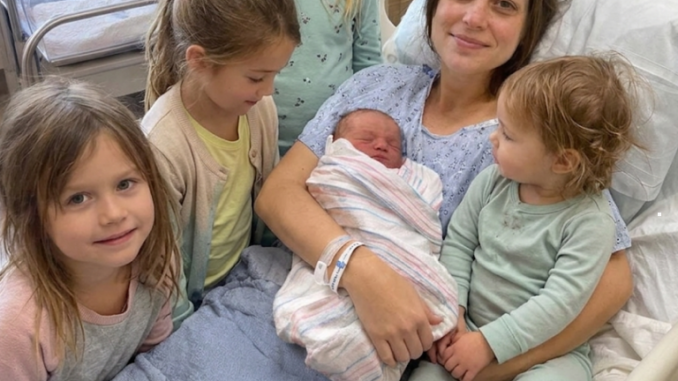
My husband, Graham, and I had been married for eight years, and throughout most of that time, our home had been filled with little girls, scattered toys, and the kind of noise that made it impossible to hold a quiet conversation.
We had four daughters, and my love for each of them was beyond words.
However, Graham had always longed for a son.
Even before we tied the knot, he spoke of teaching his little boy to ride a bike, taking him fishing, and eventually passing down the watch his father had given him.
When I became pregnant with our first child, he was so convinced we were having a boy that he purchased a tiny baseball glove before my first ultrasound.
Instead, we welcomed our daughter, Maisie.
Graham cherished her. He carried her around the house, changed her diapers without a word of complaint, and spent hours gazing at her while she slept.
Yet, when anyone inquired if we intended to have another baby, his response remained the same.
“Absolutely. Maisie needs a little brother.”
Two years later, our second daughter, Tilly, was born.
Then came Nora, followed by our youngest, Elsie.
By the time Elsie arrived, I felt completely drained. Four pregnancies had taken a toll on my body, and caring for four young children left me with barely enough energy to get through the day.
I was content with our family, but Graham wasn’t ready to stop.
“Just one more,” he would say whenever the topic arose. “I know you adore the girls, and I do too. But wouldn’t it be amazing to have a son as well?”
I attempted to explain that another baby meant another pregnancy, more sleepless nights, and additional years of diapers and daycare.
Graham always listened, but a few weeks later, the conversation would resurface.
Eventually, I consented to try one last time.
When the pregnancy test turned positive, Graham was happier than I had seen him in years.
He kissed my forehead, placed his hand on my abdomen, and whispered, “This time, I believe we’re finally having our little boy.”
At our twenty-week ultrasound, the technician confirmed it.
We were expecting a son.
Graham nearly leaped out of his chair.
He called his mother from the parking lot, bought blue balloons on the way home, and spent the next weekend clearing out the spare bedroom.
I watched him paint the walls while our daughters sat in the doorway, asking if their little brother would be allowed to play with their dolls.
“Of course he will,” I replied.
Graham chuckled.
“We’ll see about that.”
As months went by, my pregnancy became more challenging. My doctor instructed me to rest after I began experiencing contractions too early, which meant I couldn’t manage school runs or household chores as I usually did.
Fortunately, Graham’s longtime best friend, Silas, offered his assistance.
Silas had been part of our lives since before our wedding. He and Graham had grown up together, and our daughters referred to him as Uncle Silas.
When Graham worked late, Silas sometimes picked the girls up from school, brought groceries, or helped with tasks around the house.
I was thankful because I recognized how hard Graham was working to support our expanding family.
I never anticipated that such kindness would someday be turned against me.
My labor lasted nearly thirteen hours.
By the time our son arrived, I was trembling from exhaustion, and all I wanted was to hold him close.
“It’s a boy,” the doctor announced. “And he’s doing wonderfully.”
Graham stood beside my bed, tears streaming down his cheeks.
“A boy,” he whispered, laughing through his tears. “We finally have a boy.”
I smiled at him.
“Yes, Graham. We have a son.”
We named him Bennett.
He weighed seven pounds and six ounces, had a full head of dark hair, and made the sweetest little grunting noises whenever someone touched his cheek.
After the nurse finished examining him, she wrapped him in a blanket and handed him to Graham.
I watched my husband cradle our son, his face radiating the kind of happiness I had longed to see.
“Hey, buddy,” he whispered. “I’ve been waiting a long time to meet you.”
Then Bennett began to squirm.
His blanket slipped as Graham adjusted him, uncovering part of his back. The nurse moved closer to fix his clothing, but Graham abruptly stopped her.
“Hold on a second.”
He stared at something just above Bennett’s waist.
“What’s that?”
The nurse glanced down.
“Oh, that’s just a birthmark. Nothing to worry about.”
It was a small, reddish-brown mark shaped almost like a crescent.
I couldn’t see it clearly from the bed, but Graham apparently could.
His smile vanished.
He pulled the blanket down further, examined the mark again, and looked at me with an expression I didn’t recognize.
“Graham? What’s wrong?”
He didn’t respond right away.
Then he asked, “How long has this been happening?”
I frowned.
“What are you talking about?”
His jaw tightened.
“You and Silas.”
For a moment, I thought I had misunderstood him.
“What?”
“Don’t act like you don’t know what I’m asking.”
The nurse appeared uncomfortable.
“Graham, what’s going on?”
He turned toward me, still holding our newborn son.
“That birthmark. Silas has the exact same one, in the exact same spot.”
I stared at him.
“Okay? And?”
“And you think that’s just a coincidence?”
I felt the blood drain from my face.
“Are you seriously accusing me of having an affair with your best friend?”
Graham looked down at Bennett.
“How else do you explain this?”
I couldn’t believe what I was hearing.
I had just spent thirteen hours bringing his child into the world, and my husband was standing beside my hospital bed accusing me of infidelity.
“Graham, Bennett is your son.”
“Then why does he have Silas’s birthmark?”
“I don’t know! People have birthmarks. That doesn’t mean anything.”
But Graham wasn’t listening.
He began recounting all the evenings he’d worked late, how often Silas had come to our house, and the times he’d found us chatting in the kitchen.
“You two always seemed awfully comfortable together,” he remarked.
“Because he’s your friend! You were the one who asked him to help me!”
Graham shook his head.
“I can’t believe you did this to me.”
Tears filled my eyes.
“Please don’t say that. I’ve never been unfaithful to you.”
He placed Bennett back in the bassinet.
Then he took a step back.
“I don’t think that’s my child.”
Those words hurt more than anything I experienced during labor.
“Graham, please. We can do a DNA test. I’ll do whatever you want.”
But he was already reaching for his jacket.
“I’m not bringing another man’s baby into my home.”
I called his name as he walked toward the door.
He didn’t look back.
A minute later, the nurse returned and found me crying so hard that I could barely explain what had transpired.
Bennett began to cry as well.
I reached for him, wincing as I moved, and held him against my chest.
His tiny hand curled around my finger.
I couldn’t comprehend how the same man who had spent months preparing for our son’s arrival could abandon us over something neither of us could clarify.
Graham didn’t return to the hospital.
He didn’t answer my calls that evening or the following morning.
When I finally received a message from him, I almost wished he hadn’t responded at all.
I think you should stay somewhere else when you’re discharged. I need time to decide what I’m going to do.
I read those words while Bennett slept beside me.
Eight years of marriage. Five children. And Graham was asking me not to come home.
My older sister, Corinne, arrived that afternoon.
She took one look at my swollen eyes and asked what had happened.
I told her everything.
By the time I finished, she was furious.
“He left you there? Right after you gave birth?”
I nodded.
“And he won’t even agree to a test.”
Corinne sat beside me and took my hand.
“Then let him explain himself when the results come back. You don’t need to keep begging him.”
Three days later, she brought Bennett and me to her home.
Our four daughters were already staying there, and they ran toward me the moment I entered.
Maisie, our oldest, carefully peeked inside the baby carrier.
“Mommy, is that Bennett?”
“Yes, sweetheart.”
She beamed.
“Can Daddy come over so we can all take a family picture?”
I swallowed hard.
“Not today, honey.”
That evening, I sat on Corinne’s couch while the girls played around their new brother.
They had made a welcome-home banner with construction paper and markers. Tilly had drawn six little stick figures and a baby, with Graham standing beside me.
I stared at the drawing for a long time.
For weeks, the girls had talked about how excited their father was to bring their brother home.
Now I didn’t even know when they would see him again.
Four days after we left the hospital, Graham finally reached out to me.
But he didn’t call to ask about Bennett.
Instead, he told me he had spoken to a lawyer.
He wanted a paternity test before discussing anything further.
I agreed immediately.
A clinic collected the necessary samples from Graham and Bennett, and we were informed the results would take several days.
During that time, Graham refused to visit.
He called our daughters twice, but whenever Maisie mentioned her baby brother, he changed the topic.
One afternoon, Silas showed up at Corinne’s house carrying a bag of groceries and a stuffed rabbit for Bennett.
He looked genuinely puzzled when he saw my expression.
“Is everything okay? Graham hasn’t answered my calls all week.”
I stood in the doorway, uncertain of what to say.
Silas had been a wonderful friend to our family. He’d helped me through a difficult pregnancy, and now Graham had turned that kindness into something shameful.
“Things are complicated right now,” I replied.
His expression grew concerned.
“Did something happen with the baby?”
“Bennett’s fine.”
“Then what’s wrong?”
I shook my head.
“I think Graham needs to explain it to you himself.”
Silas hesitated before leaving the groceries on the porch.
“If you need anything, call me.”
After he left, Corinne asked why I hadn’t told him.
“Because I haven’t done anything wrong,” I answered. “And I’m tired of defending myself.”
But that night, while feeding Bennett, I found myself recalling something.
Two summers earlier, we had attended a barbecue at Graham’s parents’ house.
Silas had been swimming with the girls, and when he climbed out of the pool, I had noticed a small crescent-shaped birthmark on his lower back.
I hadn’t thought anything of it at the time.
Now that same mark was threatening to ruin my marriage.
The DNA results arrived on a Thursday morning.
I was sitting at Corinne’s kitchen table with a cold cup of coffee when the clinic’s email appeared on my phone.
I opened the attachment.
Then I read it again.
Probability of paternity: 99.99%.
Graham was Bennett’s biological father.
Exactly as I had told him.
I expected to feel relieved, but all I could think about was the hospital room and the look on Graham’s face when he had placed our son back in the bassinet.
He hadn’t merely questioned me.
He had abandoned me and our baby.
I forwarded the results to him without adding a single word.
Forty minutes later, my phone rang.
I let it go to voicemail.
He called again.
Then he sent a message.
Please, Maren. I need to talk to you.
For the first time since Bennett was born, I didn’t rush to respond.
An hour later, Graham appeared at Corinne’s front door.
When I opened it, he looked terrible.
His eyes were red, his hair was messy, and he was holding the hospital photograph we had taken moments after Bennett’s birth.
“Maren,” he whispered. “I’m so sorry.”
I stood silently.
“I saw the results. I know I was wrong.”
“Yes, you were.”
He began to cry.
“Please let me see my son.”
I stepped aside and allowed him into the living room, where Bennett was sleeping.
Graham approached the bassinet slowly.
For several minutes, he simply stared at our baby.
Then he turned toward me.
“I don’t understand. The birthmark looked exactly like Silas’s.”
I crossed my arms.
“That doesn’t change what the test indicates.”
“I know. I just don’t understand how—”
“Then ask Silas.”
Graham looked taken aback.
“What?”
“Call him. Inquire about that mark.”
After a moment, Graham took out his phone.
Silas answered almost immediately.
“Graham? I’ve been trying to reach you.”
Graham swallowed.
“Silas, I need to ask you something. That birthmark on your back. Do you know where it came from?”
There was a long silence.
Then Silas asked a question that made us both freeze.
“Did your son inherit it?”
Graham stared at me.
“How did you know about Bennett?”
Silas didn’t respond.
Instead, he quietly said, “I think it’s time I told you something your father made me promise I’d never reveal.”
We met Silas at his house that evening.
Corinne stayed with the children while Graham and I sat across from him at his kitchen table.
Silas appeared nervous.
He kept rubbing his hands together and looking at Graham.
Finally, Graham lost his patience.
“Will you please tell me what’s happening?”
Silas took a deep breath.
“Do you remember how your father used to say that birthmarks ran in his family?”
Graham frowned.
“Yes. He had one on his back.”
Silas nodded.
“Same shape. Same location.”
“I know that. What’s your point?”
Silas lowered his gaze.
“Your father was my father too.”
For several seconds, nobody spoke.
Then Graham laughed nervously.
“That’s not funny.”
“I’m not joking.”
Silas explained that his mother had been involved with Graham’s father years before either of them realized what had happened.
When she became pregnant, Graham’s father helped support her financially but refused to publicly acknowledge Silas.
Silas grew up knowing very little about his father.
Then, when he was seventeen, his mother finally revealed the truth.
By that time, he and Graham had already been friends for years.
“I confronted your dad,” Silas said. “He admitted everything.”
Graham stared at him.
“And you never told me?”
“I wanted to. More times than I can count.”
“Then why didn’t you?”
Silas’s voice trembled.
“He begged me not to ruin his marriage. He said your mother would never forgive him, and he feared you’d hate him.”
Graham pushed his chair back.
“So you let me spend half my life thinking you were my best friend when you knew you were my brother?”
Silas wiped his face.
“I was afraid of losing you.”
The room fell silent.
I thought about Graham’s father, who had passed away three years earlier, and the way Silas had lingered at the cemetery long after everyone else had departed.
At that moment, I realized he had been mourning his own father without being allowed to tell anyone.
Silas looked at Graham again.
“When you told me Maren was pregnant with a boy, I was thrilled for you. I never imagined the baby would have the same birthmark.”
Graham covered his face.
For the first time, he seemed to grasp how badly he had misjudged both of us.
I stood and picked up my purse.
Graham looked up.
“Maren, wait.”
I shook my head.
“You two have a lot to discuss.”
He reached toward me.
“Please don’t leave. We need to talk too.”
“We will,” I replied. “But not tonight.”
Graham came to Corinne’s house the following morning.
This time, he brought flowers, a bag of baby clothes, and the little wooden rocking horse he had bought for Bennett months earlier.
He asked if we could speak privately.
We sat at the kitchen table while Corinne took the children into the backyard.
“I barely slept,” Graham confessed. “I keep thinking about what I did to you.”
I looked at him.
“Then you understand how I felt since Bennett was born.”
He nodded, tears welling in his eyes.
“I should have trusted you.”
“Yes.”
“I should’ve stayed at the hospital.”
“Yes, Graham. You should have.”
He reached for my hand.
“I want you to come home. All of you. I’ll go to counseling. I’ll do whatever it takes.”
For years, those words would have been enough to make me forgive him.
But I kept remembering the moment he had stepped away from our newborn son.
I recalled sitting in a hospital bed, bleeding and exhausted, pleading with my husband to believe me.
And I remembered our daughters asking when Daddy would come to bring everyone home.
“Graham, I gave you eight years of my life. I gave birth to five children, even though I told you I wasn’t sure I could handle another pregnancy.”
He looked down.
“I know.”
“I agreed to have Bennett because having a son mattered so much to you. And when he finally arrived, you looked at one birthmark and decided I’d betrayed you.”
“I was scared.”
“So was I. I had just given birth, and suddenly I was facing the prospect of raising five children alone.”
He began to cry.
“I made a terrible mistake.”
“You did. And I don’t know how to move past it.”
Graham asked if I was saying our marriage was over.
I paused before responding.
“I’m saying I can’t come home and pretend everything is fine just because you finally believe me.”
He lowered his head.
“I understand.”
I wasn’t sure he truly did, but I appreciated that he didn’t argue.
We talked for another hour.
Graham promised to help financially, continue seeing the children, and attend counseling regardless of whether I decided to return.
I informed him that I needed time to figure out what I wanted and that any arrangements involving the children had to be approached thoughtfully.
When he asked if he could hold Bennett, I nodded.
He lifted our son from the bassinet and sat quietly with him.
Bennett opened his eyes, yawned, and wrapped his tiny fingers around Graham’s thumb.
My husband began to cry again.
I watched them from across the room, feeling an ache I couldn’t quite articulate.
A part of me still loved Graham.
But loving him didn’t erase what he had done.
Over the next few weeks, Graham began visiting regularly.
He brought groceries, helped with the girls, and took Bennett for walks around Corinne’s neighborhood.
He also started counseling, just as he had promised.
Maisie was delighted to see her father again, although she still inquired why we weren’t all living together.
I tried to explain in terms a seven-year-old could grasp.
“Mommy and Daddy are working through some grown-up issues,” I told her. “But we both love you very much.”
One evening, Graham came by to take the girls out for dinner.
Before leaving, he stopped beside me in the hallway.
“I still hope you’ll come home someday,” he said.
I looked toward the living room, where Bennett was sleeping peacefully.
“I know you do.”
He waited, perhaps hoping I would say something more.
But I couldn’t promise him anything.
After he left, I sat on the couch with Bennett in my arms while my sister finished folding the laundry.
For the first time in weeks, the house was quiet.
I reflected on everything that had transpired since my son’s birth.
The accusation. The hospital room. The DNA test. The secret that had been concealed between two brothers for decades.
There were still tough decisions ahead, and I had no idea what my marriage would look like six months from now.
But I knew I couldn’t return simply because Graham was remorseful.
When the girls came back that evening, Maisie ran into the living room carrying the welcome-home banner they had made before Bennett was born.
“Mommy, can we hang this up now?” she asked.
I looked at the colorful letters, then at my five children gathered around me.
“Of course, sweetheart.”
She beamed and hurried to find some tape.
I helped her hang the banner above the fireplace while Bennett slept in his little basket nearby.
It wasn’t the homecoming we had envisioned, and our family wasn’t living under the same roof.
But the girls were laughing, my son was healthy, and for the first time since leaving the hospital, I was starting to believe that we would be okay.
I still hadn’t decided whether Graham deserved another chance as my husband.
What I did know was that he would have to earn back the trust he had thrown away.
And this time, I wasn’t going to sacrifice my own peace just to make him happy.