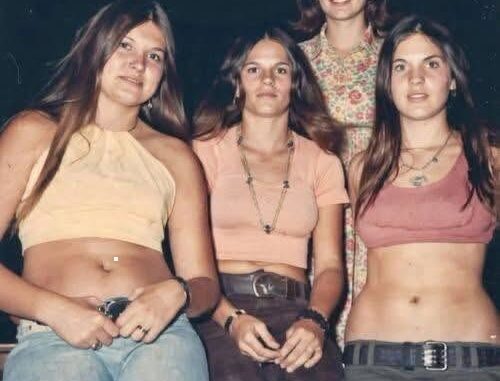
At first glance, this photograph may appear to be a typical image of four young women simply relishing a moment together. However, upon closer inspection, something becomes more remarkable—not due to their attire or the precision of their poses, but because of the genuine and unguarded nature of the moment.
At first look, the image seems rather ordinary: four young women standing together, smiling at the camera, dressed casually, with an old stereo nearby.
There is no intricate background. No meticulously arranged studio lighting. No evident effort to create an ideal photograph.
Yet, something about this picture can compel a contemporary viewer to pause.
Perhaps it's the easygoing expressions. Perhaps it's the unkempt hair, everyday clothing, natural body shapes, or the impression that none of them seem to be preoccupied with how the photograph will be perceived by countless strangers online.
This image hails from a distinctly different visual time.
Nowadays, photographs are frequently taken with an audience already considered. An image can be edited in mere moments, filtered, cropped, retouched, and meticulously chosen before it appears on anyone else’s screen.
The contrast is notable.
The older photograph appears to capture a moment that was simply experienced, rather than crafted expressly for display.
That distinction might clarify why images like this continue to draw attention.
An unguarded moment can sometimes resonate more than a flawlessly posed photograph because it reflects personality over perfection.
The Charm of an Everyday Moment
One of the first aspects people may observe in photographs from past decades is the lack of visual perfection that has become prevalent today.
The women in the image are not depicted as picture-perfect models.
They resemble typical young individuals.
Their hair is natural. Their expressions are at ease. Their clothing mirrors the era rather than a carefully curated social media aesthetic.
Most importantly, they appear relaxed simply being together.
That trait can be challenging to replicate intentionally.
When someone knows a photograph will be viewed by a large audience, even a casual pose can become calculated. Individuals may instinctively adjust their posture, facial expression, attire, hair, or body alignment.
The outcome may be a stunning photograph—but it can also feel less spontaneous.
Older photographs often served a different purpose.
A camera might emerge during a birthday celebration, a night out with friends, a family gathering, a holiday, or an ordinary afternoon.
The photograph existed mainly as a keepsake.
It didn’t necessarily need to perform.
It didn’t need to garner likes.
It didn’t need to conform to a specific trend.
And it certainly didn’t need to compete with millions of other images appearing on the same screen.
This difference can render seemingly mundane photographs surprisingly impactful.
There Was No Pressure to Appear Flawless
It would be misleading to claim that individuals in earlier generations never concerned themselves with appearance.
Of course, they did.
Beauty ideals existed long before the rise of social media. Advertising, magazines, television, movies, celebrities, and fashion all shaped perceptions of attractiveness.
Women were certainly subject to expectations surrounding clothing, hairstyles, body shape, and appearance.
However, the speed and intensity of visual comparison were different.
A young woman in the 1970s did not wake up to see hundreds of meticulously edited photographs of other women before breakfast.
There was no endless feed showcasing supposedly flawless skin, perfect bodies, ideal homes, dream vacations, and impeccably styled lives.
That doesn't imply the past was superior in every aspect.
It merely suggests the environment was distinct.
There were fewer chances for constant comparisons with strangers.
A photograph could exist without becoming part of a public persona.
This distinction is easy to overlook.
Today, capturing a photograph can sometimes involve a mental checklist:
How do I appear?
Is the lighting adequate?
Does my body look right?
Should I edit this?
Should I share it?
What will others think?
Would another photo be preferable?
The image in the original photograph seems to exist beyond that cycle.
Modern beauty culture offers more tools than ever to alter an image, but the capacity to edit everything can also make natural appearances feel unusually rare.
Social Media Altered the Meaning of a Photograph
The most significant change may not lie in the camera itself.
It may reside in what occurs after the photograph is taken.
For much of the 20th century, photographs were physical items or private files. They might be placed in albums, displayed on walls, or shared among friends and family.
Today, a photograph can become public in an instant.
One image can be seen by hundreds, thousands, or even millions of people.
That alters the psychological experience of capturing it.
A person is no longer merely documenting a moment.
They may also be showcasing themselves.
This can create an invisible pressure to appear attractive, interesting, successful, youthful, healthy, or fashionable.
The pressure doesn't necessarily originate from one specific individual.
It can stem from the environment itself.
When individuals repeatedly encounter highly edited images, those visuals can gradually shape what they consider normal.
Perfect skin starts to seem standard.
Perfect lighting begins to appear typical.
Perfect bodies start to look ordinary.
Perfectly styled homes, meals, vacations, outfits, and relationships can seem commonplace.
However, much of what is showcased online has been selected specifically because it appears exceptional.
This creates an evident dilemma.
If someone compares their everyday life to thousands of others’ carefully chosen highlights, the comparison is never genuinely equitable.
Why “Imperfect” Photos Can Feel More Authentic
There is something psychologically intriguing about an imperfect photograph.
A slightly messy hairstyle can convey movement.
A genuine smile can express emotion.
An awkward pose can imply that no one was performing.
A background that isn’t perfectly arranged can lend authenticity to the moment.
These details can create what might be described as a sense of presence.
You feel as if you are witnessing a real moment rather than an advertisement.
This may be one reason photographs from earlier decades can suddenly gain popularity today.
People are not necessarily captivated by the clothing alone.
They may be responding to the emotion behind the image.
The photograph seems to convey:
This occurred.
No one needed to make it flawless.
No one needed to justify it.
No one needed to optimize it for an algorithm.
It was simply friends sharing time together.
Fashion Has Evolved, but Confidence Has Not
The attire in older photographs may sometimes appear peculiar to contemporary viewers.
Styles shift.
Jeans, shirts, hairstyles, jewelry, shoes, and silhouettes all go through cycles.
What seems fashionable in one decade can appear outdated in another.
However, confidence is much more challenging to date.
The women in the image seem at ease in their own skin.
That is perhaps more timeless than any specific fashion trend.
Modern culture often conveys contradictory messages about appearance.
On one hand, individuals are encouraged to embrace their true selves.
On the other, they are constantly bombarded with images suggesting how they are expected to look.
The outcome can be perplexing.
Individuals may receive messages about self-acceptance while simultaneously feeling the pressure to alter nearly every visible aspect of themselves.
Older photographs can serve as an intriguing reminder that personal style does not need to adhere to every trend.
A person can simply wear something comfortable.
They can smile without rehearsing the expression.
They can have unkempt hair.
They can reveal their natural skin.
They can exist in a photograph without attempting to transform themselves into a brand.
Sometimes the most striking aspect of a photograph is not perfection, but the sense that the individual is entirely comfortable being herself.
The Distinction Between Confidence and Perfection
There is a crucial difference between appearing perfect and feeling at ease.
Perfection is external.
It relies on whether an image meets a specific standard.
Confidence is internal.
It arises from feeling secure enough not to obsess over every detail.
The photograph of the four women is compelling precisely because it doesn’t seem overly focused on perfection.
Their uniqueness remains visible.
They don’t appear identical.
They are not styled as if they belong in a commercial campaign.
And that individuality may be what makes the photograph unforgettable.
Modern beauty culture often moves in the opposite direction.
Trends encourage individuals to replicate the same makeup styles, hairstyles, body aesthetics, poses, and facial expressions.
Eventually, the traits that were meant to make someone stand out can lead to everyone appearing increasingly similar.
That is an ironic outcome of pursuing perfection.
When everyone adheres to the same notion of beauty, individuality can fade away.
Why We May Overlook the Essence of Older Photographs
It is easy to observe an old photograph and focus solely on superficial differences.
We notice the clothing.
We notice the hairstyles.
We notice the technology in the backdrop.
We might even chuckle at how different everything appears.
Yet, there can be a deeper message.
The photograph serves as a reminder that people have always relished ordinary moments.
Friendship did not necessitate a flawless background.
Happiness did not require a meticulously edited photograph.
A night out did not have to become content.
A casual gathering did not need to be documented from multiple angles.
Sometimes a memory could simply remain a memory.
This does not imply we should dismiss modern technology.
Cameras and social media have provided immense benefits. People can stay connected across distances, preserve meaningful memories, build communities, express creativity, and share experiences that would have once remained private.
The issue arises when documentation transforms into performance.
When every moment must appear impressive, even enjoyable experiences can start to feel burdensome.
We Should Be Cautious About Idealizing the Past
There’s another aspect worth recognizing.
The 1970s were not a flawless period free from appearance-related pressures.
Women encountered significant societal expectations, discrimination, and constraints that should not be overlooked.
Beauty standards existed.
Advertising was present.
Fashion magazines circulated.
Celebrities were still utilized to promote ideals of attractiveness.
Many individuals also lacked the opportunities and freedoms that are more accessible today.
Thus, the lesson shouldn’t be that the past was perfect and the present is terrible.
That would oversimplify the matter.
Instead, older photographs can be valuable because they illustrate a different relationship with images.
They remind us that a photograph doesn’t have to be perfect to hold meaning.
A person doesn’t have to look flawless to be beautiful.
And a moment doesn’t need to attract attention to be worth remembering.
What Contemporary Life Can Learn From This
Perhaps the most beneficial lesson is surprisingly straightforward:
Not everything requires optimization.
Not every photograph needs the ideal angle.
Not every outfit has to conform to a trend.
Not every day should become content.
Not every appearance needs to be compared with someone else’s.
There is liberation in allowing ordinary moments to remain ordinary.
A photograph of friends laughing together can be valuable precisely because it doesn’t resemble a professional campaign.
An image captured with imperfect lighting can still hold a wonderful memory.
A face with freckles, wrinkles, uneven skin, or other natural features does not need to be altered before it deserves to be seen.
Technology provides us with remarkable control over images.
But having the capacity to change everything doesn’t mean we need to modify everything.
Sometimes the most engaging image is the one that was allowed to remain exactly as it was.
The Subtle Allure of Being Yourself
Ultimately, that may be what draws attention to the original photograph.
It’s not necessarily the fashion.
It’s not the camera quality.
It’s not the setting.
It’s the emotion.
The women seem to be together rather than performing together.
There’s no evident indication that they are striving to become someone else.
They appear as themselves.
And perhaps that is why a decades-old photograph can feel unexpectedly modern.
In an era where artificial intelligence can alter faces, software can erase imperfections, filters can change appearances, and social media can transform daily life into a public performance, an unrefined photograph can suddenly seem almost rebellious.
It reminds us that individuals do not need to be flawless to be fascinating.
They do not require perfect bodies to feel confident.
They do not need professional styling to be appealing.
And they do not need thousands of strangers validating a photograph for the moment to have significance.
The intrigue with photographs from earlier decades is not necessarily about proving that one generation was more attractive than another.
It concerns recognizing how different our relationship with appearance has become.
People in previous generations had beauty standards too, but everyday photographs were often less tied to public validation, algorithms, filters, and constant comparisons.
This difference can make an ordinary photograph feel extraordinary today.
The true lesson may be less about the 1970s and more about the present.
In a world where nearly every image can be edited, enhanced, filtered, and critiqued, there is something refreshing about witnessing people exactly as they were in a specific moment.
Not perfectly posed.
Not carefully branded.
Not endlessly polished.
Just present.
Perhaps that is the detail we notice most: the photograph feels authentic. And in a world increasingly filled with images designed to appear perfect, authenticity can be surprisingly impactful.