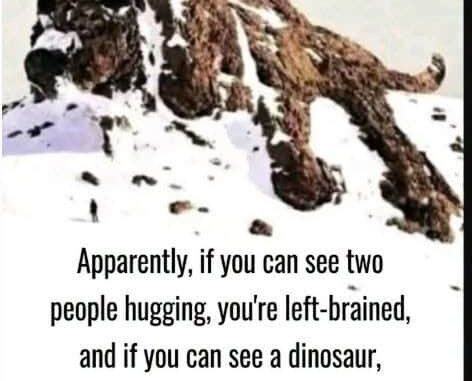
Now allow your gaze to wander further across the image.
What initially appears to be a part of the snowy scenery is, in fact, something far more astonishing.
The peculiar shape stretching over the snow belongs to a massive creature.
Its front paws seem to rest over the ridge, while the remainder of its lengthy body extends toward the right side of the photo…. Continue Reading ⬇️
Once those details start to connect, the illusion becomes significantly clearer.
It is not a dinosaur.
Nor is it two individuals embracing.
It is an enormous sleeping dog.
The most clever aspect of this image is not solely the dog itself.
It is how your mind is directed even before you begin to observe.
If someone inquires whether you perceive two people hugging or a dinosaur, your brain instinctively starts searching for those two options.
That suggestion creates a sort of visual trap.
Instead of freely analyzing the shapes in the image, your mind begins attempting to force what it sees into one of the options it has already been presented with.
This makes it much more challenging to notice an entirely different figure lurking in plain sight.
The snowy environment adds another dimension to the illusion.
Large portions of the dog’s body blend seamlessly into the white landscape, while shadows and uneven terrain complicate the recognition of the outline.
The perspective also amplifies the animal’s size.
Its paws, head, body, and tail appear disconnected at first, almost as if they belong to separate elements of the scenery.
However, once someone points out that there is a dog in the image, everything shifts.
The shapes that once seemed random suddenly link together.
The face becomes clearer.
The paws begin to make sense.
The long body no longer resembles a ridge.
And the tail becomes unmistakable.
That is what renders optical illusions like this so captivating.
The photograph itself remains unchanged.
The pixels stay exactly where they were.
What transforms is your interpretation.
Your brain reorganizes the same visual information and suddenly provides it with a completely different significance.
Before the revelation, the image might appear perplexing.
Afterwards, it can be nearly impossible not to see the dog.
So what did you notice first?
Were you looking for two people embracing?
Did you believe you had spotted a dinosaur?
Or did your eyes instantly locate the giant sleeping dog sprawled across the snow?
Sometimes the most astonishing part of an illusion is realizing that the answer was visible all along.