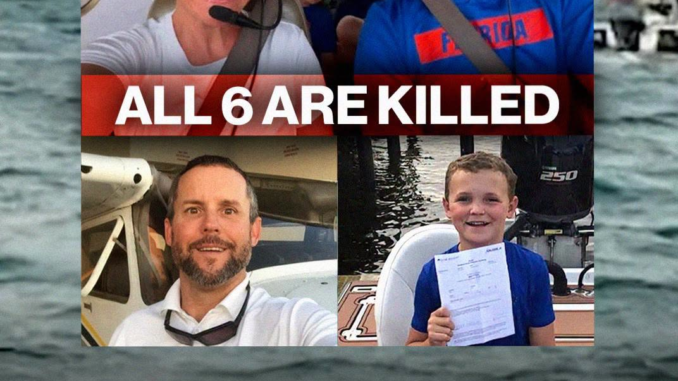
A brother and sister from Florida, along with three of their children and the sister’s husband, have been named as the six individuals who lost their lives in a single-engine plane crash near Horn Island, Mississippi, just two days before Thanksgiving.
Jackson County Coroner Bruce Lynd identified the pilot as Brent Stokes, 50, from Fort Myers, who was accompanied by his 16-year-old son, Hunter Stokes, on their flight home from New Orleans on Tuesday, November 24.
Brent’s younger sister, Arlyn Knox, 43, was flying with her husband, Michael Knox, also 43, and their sons, 12-year-old Charles Holden Knox and 10-year-old Truett Knox, the two youngest passengers aboard the Cessna 210.
Family photos released on Wednesday depict the two families that had traveled together, including one image of the Knox family where Holden stands to the right of his father, and Truett is on the left beneath his mother.
Wyman Stokes, who spoke out after the victims were named, noted that the six individuals listed by the coroner included both his son and daughter, his son-in-law, and three of his grandsons.
Wyman informed reporters that the group had been in Venice, Louisiana, and intended to return to southwest Florida in time for Thanksgiving.
The Journey Home From Louisiana
The family had multiple options for returning from Louisiana, and Brent’s wife, Dominique, along with their daughter, Addison, had taken a commercial flight back, while Brent, Hunter, and the four Knoxes flew together in the smaller aircraft, according to WUSF.
The Cessna was based in Fort Myers and owned by a woman who told WDSU that she had lent her plane to a friend, a detail that surfaced as reporters investigated how the family ended up on board.
The plane had reportedly been taken for a 45-minute test flight prior to the trip, as noted by the owner in a video interview.
The leg that brought the family over the Mississippi coast started at New Orleans Lakefront Airport, with Page Field in Fort Myers as the intended destination, based on information provided by the Coast Guard to WLOX.
In air traffic recordings reviewed by The Associated Press, the pilot seemed to report no issues upon departing from New Orleans, and there were no apparent distress calls during the flight.
Around 3:45 p.m. local time, the regional air traffic control tower in Mobile, Alabama, reported losing contact with the Cessna, prompting the Coast Guard to activate a search for a missing aircraft carrying six individuals over the water.
The Federal Aviation Administration recorded a descent rate of approximately 10,000 feet per minute when contact was lost, according to the Coast Guard’s report, and investigators had not yet determined the cause of the rapid descent.
The Search Shifts Offshore
The search involved boats and aircraft in the Mississippi Sound, the body of water between the mainland at Pascagoula and the offshore barrier islands, with responders from Mississippi and Alabama converging near Horn and Round Islands.
Horn Island, the reference point used by authorities to describe the crash site, is an undeveloped area of Gulf Islands National Seashore, accessible only by boat and lacking permanent staff, shelter, or communication facilities.
The Coast Guard station in Pascagoula deployed two small boats, while personnel in Mobile sent a cutter and aircraft to assist in the search, providing aerial support as others approached from the water.
By approximately 4:15 p.m., half an hour after contact was lost, the Pascagoula Police Department had launched a boat, and the Mississippi Department of Marine Resources also dispatched two vessels.
Emergency personnel assembled at Singing River Island as operations continued into Tuesday evening, and dispatch recordings captured the exchanges among responders directing boats to the correct area of the sound.
Captain Michael Strickland of the Mississippi Department of Marine Resources later explained that his teams navigated the waters in a grid pattern using sonar while Coast Guard aircraft searched from above for signs of wreckage.
A critical piece of equipment that evening was a GPS locator dropped by the Coast Guard near the suspected crash site, providing boats a reference point as operators searched for the aircraft using sonar.
What Crews Discovered Near Horn Island
At around 5:40 p.m., nearly two hours after the alert from air traffic control, the Coast Guard confirmed to WLOX that crews had located the plane’s cabin, three life jackets, and a life raft in the water northeast of Horn Island.
The boats reached a location approximately two miles from the island, and as personnel assessed the floating debris, one responder communicated back a description that was captured on the dispatch recording.
“We're right where the plane is. There’s debris floating in every direction.”
The 5:40 p.m. update detailed what searchers had found at the site, but information about the individuals on board came separately after state divers reached the wrecked aircraft.
Early Wednesday, the Coast Guard announced that divers with the Mississippi Department of Marine Resources had recovered all six victims, whose bodies were located inside the fuselage between Horn Island and Pascagoula.
Conditions shifted during the operation, Strickland noted, as a passing front brought stronger winds and choppier waters to crews working on the surface, while the divers below had sufficient visibility to complete their tasks.
Strickland stated that his team remained on site until about two or three on Wednesday morning, with personnel from other responding agencies still active when his crews returned.
The response included divers from Harrison County, the Jackson County Sheriff’s Department, and a U.S. Air Force C-130 crew, with local officers, state marine personnel, and federal teams collaborating and sharing equipment throughout the operation.
Coast Guard Commander Trevor Blount, who oversaw the search and rescue mission for Sector Mobile, extended his condolences to the victims’ families and praised the crews from various agencies for their efforts in locating everyone on board.
What Investigators Understand About the Flight
The National Transportation Safety Board and the Federal Aviation Administration are looking into the crash, with the last recorded descent, available radio communications, and the aircraft's location among the limited details released in the initial days.
The nearest National Weather Service station, located on the mainland in Pascagoula, reported light winds, cloud cover, and no precipitation around the time of the crash, according to The Associated Press, while Strickland’s account of rougher seas related to the hours crews spent at sea afterward.
The coroner indicated that autopsies were being conducted on Brent and his brother-in-law Michael, who also possessed a pilot’s license, although officials identified Brent as the pilot of the Cessna during the flight from New Orleans.
At Page Field, the Fort Myers airport where the family had planned to land, members of the aviation community expressed their sorrow as colleagues, teachers, and classmates across the city learned the names of the six individuals who perished.
The Family Fort Myers Knew
In southwest Florida, Brent had long built his career around the water as president of Stokes Marine, a Fort Myers contractor whose teams construct and maintain docks, seawalls, boat lifts, and boardwalks in coastal communities.
The company’s description of Brent, cited by The Associated Press, portrayed someone who had dedicated his life to boating and had a passion for fishing, a detail that family members highlighted when explaining the purpose of the Louisiana trip.
His sister and brother-in-law had established their own business in the same city, founding the Fort Myers information technology firm Knox Technologies in 2012 and managing it while raising Holden and Truett.
At Fort Myers High School, Hunter had taken on a leadership role at the age of 16 as president of his school’s Club America chapter, according to a tribute from Turning Point USA, the organization behind the student group.
The organization recalled his participation in a leadership gathering over the summer and his help in organizing a September 11 flag run, two occasions on which students outside his family had come to know him.
His younger cousins attended St. Francis Xavier Catholic School in Fort Myers, where principal John Gulley referred to Charles by the name he used at school, Holden, and informed parents that Holden was in sixth grade and Truett was in fourth.
Gulley mentioned that the family’s connection to the school spanned generations, and in his message to the community, he named the boys along with their parents, their cousin Hunter, and their uncle Brent so that families understood whom the children had been traveling with.
What Their Relatives Wanted People to Know
On the day before Thanksgiving, the Stokes and Knox families released a joint statement that began with four words reflecting the impact of losing six family members in one afternoon.
“Our family is devastated.”
Wyman expressed particular gratitude to the Coast Guard, the Mississippi Department of Marine Resources, and everyone who had ventured out on the water to search for his children, son-in-law, and grandchildren and bring them home.
The relatives requested privacy while sharing that they found comfort in the love the six had given them, along with the support from those around them in the early days following the crash.
The two families had traveled to Venice for a fishing trip, a chance for Brent and Arlyn to begin the holiday season together with Michael and the three boys before joining their extended family in Florida.
In the family’s own words, “They died doing what they loved: celebrating the start of a wonderful holiday season with a fishing trip together, before heading home to be with the rest of our family.”