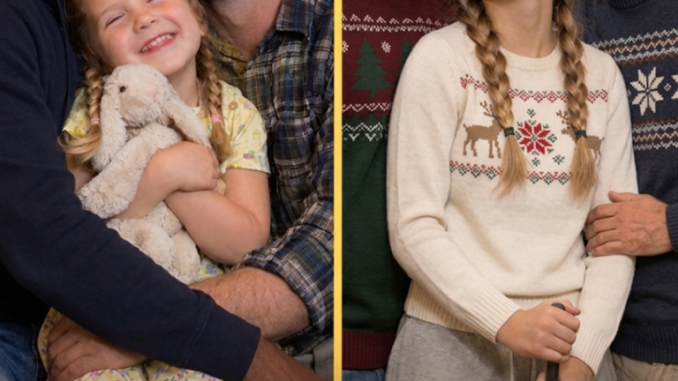
By the time Julian and I made the decision to adopt, we had already experienced the loss of people we cherished simply because we were married to one another.
My father ceased inviting me to Thanksgiving. Julian’s mother continued to refer to me as his “roommate,” even after attending our wedding. We adapted to the vacant seats during family meals, but our desire for a child never waned.
Then we encountered Molly.
She was four, blind since birth, and had been shuffled between multiple foster homes. During our initial visit, she sat with a stuffed rabbit in her lap, gently rubbing one of its worn ears.
When I stood up to fetch her some water, she grabbed my sleeve.
“Are you going away?”
“Just to the kitchen,” I replied. “I’ll be right back.”
She wouldn’t release her grip until I settled back down next to her.
On the drive home, Julian and I concurred that we wanted to be her fathers.
Not everyone shared our excitement.
My sister remarked that we were complicating an already challenging childhood by expecting Molly to explain why she had two dads. A man Julian had once considered a close friend suggested we leave her with a “normal couple.”
“They talk about her as if she’s a problem needing a solution,” Julian said one evening, gazing at the yellow cup we had purchased for her.
We proceeded with the adoption regardless.
When Molly first arrived home, she inquired about where our bedroom was and whether she could wake us if she needed anything. She expressed regret for spills, misplaced shoes, and for asking us to repeat instructions.
One evening, I discovered her sitting on the hallway carpet because she had experienced a nightmare but was hesitant to knock on our door.
I sat beside her until she allowed me to take her hand.
“You don’t have to earn your place here,” I assured her. “You live here. We’re your dads.”
It took her time to accept that.
Julian mastered the art of braiding her hair. I labeled our kitchen containers in Braille, and we learned to avoid hovering whenever she attempted something new.
By the age of sixteen, she was borrowing Julian’s sweatshirts, pleading for a later curfew, and insisting on baking her own birthday cake.
“Dad, I know where the flour is,” she informed me that morning. “You’ve labeled it three different ways.”
The little girl who once hesitated to ask for water was now sending me out of my own kitchen.
That afternoon, while Julian and I prepared her favorite pasta, someone knocked on our front door.
I recognized the man’s face before he introduced himself. He was a famous actor, the star of a film we had viewed just days prior.
But what held my attention was not his celebrity status. It was the shape of his mouth and the line of his jaw. Molly shared those same features.
“I’m Cameron Voss,” he said. “I’m Molly’s biological father.”
Molly was upstairs chatting with a friend. We invited him into the kitchen for a private conversation.
“I know I haven’t been present,” he began. “I’d like to make amends. College tuition, a car when she’s older, whatever she requires.”
I inquired why he had waited twelve years.
Instead of responding, he leaned over the table.
“I need her to come live with me next month. Tell me what it would take. I can be very generous.”
Julian slowly placed his cup down.
“You mean you’d like us to ask if she wants to meet you?”
“No,” Cameron replied. “I mean I need her staying at my house. For a while, at least.”
He opened a leather briefcase and slid a folder toward us.
Inside was a schedule for television appearances and a proposed documentary. There were questions directed at Molly, with responses already prepared in her name.
One response detailed Cameron teaching her how to bake when she was young. Another claimed that we were family friends who assisted him while he was working.
I glanced toward the kitchen cabinet where Molly kept her measuring cups.
“She has never met you,” I stated.
“The narrative got ahead of me,” Cameron countered. “I mentioned my daughter in an interview. The public responded, and the producers saw a chance.”
“Then tell them the truth,” Julian urged.
Cameron shook his head. “You don’t grasp what’s at stake.”
From upstairs came Molly’s laughter. Cameron glanced toward the sound, then lowered his voice.
“I can secure her future. Yours, too. Surely we can devise a solution that benefits everyone.”
Julian pushed the folder away.
“You should leave.”
But I had reached the final page. Beneath a question about what Molly remembered of her upbringing with her father, the answer section was blank.
I closed the folder.
“An interview might be feasible,” I proposed.
Julian stared at me. Cameron reached for his pen.
“Name your condition.”
“Send us the complete proposal, the producer’s direct contact details, and every statement you’ve previously made about Molly. She gets to read it all and decide whether she wishes to speak. No cameras unless she consents, and no contacting her behind our backs.”
“Of course,” Cameron said, smiling for the first time.
He believed we had begun to negotiate.
Then he presented a second folder containing the expansion plans for our small bakery. Julian and I had been saving for years to open a second location and provide more accessible cooking classes.
Our actual financial projections were included.
“How did you obtain those?” Julian asked.
“My business manager knows someone at the investment firm you approached. I’m prepared to invest three million dollars into the project once we have an agreement.”
I felt nauseous. He had sought out the one dream he thought we might barter our daughter for.
“In exchange,” Cameron continued, “Molly spends several weeks with me, appears in the documentary, and endorses the narrative we’ve presented. You can remain involved in private.”
“She’s our child, not a part of your promotional budget,” Julian replied.
Cameron frowned. “You’d be unwise to decline this opportunity.”
“Then we’re unwise,” I retorted. “The choice regarding meeting you belongs to Molly. The choice about selling a lie has already been made.”
He left his card and exited, looking irritated rather than disappointed.
We informed Molly after her friend had returned home.
Initially, she laughed upon hearing the actor’s name.
“Seriously? The guy whose movie you both complained about?”
But she fell silent as we explained the documentary, the fabricated memories, and the money he had proposed.
“He wants me to move into his house so he can pretend he raised me?”
“Yes,” Julian confirmed. “And we told him no.”
She contemplated that answer for a moment.
“Did he know about me when I was little?”
It was the question I had dreaded. Our adoption paperwork indicated that her biological father had been informed, although his identity had been kept from us. We had never known if he would seek contact.
“He knew,” I replied cautiously. “We don’t know everything that transpired before you came to us.”
Molly pressed her fingers against the table.
“Was it because I’m blind?”
I wanted to offer her something comforting, but I couldn’t pretend to know.
“I don’t have that answer, sweetheart.”
Julian moved his chair closer. Molly permitted him to take her hand.
“I want to ask him,” she said after a moment. “But I also want to meet the person who crafted those answers for me.”
We verified Cameron’s identity and reached out to the documentary producer, Serena, clarifying that he hadn’t raised Molly.
Serena sounded taken aback. She stated the project had not been finalized and agreed to a private meeting without recording devices.
Molly listened to an accessible version of the script using her screen reader. She chuckled at a few absurd details, but by the final page, she had grown unusually still.
“It states he taught me to recognize the sound of his footsteps,” she remarked. “I used to listen for yours because I was scared you wouldn’t come back.”
I sat beside her, recalling a small hand gripping my sleeve.
“You don’t have to go through with this.”
“I know. But I want him to hear what truly happened.”
At the production office, Serena greeted Molly directly and asked if she required any accommodations. Cameron was already waiting at the conference table.
“Molly,” he said warmly, standing. “I’ve wanted to see you for so long.”
“Then you had plenty of time,” she replied. “Please take a seat.”
He appeared embarrassed, but he complied.
Molly opened the questions on her phone.
“Your documentary claims you raised me. How old was I when you taught me to bake?”
Cameron cleared his throat. “We can adjust some of those details.”
“I’m asking what you remember.”
He glanced at Serena.
“She’s upset. This is a challenging reunion.”
“I’m upset because you wrote my childhood without consulting me,” Molly stated.
Serena turned to Cameron. “You informed our team you’d been an active parent.”
“My representatives may have exaggerated some things.”
Julian handed Serena copies of Molly’s adoption records, with her consent. The producer examined the dates, then looked back at Cameron.
“These aren’t minor corrections,” she said.
Molly continued before he could respond.
“I spent time in foster homes. I met my dads when I was four. They taught me to cook, helped me feel comfortable at school, and stayed with me when I had nightmares. You weren’t there for any of that.”
Cameron lowered his gaze.
“I made mistakes. But I’m here now.”
“Why weren’t you here then?” she pressed.
He took a deep breath.
“I was young. My career was just taking off. When I learned you were blind, I panicked. I thought I’d be accountable for things I didn’t know how to manage.”
Julian’s hand tightened around mine beneath the table.
Molly’s voice trembled, but she didn’t falter.
“So you believed being my dad was too challenging when I needed one. But now you want people to pay you for telling them how wonderful you were at it?”
Cameron had no response.
She turned to Serena.
“I don’t want to be in his documentary. I also don’t want my dads referred to as family friends. They’re my parents. Whatever you decide to create, please don’t share those stories about me.”
Serena closed her folder. “I understand. We can’t proceed with the account we’ve been given.”
Cameron attempted to argue, but Molly had already put her phone away.
“Could we speak privately another time?” he inquired.
She contemplated it.
“Maybe. But not because of a movie, and not because you offered money. If I want to talk, I’ll let you know through my dads.”
Two weeks later, Serena confirmed that the company had canceled the documentary. Cameron asked if Molly would meet again, but she wasn’t ready. We didn’t pressure her.
Our bakery expansion remained on pause. We still worked long hours, and the folder of plans stayed in the desk drawer.
One Saturday, Molly found me reviewing the figures.
“You could’ve opened both places with his money,” she remarked.
“Perhaps,” I conceded. “But he wanted something we couldn’t provide.”
She leaned against the counter.
“I’m glad you let me speak for myself.”
I looked at the girl who once feared that asking for a glass of water might cause us to leave. Now she was articulating exactly what she wanted, and I couldn’t have been prouder.
“Are you staying here all afternoon?” she asked.
“Why?”
“I need someone to try my new frosting. But first, please vacate the kitchen.”
I chuckled and stepped into the hallway.
Twenty minutes later, she called for me, confident that I would return.