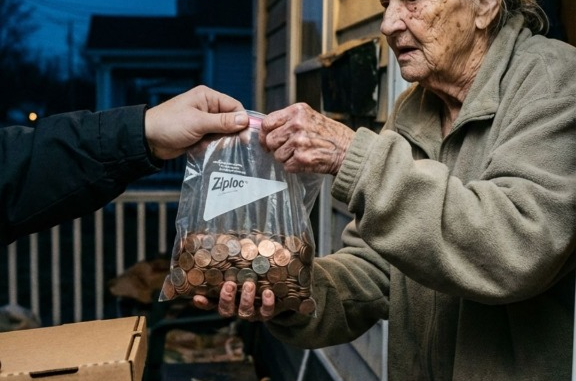
She handed me a Ziploc bag full of pennies for a $14 pizza and whispered, “I think there’s enough.”
I stood on the rotting porch, the wind cutting through my jacket. The receipt said: Back door. Knock loud.
Inside, the air was colder than outside. An elderly woman sat in a recliner under quilts, no TV, no radio, just her labored breathing. She held out the heavy bag of coins. “I counted it twice… mostly pennies and some nickels. Is it enough?” The total was $14.50.
Her kitchen was barren: half-empty jug of water, baking soda, a prescription bag. She wasn’t lazy—she was too weak to cook. Forty years as a nurse, now alone, choosing between heat, medicine, and food.
I lied. “The system glitched. You’re our 100th customer. It’s on the house.” She hesitated. I set the pizza on her lap. She inhaled the steam, a tear tracing her cheek.
I didn’t leave it there. I drove to the store and returned with milk, eggs, bread, soup, bananas, oatmeal, a rotisserie chicken. She wept as she tried to wheel toward me; I helped her, held her hand to her forehead. I sealed her windows, changed a lightbulb, set the thermostat to 70.
We live in the richest country, yet a retired nurse might eat baking soda to afford her heart pills. Check on your neighbors—the quiet ones.
The next day, my manager called. Inventory off, I’d left my route. I told him what happened. “She didn’t have food. Her house was freezing.” He said, “You can’t just play savior.” He tried to reduce compassion to a line item: pay for the order or sign a write-up. I refused. I left the job, not proud, but unable to unsee her life.
I returned to her house when I got the message she was struggling again. She had eaten almost nothing. Her son, Eddie, arrived, furious and worried. He didn’t understand why a stranger had intervened—but he saw the reality he’d avoided.
I called him, she spoke to him, reassured him with the lie she used to protect him: “I’m fine.” He saw the groceries, the cold, the house, and for the first time, her vulnerability.
She told me about my father from decades ago—a reminder of how lives intersect in unexpected ways. Her gratitude was simple, heartfelt, and anonymous: a note in a community group.
And then the system called. Official voices, rules, judgment—but none of it changed the fact that she should not have been alone, hungry, or freezing.
Sometimes doing the right thing isn’t a movie ending—it’s choosing humanity over policy, even when the world judges.