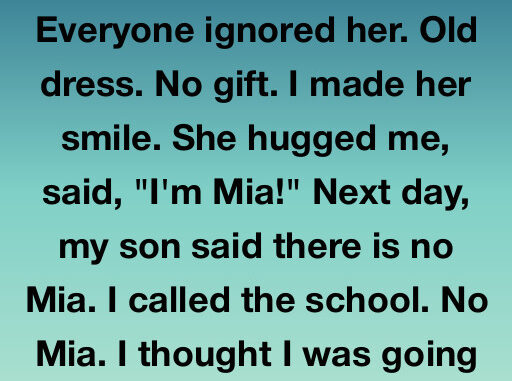
At my son’s 9th birthday party, I noticed a little girl in an old yellow dress crying by the shoe rack. No one seemed to know her. I gave her cake, let her sit with us, and before she left she hugged me and said, “I’m Mia.”
The next day, my son insisted there was no Mia in his class. I called the school—no Mia. For days, I felt unsettled, almost crazy. Maybe she’d wandered in from another party.
Five weeks later, I dropped cupcakes at a community center and saw a paper plate with blue crayon words on the back: “Thank you for the cake. Love, Mia.” On the front was a drawing of me in the blue scarf I’d worn that day.
The volunteer said there was no Mia—but there was a Mila.
In the corner sat the same quiet girl.
Her full name was Amila. She’d said “Mia” because it was easier. She didn’t go to my son’s school—she’d been at a different birthday party in the next room that day. While her mom was arguing over an unexpected bill, Mila had wandered into ours.
Her father had died the year before. Money was tight. That party had been a last attempt to give her something normal.
Then I realized something else.
A month before, I’d lost my wallet with cash and cards. It had been returned anonymously, untouched.
Her mom admitted Mila had insisted they bring it back—even though they desperately needed the money.
We both almost made different choices.
I almost ignored a crying girl.
She almost kept a wallet.
Instead, we chose kindness.
I helped her mom find steady work at a bakery. Mila and my son became friends. A year later, they moved closer, and this time when I called the school, her name was on the list:
Amila Soraya Rahman.
She was never imaginary. Just a child who walked into the wrong room at the right time.
I thought I’d found a mystery.
What I really found was proof that small acts—cake, a returned wallet, a simple hello—can quietly change lives.
Sometimes magic isn’t magic at all.
It’s just kindness, coming back around.