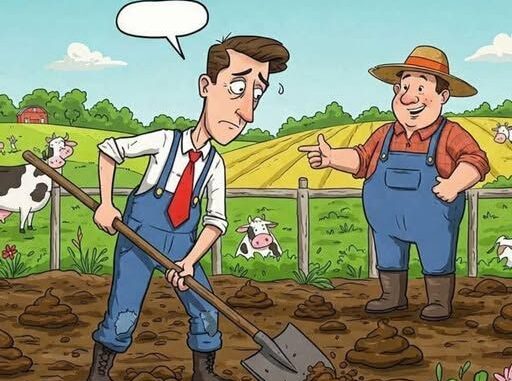
Arthur Vance, a senior vice president at a global logistics firm, lived at the mercy of deadlines, stock prices, and nonstop emails. Sleep was optional; caffeine was essential.
Until, during a presentation, his heart gave out.
After surgery, his doctor ordered a month away from work — no phone, no laptop — on a remote farm. The silence unsettled him. Without meetings or metrics, he felt useless. By day three, he begged the farmer, Silas, for work.
Silas pointed him toward a barn filled with months of cow manure. Arthur attacked it like a corporate crisis and finished in a day.
Next came processing 500 chickens — bloody, exhausting work. Arthur handled it with cold efficiency. “I’ve been making cuts my whole career,” he said. “At least these are honest.”
On the third day, Silas gave him an easy task: sort potatoes. Large ones in one crate, small ones in another.
By sunset, Arthur hadn’t sorted a single one.
He was paralyzed.
He confessed the truth: in corporate life, he hadn’t truly made decisions in years. Every choice was filtered through committees, data, and shared accountability. No single decision was ever fully his. But here, alone with a potato, there was no one else to blame. Large or small — he had to choose and own it.
That night, he realized his success had been built on avoiding responsibility disguised as collaboration.
The next morning, he picked up a potato and dropped it into a crate. Then another. Slowly, he found peace in simple decisions. Not every choice needed a strategy deck. Some things were just large or small — and the world didn’t collapse if you got it wrong.
When Arthur returned to the city, he was different. He cut unnecessary meetings, empowered his team, and made clear decisions without hiding behind process.
When asked what leadership lesson he’d learned, he said:
“Business school teaches you to manage complexity. A potato teaches you to choose.”
Sometimes the hardest decision isn’t the biggest one — it’s the simplest one you have to own.