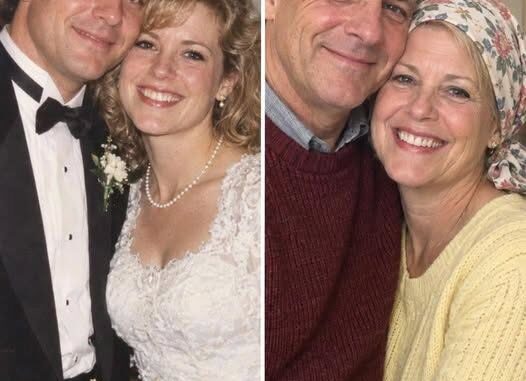
PART 1
My wife, Margaret, and I had been married for thirty-six years when the doctor informed us that her cancer had already metastasized and there was nothing more they could do.
During the last week of her life, I hardly left her side at the hospital.
One evening, she grasped my hand and whispered:
“You must promise me something.”
I looked at her, tears welling in my eyes, and replied:
“Anything, my dear.”
Then Margaret sighed and said:
“Please find Claire. You’ll understand everything once you locate her. And… forgive me in advance.”
When I attempted to get some clarification from Margaret about why I needed to seek Claire and what exactly she wanted me to forgive, the doctors requested that I leave the room since she required rest.
The truth was, Claire had been my first love.
We were both around 20 at that time and attended college together. I loved her deeply and even proposed, but she rejected me because I had to relocate to another state for work.
That was how our relationship ended.
I never expected my dying wife to mention my former girlfriend, a woman I hadn’t heard from or seen in nearly 40 years.
In the following days, Margaret’s condition deteriorated. Three days later, she passed away.
My heart was shattered. I had no idea how I would continue living without Margaret.
I missed her profoundly.
Yet, over the following weeks, I couldn’t shake her words from my mind.
Why had she urged me to find Claire?
Nevertheless, it had been my wife’s last wish, and I had promised to fulfill it.
I had no idea why Margaret wanted this, but I kept my word.
After searching through numerous Facebook groups and making call after call, I eventually located Claire.
She resided in another city about four hours away from me.
One weekend morning, I drove there.
I found Claire’s home and sat in my car for a long time, pondering what I was doing there.
Finally, I mustered my courage and knocked on the door.
I recognized Claire instantly. Her hair had turned gray, and she had wrinkles just like I did, but it was undoubtedly her.
I greeted her and shared everything about Margaret.
Claire welcomed me and expressed her condolences.
Then she took a breath and said:
“Yes, I believe I know why your wife asked you to find me. Many years ago, I came looking for you, but Margaret was the one who met me. There’s something you don’t know. I suppose her conscience finally caught up with her. Please, come in. You should sit down.”
PART 2
I stepped into the cozy warmth of Claire’s living room. The air was infused with the scent of old paper, lavender, and freshly brewed coffee. Pictures of children and grandchildren adorned the mantelpiece, framed in worn silver and wood. My hands shook as I removed my coat, settling into a floral-patterned armchair that creaked under my weight.
Claire walked into the kitchen, her movements slow and deliberate. The gentle clinking of porcelain mugs resonated down the hallway before she returned, placing a steaming cup of tea on the small wooden table beside me.
She sat on the sofa across from mine, her hands folded in her lap. For a long moment, she simply gazed at me. There was no anger in her eyes, nor the romantic nostalgia of two long-lost lovers reuniting. There was only the heavy, quiet sorrow of someone who had carried a secret for nearly four decades.
“You look well, David,” she said softly. “Grayer. But still the same boy who used to stay up until three in the morning debating poetry.”
“I don’t feel like him,” I confessed, my voice hoarse. “Claire… what happened? What did Margaret do?”
Claire leaned back, taking a slow breath. Her gaze drifted toward the window, reflecting on a past I had lived without fully understanding.
“Thirty-six years ago,” Claire began, her voice steady, “you moved to Chicago for that logistics management firm. Do you recall how we parted?”
“Of course I do,” I replied, my throat tightening. “I asked you to come with me. I proposed marriage. You told me you couldn’t leave your family, that you weren’t ready, and that moving across the country was a mistake. You broke my heart, Claire.”
Claire let out a soft, sad chuckle, shaking her head slowly. “I never said those words to you, David. Not once.”
I froze. “What?”
“I loved you,” she said, looking directly into my eyes. “I loved you with everything I had. But when you asked me to move to Chicago, I panicked. I was twenty years old, terrified of leaving home, and I requested three days to think it over. You agreed.”
“I remember waiting,” I whispered. “I waited three days. And on the third night, I received a letter slipped under my door…”
“A letter you thought I wrote,” Claire gently interrupted. “Declining your proposal. Telling you that I didn’t love you enough to abandon my life and that you should move on and never contact me again.”
My heart began to race against my ribs like a trapped bird. “I… I read that letter countless times. I wept over it. I burned it the night before I boarded the train to Illinois.”
“I didn’t write that letter, David,” Claire stated plainly. “Your friend—the girl who lived two doors down in your apartment complex, the one who helped you pack… Margaret.”
The room seemed to tilt. The floor felt unsteady beneath my feet.
“Margaret?” My voice was barely a whisper. “No. No, Margaret was just my friend back then. She supported me when I was heartbroken. She moved to Chicago six months later, got a job in the same city, and… and we reconnected. We grew close. We fell in love.”
“She didn’t move there by coincidence, David,” Claire said gently, her tone lacking malice, carrying only devastating truth. “She intercepted my real letter. The one where I wrote that I was packing my bags, that I was coming with you, and that I wanted to spend the rest of my life as your wife.”
“No…” I shook my head, gripping the armrests until my knuckles turned pale. “No, that’s impossible. Margaret was the kindest, most honest woman I ever knew. She spent thirty-six years as a devoted wife. She wouldn’t… she couldn’t…”
“Listen to me, David,” Claire said softly, reaching across the small table to place her hand over mine. Her skin was warm, a sharp contrast to the chill running through my veins. “Three weeks after you left for Chicago, I realized I hadn’t heard from you. I was terrified. I thought maybe you’d had an accident during the drive. I spent my savings on a bus ticket and traveled all the way to your old apartment complex to ask around.”
“And?” I stammered.
“Your landlord informed me you were gone. But Margaret was still there, packing up her final belongings before her own move. I knocked on her door. I asked her if she knew where you were, why you hadn’t contacted me, why you left without me.”
Claire swallowed hard, a flicker of old pain crossing her face.
“Margaret looked me in the eye,” Claire continued, “and told me that you had read my letter, laughed, and said you were glad I revealed my true self before you made a mistake. She claimed you were already seeing someone else in Chicago, that you resented me for hesitating, and that if I ever tried to reach out to you, you’d file a restraining order.”
I withdrew my hand, burying my face in my palms. My body trembled violently with silent, dry sobs.
Thirty-six years.
Thirty-six years of my life, built on a foundation of orchestrated lies. The woman I had buried three weeks ago—the woman whose hand I had held as she took her final breath—had not just comforted me through heartbreak. She had orchestrated the heartbreak herself. She had taken the life I was supposed to have, rewritten my history, and assumed the role of the devoted wife while I lived in complete, blissful ignorance.
“Why…?” I wept into my hands, tears finally breaking free. “Why would she do that?!”
“Because she loved you,” Claire said gently. “Obsessively. Ruthlessly. And she was clever enough to play the long game. She knew you were vulnerable, so she waited. She moved to Chicago, positioned herself as your comforting angel, and built a life with you.”
“And you?” I looked up, my eyes red and burning. “Why didn’t you write to my new address? Why didn’t you contact my parents?!”
“I was twenty years old and utterly heartbroken, David,” Claire said, a sad smile touching her lips. “Margaret was so convincing. She showed me a fake postcard she claimed you’d sent her from Chicago, talking about how much you hated me. I believed her. I returned home, cried for a year, met my husband two years later, and tried to move on.”
She paused, glancing at a framed photo on her wall of a kind-faced man with a warm smile. “My husband, Thomas, passed away four years ago. We had a good life. Three wonderful children. I loved him dearly. But I never forgot you, David. And when Margaret called me two months ago from her hospital bed… I knew the truth had finally emerged.”
My lungs constricted. “Margaret called you? Before she passed?”
“Yes,” Claire whispered. “She was crying. She said the cancer was consuming her, but the guilt was consuming her even faster. She told me she couldn’t die in peace knowing what she had taken from us.”
PART 3
The silence that followed was suffocating. I sat in that quiet house four hours from my home, feeling as though the man I had been when I awoke that morning had ceased to exist.
Everything was a lie.
My marriage. My memories. The romantic tale I used to share with friends at dinner parties about how Margaret and I “reconnected by chance” in Chicago after my tragic breakup. It was all a meticulously crafted trap.
“Did she ask for your forgiveness?” I managed to ask, my voice hollow, stripped of warmth.
“She did,” Claire replied.
“And did you grant it to her?”
Claire looked down at her tea, watching the steam rise into the quiet air. “I told her it wasn’t my place to forgive her. I told her the life I had built with Thomas was real, and I wouldn’t trade my children or grandchildren for anything in the world. But I told her the man she truly owed an apology to was you. Because while she stole my past, she also stole your entire reality.”
I abruptly stood up, my legs trembling so badly I had to lean against the back of the armchair to avoid falling. “I need to leave.”
“David, wait,” Claire said, rising quickly. “You’re not in a condition to drive four hours back home. Please, sit down. Let me prepare something for you to eat.”
“I can’t,” I choked out, backing toward the front door as if the walls of the house were closing in on me. “I can’t stay here, Claire. I look at you, and I see the forty years I was meant to have. I look at you, and I realize I spent my entire adult life loving a phantom—and sleeping beside a stranger.”
“David…”
“I promised her,” I whispered, tears streaming down my face as I reached for the door handle. “On her deathbed, she looked at me with those sad, dying eyes and said, ‘Find Claire… and forgive me in advance.’ She knew. She knew I would discover the truth. And even in her final moments, she manipulated me into making a promise so I would seek the truth after she was safely buried, beyond my reach!”
The rage surged within me then—a sudden, blinding fire that burned through the numbness. She hadn’t confessed out of remorse; she had confessed to clear her own conscience before meeting her maker, leaving me to deal with the psychological wreckage of her deceit alone.
Claire stepped closer, her eyes filled with deep sympathy. She didn’t attempt to touch me, nor did she offer empty words. She simply stood there, a witness to my devastation.
“What will you do now?” she asked gently.
“I don’t know,” I sobbed. “I honestly don’t know who I am anymore.”
“You are David,” she said firmly, her voice grounding me for a brief moment. “You are still the kind, honest man who loved deeply forty years ago. She took your history, David. Don’t allow her memory to take whatever years you have left.”
I opened the door and stepped out into the crisp afternoon air. I didn’t look back as I walked down the driveway to my car.
The drive back was a blur of highway lines, gray skies, and deafening silence. I didn’t turn on the radio. I didn’t stop for gas or coffee. My mind raced backward through time, replaying thirty-six years of marriage through a horrifying new perspective.
Every time Margaret had comforted me when I was down. Every time she had smiled when I praised her loyalty. Every anniversary we had celebrated.
Was any of it genuine? Did she love me, or did she simply love the prize she had taken?
When I pulled into the driveway of my house—the house we had purchased together twenty years ago, the house where we had raised our dog, hosted neighborhood barbecues, and grown old—I couldn’t bring myself to enter. The front porch light, set to turn on at dusk, cast a warm, inviting glow over the front door.
To the outside world, it was the home of a grieving widower who had just lost the love of his life.
To me, it was a museum dedicated to a thirty-six-year fraud.
FINAL PART
I sat in my car in the dark driveway for two hours, observing the quiet neighborhood. Finally, cold and fatigued, I opened the car door and entered the house.
The silence inside was heavy. Her scent—a faint blend of rosewater perfume and lavender—still lingered in the entryway. Her coat remained hanging on the rack by the door. Her favorite reading glasses were on the side table next to her empty armchair.
I walked upstairs, my boots heavy against the carpet, and entered her private study.
It was a small room off the master bedroom where she kept her sewing supplies, tax records, and personal journals. I had never invaded her privacy when she was alive. I had trusted her completely.
I approached her desk, sat down in her chair, and opened the bottom drawer.
There, hidden beneath old bank statements and sewing patterns, was a dusty, ribbon-tied wooden box. My hands trembled as I untied the velvet string and lifted the lid.
Inside were two items.
The first was a yellowed, folded piece of notebook paper dated thirty-six years ago. I opened it.
It was written in Claire’s handwriting:
David,
I was foolish to hesitate. I love you. I’m packing my bags tonight. Meet me at the train station tomorrow at 8:00 AM. I’m coming to Chicago with you.
Yours forever, Claire
I stared at the letter for a long time. The ink was slightly faded, but the words were clear. Claire had loved me. She had been ready to follow me anywhere. And this piece of paper—this single, beautiful declaration of love—had sat in a dark box in my own home for nearly four decades while I believed I had been abandoned.
Beneath the letter was a small leather-bound notebook. Margaret’s diary.
I opened it to the entries dated from the month before her passing.
October 14th: The pain in my chest is unbearable, but the pain in my soul is worse. The doctor says I have weeks left. Every time David kisses my forehead, every time he holds my hand and calls me his strength, I feel like I am choking on glass. He thinks I saved him. He thinks I was his second chance.
October 22nd: I can’t take it to the grave. I thought I could. I thought if I died, the secret would die with me and he would live out his remaining years remembering me as a saint. But God won’t let me rest. I called Claire today. Hearing her voice after all these years made my blood run cold. She was happy. She had a good life. But I know what I did.
November 2nd: I am going to tell David to find her. I am coward enough to make him do the work after I’m gone, because I am too terrified to see the love in his eyes turn to hatred while I am still breathing. I hope he can forgive me. But if he can’t, I know I deserve whatever hell awaits me.
I closed the notebook.
I didn’t scream. I didn’t throw the box against the wall. I didn’t break down into hysterical weeping.
A profound, absolute coldness settled deep into my bones.
She hadn’t sent me to Claire for closure. She had sent me to Claire because her own fear of divine judgment outweighed her respect for my peace. Even in her final days, she was managing her own story, ensuring she wouldn’t have to face the wrath of the man whose life she had hijacked.
I walked downstairs into the living room. I built a small fire in the fireplace, watching the orange flames catch on the dry wood.
One by one, I took the items from the desk.
I held Claire’s yellowed letter in my hands. For a moment, I considered keeping it—a tangible proof that I had once been truly, deeply loved by the girl of my dreams. But as I stared at the paper, I realized that holding onto it would only tether me to a past that could never be rewritten. The young man who wrote those poems and waited by the window was gone. The young girl who packed her bags was gone.
I gently placed Claire’s letter into the fire, watching it curl into black ash and vanish up the chimney.
Then, I took Margaret’s diary.
I looked at her neat, precise handwriting on the cover—the same handwriting that had signed our mortgage, written our grocery lists, and signed thirty-six years’ worth of birthday cards.
I tossed the diary into the flames.
I watched her confessions, her guilt, and her desperate pleas for forgiveness burn into cinders until nothing was left but smoke.
I would not carry her guilt for her. I would not spend the rest of my days as a tragic figure in a story she wrote. She wanted my forgiveness? She would have to settle for my silence.
The next morning, I called a local real estate agent.
Within two weeks, the house was listed on the market. I donated most of the furniture, packed two suitcases with my own clothes, and gave away the rest. When my neighbors inquired why I was moving so suddenly, weeping for the “poor widower who couldn’t bear to live in the house without his sweet wife,” I simply smiled politely and stated I needed a fresh start.
I purchased a small, sunlit cottage near the coast in Oregon—a place I had always wanted to live, but a place Margaret had always disliked because she preferred the Midwest.
Two months after moving, I sat on my new back porch, watching the waves crash against the rocky shoreline. The air was crisp, filled with the scent of salt and pine.
My phone buzzed on the small table beside me. It was a text from Claire.
Over the past few weeks, we had spoken on the phone a few times. Not to dwell on the past, and certainly not to try and kindle some absurd, late-in-life romance. We were two old individuals who shared a strange, unique scar, and in talking to each other, we found a quiet, platonic comfort.
“How is the ocean today, David?” her text read.
I took a picture of the golden sunset spilling over the water and sent it to her.
“It’s beautiful, Claire,” I typed back. “It’s real.”
I put my phone away and took a deep breath of the cold ocean breeze.
My past was a shadow, built on a lie I didn’t choose. But the air in my lungs was mine. The sunset before me was mine. And for the first time in thirty-six years, the life I was living belonged entirely to me.