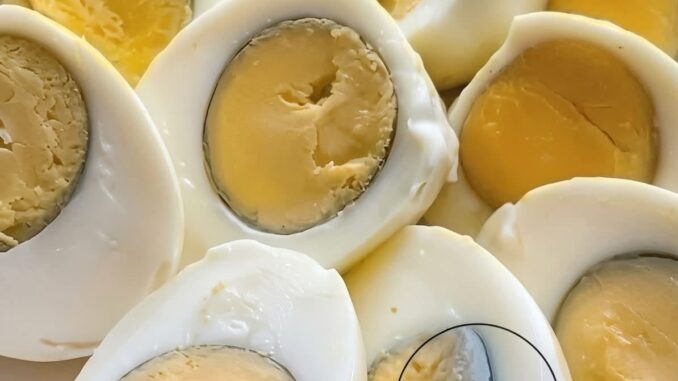
Have you ever peeled a perfectly ordinary hard-boiled egg, sliced it open, and thought, “Wait… why is my yolk GREEN?”
Instead of that familiar sunny yellow center, you may see a thin green or grayish-green ring around the outside of the yolk.
It looks strange.
Maybe even a little alarming.
But before you toss the entire batch into the trash, there’s something important to know:
A green ring around a hard-boiled egg yolk is usually caused by the way the egg was cooked — and it doesn’t necessarily mean the egg is spoiled.
So, what’s actually happening inside that little egg?
Let’s crack into the science.
Why Do Hard-Boiled Egg Yolks Turn Green?
The most common reason is overcooking.
When eggs are heated for too long or exposed to excessive heat, chemical reactions can occur between sulfur-containing compounds in the egg white and iron in the yolk.
The result can be the familiar greenish-gray ring around the yolk.
It’s one of those little kitchen mysteries that looks much more dramatic than it really is.
And if you’ve ever wondered why the discoloration tends to appear around the outer edge of the yolk, there’s a reason for that too.
The egg white surrounds the yolk, so the sulfur compounds generated during cooking are positioned right next to the yolk’s surface. Under certain cooking conditions, they can react with iron-containing compounds near the yolk’s exterior.
That’s what produces the characteristic discoloration.
The Chemistry Behind the Color
Here’s where this ordinary kitchen phenomenon gets surprisingly interesting.
Egg whites contain sulfur-containing compounds.
Egg yolks contain iron.
When an egg is cooked, heat changes the proteins and other components inside the egg. If the egg becomes overcooked, sulfur and iron can interact near the boundary between the white and yolk.
This can produce iron sulfide compounds, which have a greenish-gray appearance.
That’s why you may notice a ring rather than an entirely green yolk.
The reaction is happening right where the white and yolk meet.
Is It Really Ferrous Sulfide?
You’ll sometimes see the green color attributed specifically to ferrous sulfide.
That’s a useful shorthand for explaining the phenomenon, but the chemistry is a little more complicated than that simple label suggests.
The important takeaway for home cooks is much simpler:
Sulfur from the egg white + iron from the yolk + prolonged cooking can produce the greenish discoloration.
You don’t need a chemistry degree to prevent it!
Is a Green Egg Yolk Safe to Eat?