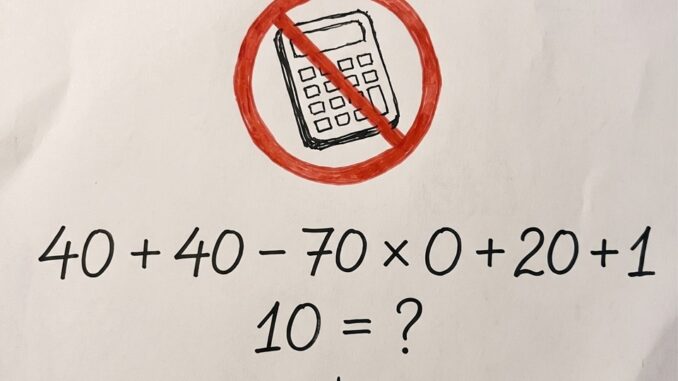
Have you ever browsed through social media and come across a math puzzle that appears extremely simple at first glance?
Many of us glance at these challenges and assume we can solve them in just a few seconds.
Then, we check the comment section and discover countless individuals passionately debating entirely different answers.
The handwritten note in the image presents a classic brain teaser: “40 + 40 – 70 × 0 + 20 + 110 = ?”.
It also includes a direct challenge: “Try to calculate without a calculator.”
At first glance, your mind might suggest that this is merely basic elementary arithmetic.
However, straightforward math problems often conceal clever traps that can easily trip up even the brightest adults.
The main trap in this equation is the zero next to the multiplication sign.
Many individuals quickly scan the problem, notice “× 0”, and assume that everything turns into zero.
They believe the entire front half disappears instantly, leading them to an incorrect conclusion.
Another frequent mistake occurs when people calculate strictly from left to right, as if reading a book.
If you proceed from left to right, you would add 40 and 40 to arrive at 80, subtract 70 to reach 10, and then multiply by zero.
This results in zero, plus 20, plus 110, yielding an answer of 130.
While that seems neat and straightforward, mathematics doesn’t function that way.
In math, there exists a fundamental rule known as the order of operations, often referred to as PEMDAS or BODMAS.
This universal guideline informs us which operation receives priority and should be solved first.
Parentheses and exponents take precedence, followed closely by multiplication and division.
Only after completing all multiplications and divisions can we proceed to addition and subtraction from left to right.
Now, let’s revisit our equation with this important rule in mind.
There are no brackets or exponents, but there is one multiplication: 70 multiplied by 0.
Any number multiplied by zero equals zero, so “70 × 0” simply becomes 0.
Notice that the multiplication pertains only to the 70 immediately preceding it, not to the entire expression.
Now we can neatly rewrite the entire line: 40 + 40 – 0 + 20 + 110.
All that remains are straightforward additions and subtractions, allowing us to proceed smoothly from left to right.
First, we calculate 40 + 40, which results in 80.
Next, we subtract 0 from 80, which still leaves us with 80.
Then, we add 20 to 80, bringing our running total to exactly 100.
Finally, we consider the last number, which is 110 spread across the two lines on the paper.
We add 110 to our current total of 100.
100 plus 110 equals 210.
That is our solid, logical, and undeniable final answer.
The correct solution to this enjoyable puzzle is 210.
Setting aside the calculator for a moment serves as a great reminder of how gratifying simple logic can be.