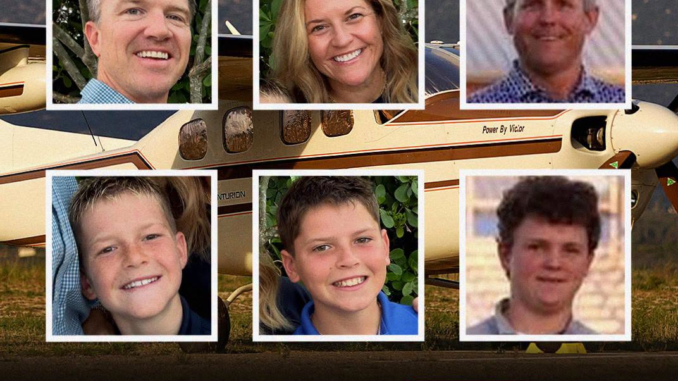
What started as a beloved family custom concluded in a heartbreaking disaster just 2 days prior to Thanksgiving. As family members grieved the loss of 6 individuals, several remarkable details surfaced regarding those on the plane and the events leading up to their last flight.
What transpired in the air just before communication with the plane was lost?
Who was the pilot, and what insights did his friend of 30 years provide about him and his teenage son?
How did 2 other family members who participated in the fishing trip manage to return home safely?
And what extraordinary individual from the aircraft's last moments raised alarms among aviation experts?
From the family's cherished memories to the unsettling specifics of their final journey, here’s what we have learned thus far.
Just 2 Days Before Thanksgiving
For one family in Florida, many of their most joyful moments occurred on the water.
Fishing was more than a simple hobby — it was a family custom that united parents, children, siblings, and cousins.
As Thanksgiving neared, extended family members had traveled to Venice, Louisiana, for yet another fishing expedition.
They aimed to return to Florida in time to celebrate the holiday with the rest of their family.
Among those reveling in the vacation were 3 boys, each raised among relatives who shared their love for fishing and the outdoors.
For their parents, the trip represented another chance to bond with their children before resuming their usual routines, including school, work, and the holiday preparations.
On Tuesday, November 24, 2026, just 2 days before Thanksgiving, 6 family members boarded a private plane headed for Fort Myers, Florida.
Their destination was Page Field, an airport in the community where they had raised their children, built their businesses, and formed friendships that spanned decades.
The aircraft had been lent to the family for their trip, and the flight was intended to bring them back after several days of enjoying their passion.
However, not everyone who had joined the fishing trip got on that plane, a fact that would take on an entirely new significance in the hours that followed.
Before the family understood what had transpired, a warning had already been issued to the pilot from the ground.
What Happened Before the Plane Vanished?
The family was flying in a single-engine Cessna 210, an aircraft carrying 6 people on its route from Louisiana to southwest Florida.
The plane took off from New Orleans Lakefront Airport around 2 p.m., heading toward the Florida community where the passengers resided.
The publicly accessible air traffic control recordings revealed no evident reports of issues from the pilot during takeoff.
However, shortly before contact with the plane was lost, an air traffic controller at Gulfport–Biloxi International Airport informed the pilot about rain and adverse weather conditions in the vicinity.
A former Boeing safety engineer reviewed the available air traffic control recordings and found nothing particularly unusual in the conversations between the pilot and controllers.
Yet, a retired airline captain with 50 years of flying experience focused on the aircraft's movements, analyzing data gathered through flight-tracking technology.
His findings, reported after the crash, indicated that the plane had been flying at roughly 9,000 feet before initiating an unusually steep descent while turning to the right.
At around 3:45 p.m., air traffic controllers in Mobile, Alabama, reported that they had lost contact with the aircraft.
However, the information recorded during the aircraft's final moments included one particularly alarming statistic — and by the time experts began to examine it, rescue teams were already heading toward the waters off Mississippi.
The First Things They Discovered
As authorities commenced searching near Horn Island, emergency responders from multiple agencies were called in to assist in locating the missing aircraft.
The Coast Guard dispatched boats and aircraft, while local law enforcement, divers, and personnel from the Mississippi Department of Marine Resources joined the search efforts.
By around 5:40 p.m., search teams had located debris from the aircraft northeast of Horn Island.
Among the items floating in the water were 3 life jackets, a life raft, and a section of the aircraft's cabin.
The individuals who had been on board had not yet been found.
Emergency responders continued their search as nightfall approached, but conditions were becoming increasingly challenging.
Capt. Michael Strickland of the Mississippi Department of Marine Resources later recalled how the winds intensified as a weather system moved through the area, making the water progressively rougher.
Search teams utilized sonar technology to locate objects beneath the surface.
A GPS locator dropped by the Coast Guard helped to narrow down the area where crews believed the aircraft could be located.
Despite the worsening conditions on the water, Strickland noted that visibility below the surface was relatively good, aiding divers in their search.
After several hours, divers reached the submerged fuselage.
Inside, they made the discovery that everyone involved in the operation had hoped to avoid: all 6 occupants had perished.
For the rescue personnel, the mission had shifted to returning the victims to their families.
Back in Florida, however, the devastating announcement was about to reveal something particularly heart-wrenching: the youngest victims were 2 little brothers and their teenage cousin, and the images their families had shared throughout the years told a very different story about their lives.
A Mother's Words Just Weeks Prior
The victims were part of the closely-knit Stokes and Knox families, both of which had deep ties in the Fort Myers community.
Among those on board were 43-year-old Arlyn Knox, her husband, Michael, also 43, and their 2 sons, Charles Holden Knox, 12, and Truett Knox, 10.
The other victims included Arlyn's older brother and his teenage son, but just weeks before the tragedy, Arlyn had been celebrating significant milestones in her children's lives.
In October, she celebrated Holden's 12th birthday with a heartfelt tribute to his adventurous spirit, sense of humor, and passion for fishing.
"You made me a momma 12 years ago, and life has been wild ever since!"
Only a few weeks later, her youngest son turned 10, prompting another loving birthday message recognizing his kind nature, curiosity, and seemingly boundless energy.
His mother affectionately referred to Truett as their "little human exclamation point."
Arlyn had also recently embarked on a new professional journey, leaving a corporate career that spanned over 20 years to become the chief marketing officer of Knox Technology, the company her husband founded in 2012.
Her professional biography revealed a more personal glimpse into her life, listing fishing, Pilates, mahjong, and cheering for her son from the sidelines as some of her favorite pastimes.
Fishing was also a part of their marriage, with photographs celebrating their 12th wedding anniversary depicting the couple aboard a boat, seated in chairs labeled captain and first mate.
That same love of the water connected Arlyn to another parent aboard the aircraft — a man who had spent years sharing his passion with his own son.
The Man Behind the Controls Was a Familiar Face
The pilot was identified as Brent Stokes, 50, Arlyn's older brother and a father of 2.
He had transformed his lifelong passion for boating into a thriving business, founding Stokes Marine in 2003.
Before entering marine construction, Brent worked in medical sales and received encouragement to pursue his business dreams from Mike Gavala, a friend for around 30 years.
Despite lacking formal training in the field, he began with just 3 employees, ultimately establishing a company recognized as one of southwest Florida's top marine contractors.
His company's projects included Sanibel's fishing pier and the boardwalk of the J.N. "Ding" Darling National Wildlife Refuge, yet Brent's involvement in the boating community extended far beyond his business.
After Hurricane Dorian devastated parts of the Bahamas in 2019, he helped organize aid and encouraged fellow boaters to search for 2 missing fishermen off the Florida coast.
Gavala had witnessed many chapters of his friend's life, but some of his most cherished memories involved someone who frequently joined their fishing trips — Brent's 16-year-old son.
A Friend Had Already Envisioned His Future
Hunter Stokes had grown up accompanying his father and Gavala on fishing outings, some lasting 12 to 14 hours or continuing overnight.
Those long hours on the water allowed Gavala to witness Hunter's growth and get to know the remarkable young man he was becoming.
In the wake of the tragedy, the family friend remembered Hunter as "a fantastic young man."
He had even envisioned what the teenager's future might entail:
"I could see him following in his dad's footsteps."
Gavala credited Hunter's upbringing to his parents, and when reflecting on Brent's priorities in life, he offered a particularly touching remark:
"It was always about the kids."
Gavala had also flown with Brent during Labor Day weekend in 2026, less than 3 months before the tragedy.
Another friend, April Lennon, remembered Brent through a photograph from a Miami fishing tournament that had adorned her wall for years, recalling his willingness to assist others in the boating community.
Yet Hunter was not Brent's only child, and 2 other family members had also joined the Louisiana fishing trip — but their journey home ended very differently.
The Unexpected Detail in a Family Photograph
Among the family photographs released after the tragedy was a picture of 4 smiling individuals: Brent, Hunter, Brent's wife, Dominique Stokes, and their daughter, Addison.
Both mother and daughter had participated in the fishing trip and were also preparing to travel home for Thanksgiving.
However, Dominique and Addison had made separate travel plans and returned home on a commercial flight instead.
Their reasons for traveling separately were not publicly disclosed, but neither was aboard the Cessna when it departed New Orleans.
For another relative, Wyman Stokes, the tragedy meant losing his son, daughter, son-in-law, and 3 grandchildren in a single incident.
During a phone interview the following day, the grieving grandfather attempted to read a prepared family statement but became overwhelmed as he reached the names and ages of his youngest grandsons.
Meanwhile, aviation experts analyzing the aircraft's final recorded movements had identified one particularly concerning figure.
One Number Told a Troubling Story
The available flight data indicated that the Cessna had begun descending rapidly before air traffic controllers lost contact with it.
But how quickly had the aircraft been losing altitude?
According to the U.S. Coast Guard, the Federal Aviation Administration reported that the aircraft was descending at about 10,000 feet per minute when communication was severed.
That figure was significantly higher than what would typically be expected during a controlled descent.
Aviation law firm Kreindler & Kreindler, which initiated an independent investigation, explained that the unusual descent raised substantial questions about the circumstances leading up to the crash.
Flight instructor Emmet Bartholomew also noted that the investigation could be complicated because small aircraft of this type generally do not carry the cockpit voice and flight data recorders found on larger commercial planes.
Both the Federal Aviation Administration and the National Transportation Safety Board are looking into the incident, but as of November 26, 2026, the cause of the crash remained unknown.
Back in Florida, another community was preparing to confront a heartbreaking reality when its children returned from Thanksgiving break.
When the Children Return to School
At St. Francis Xavier Catholic School in Fort Myers, students and teachers learned that 2 young brothers would not be coming back after Thanksgiving.
Holden had been in sixth grade, while his younger brother, Truett, attended fourth grade.
Principal John Gulley released an emotional statement describing the family's loss as irreplaceable and encouraging the community to honor their memory through acts of kindness.
He also announced that support would be available to students and staff upon their return to school on Monday, November 30.
Ahead of Thanksgiving, Gulley urged families to cherish their loved ones and value the time they had together.
It was a message echoed by the surviving members of the Stokes and Knox families, who shared their own heartfelt tribute to the 6 relatives they had lost.
The Memories They Will Hold Forever
In the aftermath of the tragedy, the family expressed gratitude to emergency responders and everyone who had supported them through prayers and messages of goodwill.
They also shared their desire for their loved ones to be remembered:
"They died doing what they loved."
In their statement, the surviving relatives requested privacy as they provided care for one another, especially the children, and indicated that details about memorial services would be shared when they were prepared.
While investigators continue searching for answers, the photographs left behind capture the lives they shared — a mother's love for her boys, a father's adventures with his son, and a family's beloved tradition.
For the loved ones facing Thanksgiving without Brent, Hunter, Arlyn, Michael, Holden, and Truett, those memories are now accompanied by a lasting pledge:
"We will carry them with us always."