Eighteen months after the incident that resulted in my daughter losing both her legs, she finally danced once more. However, what transpired during her school performance left me in shock.
A man pushed Chloe with enough force to send her wheelchair tumbling.
I yelled.
For a brief moment, I feared he had attacked my daughter.
Then something crashed onto the floor right where she had been seated.
A metal lighting rig.
One of the tall portable stands next to the dance floor had toppled over.
The crossbar fell so forcefully that one of the stage lights shattered.
Glass scattered across the gym floor.
Parents screamed.
Children began to cry.
And the school staff member who had knocked Chloe down was lying over her, protecting her with his body.
I froze.
My mind couldn’t process what was happening.
Just seconds before, I had been trying to fight him because he had grabbed me.
Now he was hunched over my daughter while broken metal lay just inches from his back.
"Chloe!"
He rolled away.
I dropped down beside her.
She was crying now.
Not because she was seriously hurt.
But because everyone else was screaming.
"Mommy!"
"I'm here."
I pulled her close.
Her purple dress was twisted around her.
One ribbon had fallen out of her hair.
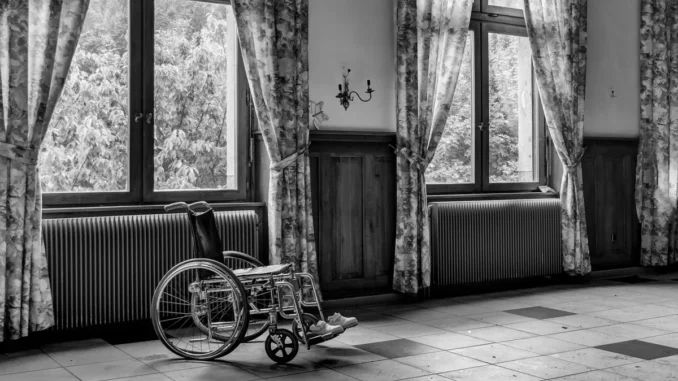
Her wheelchair was tipped over.
I ran my hands over her arms, shoulders, and head.
"Does anything hurt?"
"My elbow."
"Anywhere else?"
She shook her head.
The staff member sat up slowly.
His forearm was injured.
One of the teachers shouted, "Call 911!"
Someone had already done that.
My name is Rachel. Chloe is my daughter.
Before that day, I believed the most terrifying moment of my life had already happened 18 months prior.
I was mistaken.
The accident that altered Chloe's life occurred on a Tuesday afternoon.
A driver ran a red light.
Our vehicle was hit on the passenger side.
I remember the sound more than anything else.
Metal. Glass. Then silence.
Chloe was eight by that time.
She survived.
That statement is crucial.
She survived.
But both of her legs were so severely damaged that doctors could not save them.
One was amputated above the knee.
The other below.
The first few months afterward are still hard for me to articulate.
Pain. Surgeries. Rehabilitation.
Learning how to transfer from a bed to a wheelchair.
Learning to bathe differently.
Learning how to respond to strangers who stared.
Before the accident, Chloe danced constantly.
Everywhere.
She had been taking beginner dance classes since she was five.
Nothing too serious.
She wasn’t a child prodigy.
She just adored music.
If a song played in the grocery store, she’d start moving.
If I played music while cooking, she’d twirl through the kitchen until I shouted, "Hot stove!"
Then she’d dance three feet further away.
After the accident, music vanished from our home.
Not because I prohibited it.
But because Chloe stopped requesting it.
One afternoon, a few weeks after she returned home, she looked at the mirror in her bedroom.
Then said, "Can you take that down?"
I understood why.
Still, I asked, "Why?"
She gazed at her lap.
"I don’t like looking at myself anymore."
I made it to the hallway before I began to cry.
The mirror came down.
I loathed myself for removing it.
Then I despised myself for wondering if I should have refused.
Grief causes you to second-guess every small choice.
Should I encourage her?
Should I leave her be?
Should I say legs don’t define her?
Would that sound absurd coming from someone who still had both of mine?
So I learned to listen more.
Chloe eventually returned to school.
Her classmates were mostly kind.
Kids can be cruel.
They can also adapt faster than adults.
After the first week, her wheelchair ceased to be the most fascinating thing about her.
It became Chloe’s chair.
Sometimes a classmate held a door.
Sometimes she shouted, "I can do it!"
Sometimes she needed assistance.
Sometimes she didn’t.
Then came dance.
During recess, a few girls would play music through a teacher’s speaker.
Chloe watched.
She pretended not to.
But I noticed it when I volunteered at school.
She’d sit near the edge of the playground.
Smile. Clap. Never join in.
In early October, her teacher, Ms. Ramirez, asked me to stay after pickup.
She looked anxious.
"Can I ask you something without you saying no right away?"
"That’s a concerning introduction."
She smiled.
"The class is doing a dance for the fall festival."
I already sensed where this was headed.
"The kids want Chloe in it."
I didn’t respond.
Ms. Ramirez quickly added, "Only if she wants to."
"Did they ask her?"
"Not yet."
"Why not?"
"Because I wanted to ask you first."
I appreciated that.
She informed me the children had been planning a routine.
One boy, Mason, suggested Chloe could dance in her wheelchair.
Another girl said, "Why don’t we make the dance accommodate everyone instead of making Chloe fit the dance?"
That line came from an eight-year-old.
I still ponder it.
I asked Chloe that evening.
At first, she stared at me.
"Me?"
"Only if you want."
"But I can’t dance."
I sat beside her.
"You can’t dance the way you used to."
Her eyes filled with tears.
I regretted saying it.
Then I added, "That doesn’t mean you can’t dance."
She didn’t respond.
The next morning, she said, "I want to try."
That led to six weeks of chaos.
Music returned to our home.
Chloe practiced turns in her wheelchair.
She learned to spin without getting dizzy.
The class changed formations so some children danced standing while others moved around her.
One boy mirrored Chloe’s movements with his arms.
Another girl sat in a chair for part of the routine, so Chloe wasn’t the only one dancing from a seated position.
It wasn’t perfect. It didn’t need to be.
Chloe laughed again. Really laughed.
She chose a sparkly purple dress.
Matching ribbons.
Silver shoes even though she wouldn’t wear them.
She wanted them attached to the front of her chair because, as she said, "dancers need shoes."
I didn’t argue.
On the morning of the festival, she asked me to put the mirror back up.
I hesitated.
"Are you sure?"
She nodded.
So I hung it. Not exactly where it had been.
A little lower.
She looked at herself in the dress.
Then said, "I look fancy."
I cried in the bathroom where she couldn’t see me.
The school gym was packed that afternoon.
Parents sat on folding chairs.
Kids ran everywhere.
The class performed near the center of the gym.
Portable lights had been brought in because the regular gym lighting was inadequate for performances.
There were speakers.
Cables were taped to the floor, along with a backdrop.
Everything seemed more professional than I had anticipated.
The music began, Chloe rolled onto the floor, and the children danced around her.
She turned, clapped, spun, and raised both arms.
She was laughing so much that she missed one cue.
Nobody cared.
I filmed everything.
Then the music stopped.
Not faded. Stopped.
A metallic cracking sound came from somewhere to my left.
Then another.
People looked up.
One teacher screamed, "Move!"
I dropped my phone.
I saw one of the lighting stands leaning.
Slowly at first. Then faster.
Toward the children. Toward Chloe.
I ran.
That was when someone grabbed me around the waist.
I fought him.
"Let me go!"
He released me. Then sprinted.
I vaguely recognized him.
A school facilities employee.
His name, I later learned, was Marcus.
He reached Chloe before I did.
He pushed her sideways out of the wheelchair. Then covered her.
The lighting rig crashed down.
If Chloe had still been sitting upright, the metal crossbar would have struck her.
Instead, it smashed into the chair.
Bent one wheel.
Destroyed the armrest.
And missed Chloe by less than a foot.
Paramedics arrived quickly.
Chloe had a bruised elbow and a small scrape on her shoulder.
Marcus required stitches in his forearm.
One child was hurt by flying plastic from a light cover.
No one sustained a major injury.
That statement still feels miraculous.
At the hospital, Chloe kept asking about her wheelchair.
"Is it broken?"
"Yes."
Her face fell.
"My dance chair."
I almost laughed with relief.
She had nearly been injured by a lighting rig and was upset about missing the remainder of the dance.
Ms. Ramirez arrived about an hour later.
She was in tears.
"I’m so sorry."
I hugged her.
Then the principal arrived.
Then someone from the district.
Eventually, the questions began.
What happened?
Why did the stand fall?
Was it secured?
Who set it up?
I assumed it had simply been a terrible accident.
It wasn’t quite that simple.
The stand had been positioned near the edge of the performance area.
One of its stabilizing legs had been partly folded inward to make room for a row of chairs.
Someone had also run an extension cable too tightly around the base.
During the performance, another staff member moved a speaker cart.
The cart caught the cable. The cable pulled.
The already unstable stand tipped.
There was no villain.
No one had intentionally created danger.
Just several minor decisions that lined up poorly.
That almost made me angrier.
Because each decision probably seemed harmless.
Then suddenly, hundreds of pounds of equipment were falling toward children.
Marcus had noticed something was wrong before the teacher shouted.
He told me later he’d heard the base scrape.
He worked in facilities.
He recognized that sound was wrong.
When he saw the stand beginning to lean, he attempted to stop me first because I was running directly into its path.
Then he realized he couldn’t reach both of us in time.
Once he pulled me out of its path, he let me go and went for Chloe.
I asked him, "Why her?"
We were sitting in the hospital hallway.
His arm was bandaged.
He looked puzzled.
"What do you mean?"
"There were other kids."
"I know."
"Why Chloe?"
He paused.
Then said, "Because the others were moving."
That answer hurt.
Not because it was cruel.
Because it was true.
When the teacher yelled, most of the children could scatter.
Chloe couldn’t.
Her wheelchair needed space to turn.
She couldn’t simply jump sideways.
Marcus saw that in one instant. So he made the choice for her.
He pushed her out of the chair.
I said, "You could’ve hurt her."
"I know."
"You did hurt her elbow."
"I know."
"But…"
My voice broke.
He looked down.
I said, "You saved her."
He shook his head.
"I moved her."
"Marcus."
He looked at me.
"Thank you."
He nodded once.
Then said, "She’s tough."
I laughed.
"She’s going to be unbearable when she hears you said that."
The school canceled the rest of the festival.
The district initiated a safety review.
All portable staging and lighting equipment was removed until inspections were completed.
The company that supplied some of the equipment also reviewed its setup procedures.
I cared about all of that.
But Chloe cared about one thing.
The dance.
Two days later, lying on the couch with her bruised elbow, she said, "We didn’t finish."
I looked at her.
"The lighting rig nearly fell on you."
"I know."
"You went to the hospital."
"I know."
"And you’re worried about the dance?"
"We practiced for six weeks."
Fair.
Then she said, "Can we do it again?"
I wanted to say no.
Every part of me wanted to say no.
I envisioned another accident.
Another ambulance. Another phone call.
Then I remembered the mirror.
I recalled how long it had taken for music to return to our home.
I asked, "Do you want to?"
"Yes."
So I called Ms. Ramirez.
She was silent for a moment.
Then said, "The kids have been asking the same thing."
A week later, the school restaged the performance.
Very differently.
No portable lighting rigs. No unnecessary cables. No elaborate backdrop.
Just the regular gym lights and one speaker secured against the wall.
I appreciated the lack of ambition.
The district also arranged for Chloe to receive a temporary wheelchair while hers was repaired.
But she disliked it.
On the day of the second performance, the gym was full again.
Fuller than before.
Word had spread.
I worried that people were coming because they wanted to see the "brave little amputee girl."
I didn’t want that for her.
But Chloe didn’t seem bothered.
She was focused on the dance.
Then, just before the music began, she spotted someone standing at the back.
Marcus, bandage still on his arm.
She waved. He waved back.
Then Chloe rolled into place as the music started.
I held my breath for the first 30 seconds.
Every sound made me flinch.
Then something shifted.
I stopped watching the ceiling.
I focused on my daughter.
She moved through the routine.
Spun. Clapped. Leaned. Turned.
The other children moved with her.
Not around her as if protecting her.
With her.
Near the end came Chloe’s favorite part.
The children formed two lines.
She rolled between them while everyone clapped to the beat.
Then she stopped in the center.
Raised both arms. And the whole class froze.
For one moment, the gym was silent.
Then the music ended.
Everyone stood.
The applause was thunderous.
Chloe looked astonished. Then thrilled.
I cried. Marcus did too.
I saw him wiping his face with his uninjured arm.
Afterward, Chloe rolled straight toward him.
"You pushed me."
Marcus looked anxious.
"I did."
"I’m sorry."
She thought about that.
Then said, "But the light would’ve hurt worse."
He nodded.
"Probably."
She extended her arms.
He glanced at me first.
I nodded. Then he hugged her.
Chloe whispered something.
I couldn’t hear it.
Later I asked what she had said.
"Thank you for not letting me get squished."
Apparently that was her version of emotional depth.
Her wheelchair was repaired two weeks later.
The school covered the damage.
The dance became a pivotal moment I hadn’t anticipated.
Not because Chloe suddenly ceased grieving her legs.
There were still difficult days.
There still are.
She eventually started learning to use prosthetic legs too, though she preferred her wheelchair for a long time because it was quicker and more comfortable.
Some days she practiced standing.
Some days she refused.
We ceased treating either choice like a victory or a failure.
Then one afternoon, months after the festival, I walked past her bedroom and heard music.
I paused.
Chloe was in front of the mirror.
The same mirror she had once asked me to remove.
She wasn’t standing.
She wasn’t wearing prosthetics.
She was seated in her wheelchair, moving her arms to the music.
Practicing.
She saw me in the reflection.
"Mom."
"Yeah?"
"You’re staring."
"Sorry."
"Come dance."
I laughed.
"I can’t dance."
She rolled her eyes.
"That’s what I said."
So I went in.
I was awful.
She informed me of that immediately.
We danced anyway.
Chloe is ten now.
She still loves music.
She has tried adaptive dance classes.
Wheelchair dance. A bit of gymnastics.
She also quit one class because the instructor kept calling everything she did "inspiring."
Chloe came home furious.
"I did a turn. She said I was inspiring."
I said, "Maybe she meant it kindly."
"I want her to say my turn was good."
Fair.
So we found another instructor.
Marcus still works at the school.
Every fall festival, Chloe asks him whether the lights are safe.
He always replies, "I checked twice."
Last year she said, "Check three times."
He did.
I sometimes reflect on the seconds before that lighting rig fell.
How quickly I misunderstood what I witnessed.
A man grabbed me.
Then knocked my disabled daughter out of her wheelchair.
If someone had shown me only those two moments, I would have thought he was harming us.
In reality, he was trying to save both of us.
I also think about the 18 months leading up to that day.
All the ways I had wanted to shield Chloe from pain.
Some of that protection was necessary.
Some of it was fear disguised as responsibility.
Chloe didn’t need me to promise that nothing bad would ever happen again.
I couldn’t make that promise.
She already knew better.
What she needed was the space to understand that losing her legs had altered the way she danced without taking dancing away from her.
The first performance ended with shattered glass and an ambulance.
The second concluded with applause.
But the moment I cherish most came months later in her bedroom.
No audience. No sparkly dress. No teacher.
Just Chloe, sitting in front of the mirror she had once refused to look into.
Music playing. Arms moving. Smiling at herself.
She hadn’t reverted to the dancer she used to be.
She had become a dancer again.
Would you have reacted the same way as Rachel if you witnessed someone shove your child out of a wheelchair?
If Chloe's story moved you, you'll want to read about a woman whose husband insisted that she give up their newborn daughter because she had Down syndrome. She agreed, but on one unexpected condition. Click here to read the complete story.